
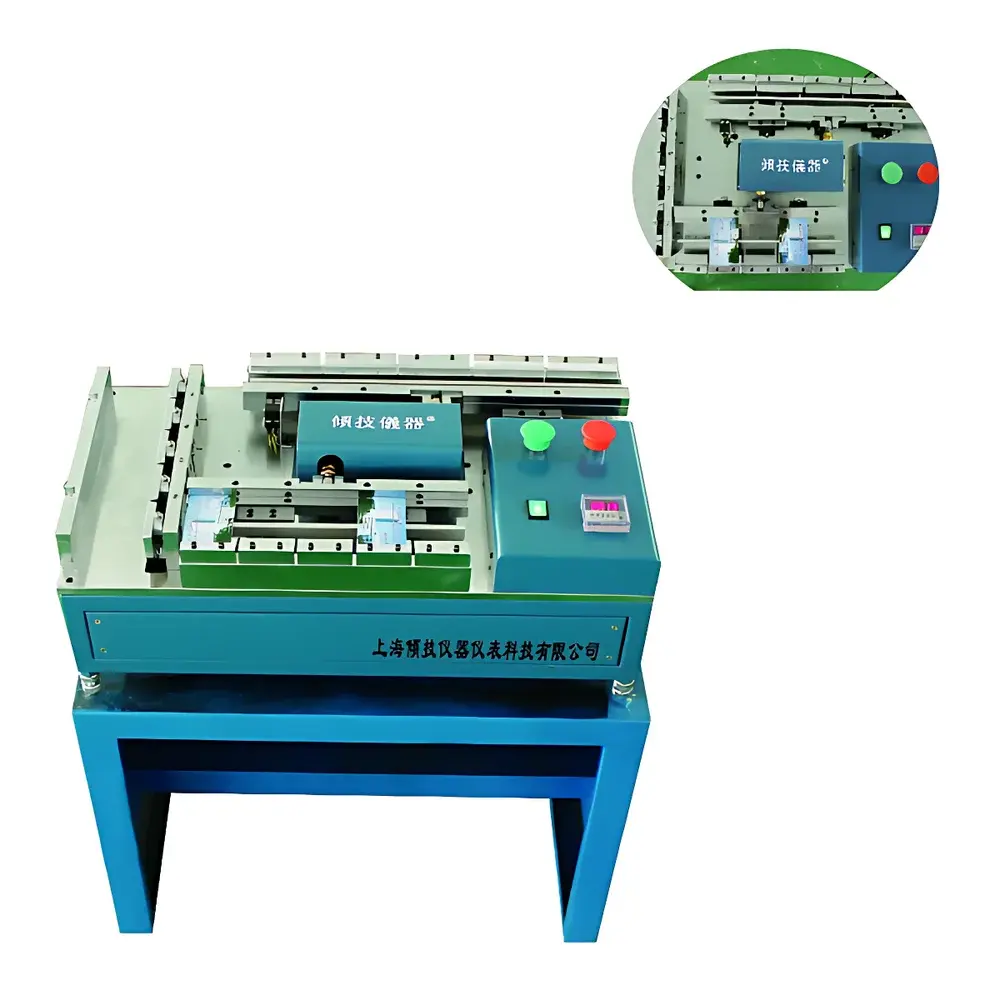
QJIC Dynamic Torsion and Bending Tester for IC Cards
| Brand | Qingji |
|---|---|
| Origin | Shanghai, China |
| Model | QJIC |
| Voltage | AC 220 V ±5% |
| Power Consumption | 35 W |
| Bending Speed | 29 rpm |
| Test Cycles | 1–999 cycles |
| Angular Displacement (Torsion) | 15° ±1°, bidirectional |
| Dimensions (L×W×H) | 670 × 380 × 220 mm |
| Weight | 70 kg |
Overview
The QJIC Dynamic Torsion and Bending Tester is a specialized electromechanical testing system engineered for the standardized mechanical endurance evaluation of contact and contactless integrated circuit (IC) cards. It operates in strict accordance with ISO/IEC 7816-1, ISO/IEC 7810, and GB/T 16649.1–2006 (equivalent to ISO/IEC 10373-6), which define quantitative requirements for card flexibility, torsional resilience, and cyclic deformation resistance. The instrument applies controlled, repeatable bending and torsional loads to simulate real-world handling stresses—including wallet flexing, insertion/removal forces, and lateral twisting during use—enabling objective pass/fail assessment of card substrate integrity, laminate adhesion, and embedded chip interconnect reliability. Its dual-axis actuation mechanism executes synchronized or independent bending (±15° angular displacement) and torsional motion at a fixed rotational speed of 29 rpm, ensuring high reproducibility across test sequences.
Key Features
- Programmable cycle control (1–999 cycles) with automatic termination and digital counter display
- Bidirectional torsional actuation with precise angular displacement of 15° ±1°, calibrated per ISO/IEC 10373-6 Annex D
- Constant-speed bending motion at 29 rpm, compliant with the kinematic profile specified in GB/T 16649.1
- Compact benchtop architecture (670 × 380 × 220 mm; 70 kg) designed for integration into QC laboratories and certification testing facilities
- Low-power operation (35 W nominal) with universal AC 220 V ±5% input, suitable for stable long-duration testing without thermal drift concerns
- Modular gripping fixture system accommodating standard ID-1 format cards (85.6 × 53.98 × 0.76 mm), including PVC, PET, polycarbonate, and composite laminates
Sample Compatibility & Compliance
The QJIC tester accommodates all ISO/IEC 7810 ID-1 format smart cards, including contact-based (e.g., EMV-compliant banking cards), contactless (RFID/NFC), and dual-interface variants. It supports cards with embedded silicon die, antenna coils, and multi-layer lamination structures. Testing conforms to mandatory mechanical stress protocols defined in ISO/IEC 10373-6 (Test Method 6: Bending and Twisting Endurance), GB/T 16649.1 (Chinese national standard for identification cards), and relevant clauses of EN 14443. While not a certified calibration standard itself, the system’s mechanical repeatability and displacement accuracy are traceable to factory verification using optical encoder feedback and angular position sensors. It is routinely deployed in GLP-aligned quality assurance workflows for card manufacturers, personalization centers, and third-party conformity assessment bodies.
Software & Data Management
The QJIC operates via front-panel digital interface with LED cycle counter and status indicators—no external PC or proprietary software is required for basic operation. For traceability and audit readiness, users may integrate the device into broader laboratory information management systems (LIMS) via optional RS-232 or TTL-level serial output (available upon request). Cycle logs, start/stop timestamps, and operator IDs can be recorded externally to meet FDA 21 CFR Part 11 requirements when paired with validated data capture software. Firmware updates and calibration certificates are provided annually as part of the extended service agreement.
Applications
- Pre-certification mechanical validation of IC cards prior to ISO/IEC 10373-6 type testing
- Comparative fatigue analysis of substrate materials (e.g., PVC vs. PETG vs. bio-based polymers)
- Verification of lamination bond strength between chip module and card body
- Routine incoming inspection of card blanks and finished goods in high-volume personalization lines
- Root-cause analysis of field failures linked to physical deformation (e.g., delamination, antenna breakage, solder joint fracture)
- Supporting internal R&D studies on bend radius limits and torsional fatigue thresholds for next-generation flexible smart cards
FAQ
Does the QJIC comply with ISO/IEC 10373-6 Annex D for torsion testing?
Yes—the angular displacement, bidirectional rotation, and cycle count logic are implemented per the dimensional and kinematic specifications outlined in Annex D.
Can the instrument test cards with embedded antennas or metal layers?
Yes—its non-magnetic actuation system and low-force profile prevent electromagnetic interference or mechanical damage to RF components.
Is calibration documentation included with shipment?
A factory verification report confirming angular displacement accuracy and cycle timing stability is supplied with each unit.
What maintenance intervals are recommended?
Routine visual inspection and lubrication of rotary joints every 6 months; full mechanical recalibration recommended annually or after 50,000 test cycles.
Is technical support available outside mainland China?
Yes—remote diagnostics, English-language documentation, and application engineering consultation are provided globally through Qingji’s authorized distribution partners.



