
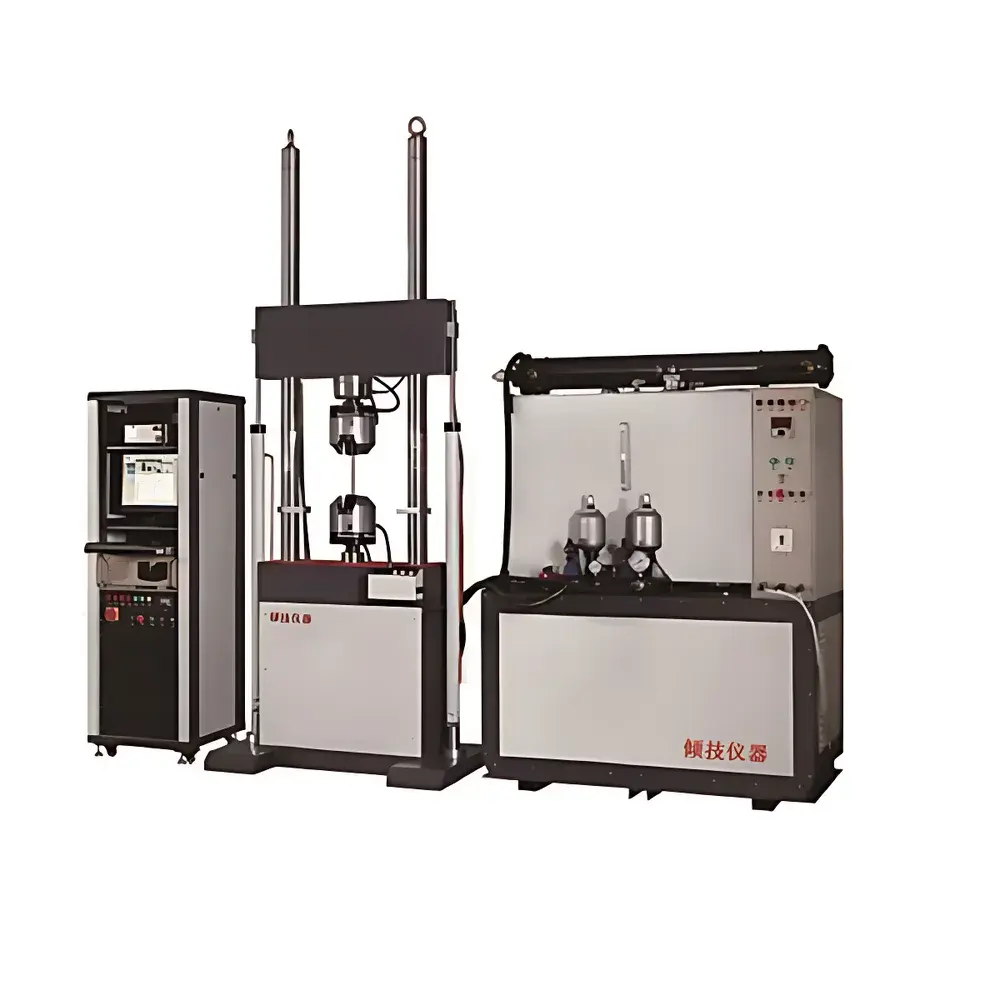
QJWE543L-1 Qins Instruments Electro-Hydraulic Servo Fatigue Testing Machine
| Brand | Qins Instruments |
|---|---|
| Origin | Shanghai, China |
| Model | QJWE543L-1 |
| Test Force Range | 2–100% of Full Scale |
| Force Accuracy | ±1% (within 2–100% FS) |
| Dynamic Force Ripple | ≤2% |
| Actuator Stroke | ±50 mm (customizable) |
| Frequency Range | 0.01–80 Hz (standard), extendable to 0.001–1000 Hz |
| Frequency Resolution | 0.001 Hz |
| Control Bandwidth | 10 kHz |
| Waveform Options | Sinusoidal, Triangular, Square, Trapezoidal, Sawtooth, Half-Sine, Half-Triangle, Random, and User-Defined or External Input Waveforms |
| Control Modes | Force, Displacement, and Strain Closed-Loop Control with Seamless Mode Switching |
| Compliance | Designed for ASTM E466, ASTM E606, ISO 1099, and GB/T 3075 fatigue testing standards |
Overview
The QJWE543L-1 Electro-Hydraulic Servo Fatigue Testing Machine is a high-performance, multi-axis capable dynamic mechanical test system engineered for precision-controlled cyclic loading of metallic, polymeric, composite, and ceramic materials under uniaxial tension-compression, bending, or combined load conditions. Based on the principle of electro-hydraulic servo actuation—where digital command signals modulate high-bandwidth hydraulic valves to drive a piston-mounted load frame—the system delivers stable, repeatable force output across a broad frequency spectrum. Its architecture supports both high-cycle fatigue (HCF) and low-cycle fatigue (LCF) regimes, enabling characterization of crack initiation thresholds, crack growth rates (da/dN), and fatigue life prediction under controlled stress/strain amplitudes. The machine integrates seamlessly into R&D laboratories, quality control departments, and certification facilities where compliance with international fatigue testing protocols is mandatory.
Key Features
- Full-digital hydraulic servo controller developed by Qins Instruments, supporting real-time closed-loop control at up to 10 kHz bandwidth for minimal phase lag and high fidelity waveform reproduction.
- Force measurement accuracy of ±1% over 2–100% of full-scale capacity, verified per ISO 7500-1 Class 1 requirements; dynamic force ripple maintained at ≤2% RMS during sustained cycling.
- Standard actuator stroke of ±50 mm, configurable to meet application-specific displacement demands—including high-stroke variants for large-deformation polymer or elastomer testing.
- Multi-waveform generation capability including sinusoidal, triangular, square, trapezoidal, sawtooth, half-sine, half-triangle, and user-defined waveforms—enabling simulation of real-world service loads such as engine vibrations, road-induced shocks, or seismic excitations.
- Simultaneous acquisition and closed-loop regulation of force, displacement, and strain signals—facilitating advanced control strategies such as strain-controlled LCF tests with extensometer feedback or load-controlled HCF with high-frequency resonance suppression.
- Modular hydraulic power unit with constant-pressure servo pump station, designed for continuous operation under thermal load stability and low noise emission (<72 dB(A) at 1 m).
Sample Compatibility & Compliance
The QJWE543L-1 accommodates standard and custom specimen geometries per ASTM E606 (strain-controlled fatigue), ASTM E466 (force-controlled axial fatigue), ISO 1099 (metallic materials—axial fatigue testing), and Chinese national standard GB/T 3075. It supports threaded, shoulder, and tabbed specimens ranging from miniature coupons (e.g., 2 mm diameter high-strength wires) to structural components (e.g., welded joints, turbine blades, or automotive suspension links). Gripping systems are compatible with hydraulic wedge, pneumatic, or servo-motorized actuation, ensuring uniform stress distribution and minimizing premature failure at clamping interfaces. All control firmware and data logging modules are architected to support audit-ready documentation in GLP/GMP environments, with optional 21 CFR Part 11-compliant electronic signatures and audit trail functionality available upon configuration.
Software & Data Management
The system operates under QinsTest™ v5.x—a Windows-based, modular test software platform featuring intuitive workflow-driven test definition, real-time graphical monitoring, and post-test analysis tools. Users define test sequences via drag-and-drop logic blocks—including ramping, hold, step-change, and conditional branching—while maintaining full traceability of setpoints, feedback signals, and environmental metadata. Raw data streams are recorded at ≥10 kHz sampling rate with 24-bit ADC resolution and stored in HDF5 format for long-term integrity and cross-platform compatibility. Export options include CSV, MATLAB .mat, and universal MDF4 formats. Calibration certificates, system verification reports, and test method templates (e.g., ASTM E466 Annex A) are embedded within the software library and auto-linked to each test record.
Applications
- Mechanical design validation of rotating machinery components (shafts, gears, bearings) subjected to alternating bending and torsional stresses.
- Material science research on fatigue crack nucleation mechanisms in additive-manufactured alloys, including microstructure-sensitive life modeling.
- Automotive Tier-1 suppliers conducting component-level durability testing per SAE J227a and OEM-specific specifications (e.g., GMW14872, Ford CETP).
- Aerospace qualification of fasteners, landing gear assemblies, and airframe substructures per MIL-STD-1540 and RTCA DO-160 Section 8.
- Biomedical device development—including fatigue assessment of orthopedic implants (ISO 14801) and cardiovascular stents (ISO 14040 series).
- Academic and governmental laboratories performing fundamental studies on viscoelastic fatigue in thermoplastics and fiber-reinforced composites.
FAQ
What standards does the QJWE543L-1 comply with for fatigue testing?
It is configured to meet core requirements of ASTM E466, ASTM E606, ISO 1099, and GB/T 3075. Optional calibration and verification packages align with ISO/IEC 17025-accredited procedures.
Can the system perform strain-controlled low-cycle fatigue tests?
Yes—via integrated extensometer interface and dual-closed-loop control architecture supporting simultaneous force and strain regulation with seamless mode transition.
Is remote monitoring and diagnostics supported?
Standard Ethernet/IP connectivity enables secure remote access for system health monitoring, firmware updates, and limited parameter adjustment via authenticated client interface.
What is the typical lead time for customized stroke or load capacity configurations?
Standard delivery is 12–16 weeks from order confirmation; extended stroke, higher force capacity, or environmental chamber integration may require additional engineering review and timeline extension.
Does the controller support third-party sensor inputs (e.g., acoustic emission, temperature, or DIC systems)?
Yes—the controller provides eight analog input channels (±10 V, 24-bit) and four digital I/O ports, fully programmable for synchronized acquisition and trigger-based event capture.



