
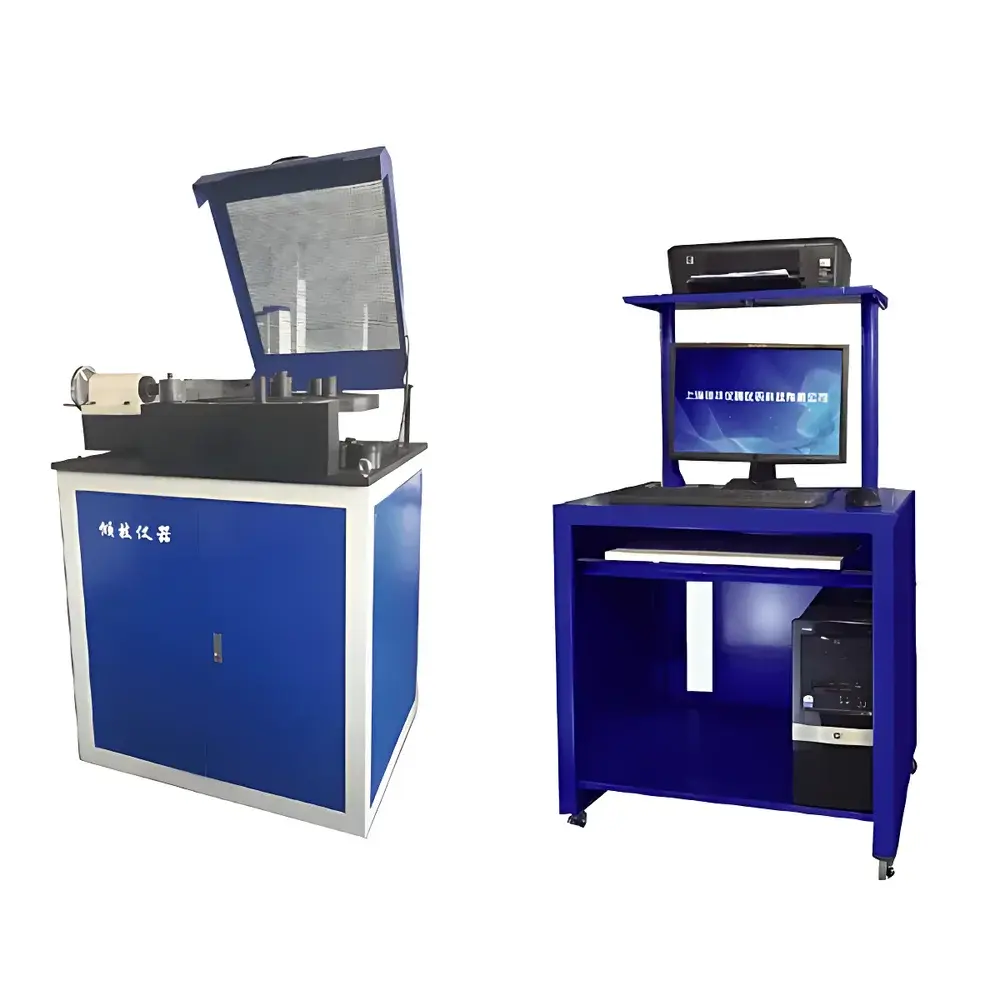
QJWQ-2A Plate Bending Testing Machine – Electro-Hydraulic Servo Universal Testing System
| Origin | Shanghai, China |
|---|---|
| Manufacturer Type | Authorized Distributor |
| Origin Category | Domestic (China) |
| Model | QJWQ-2A |
| Quotation | USD 9,800 (FOB Shanghai) |
| Instrument Type | Electro-Hydraulic Servo Universal Testing Machine |
| Compliance | GB/T 232–1999, GB/T 19869.1–2005 (Section 7.4.3), GB/T 2653–2008 |
Overview
The QJWQ-2A Plate Bending Testing Machine is an electro-hydraulic servo-controlled universal testing system engineered for standardized static bending evaluation of metallic plates and welded joints in accordance with major Chinese national standards—including GB/T 232–1999 (Metallic Materials – Bend Test), GB/T 19869.1–2005 (Welding Procedure Qualification – Part 1: Steel), and GB/T 2653–2008 (Methods of Bend Testing of Welded Joints). Designed for structural integrity verification in quality control laboratories, fabrication shops, and third-party inspection agencies, the machine implements a dual-mode bending configuration—support roller bending and flip-type bending—enabling precise control over bend axis orientation, mandrel positioning, and specimen restraint geometry. Its load frame architecture integrates high-rigidity cast-iron base, reinforced crosshead guidance, and synchronized dual-clamping stations, ensuring minimal parasitic moments and consistent force transmission during large-displacement plastic deformation tests.
Key Features
- Dual-bending configuration: Interchangeable support-roller and flip-type bending fixtures, both motor-assisted for lateral alignment via auxiliary hydraulic cylinders
- Modular mandrel system: Quick-release bend dies accommodate standard diameters per GB/T 232; tooling change time < 90 seconds without disassembly
- Electro-hydraulic servo actuation: Dual independent clamping stations rated at 160 kN each; main bending ram rated at 380 kN with triple-stage pressure regulation
- Precision stroke control: Main piston stroke 270 mm; dual-clamp piston stroke 200 mm each; programmable displacement rates (0.1–80 mm/min forward; 0.1–160 mm/min return)
- Integrated safety architecture: Hydraulic overload cutoff, mechanical limit switches, emergency stop circuit compliant with ISO 13850, and guarded test zone per EN 60204-1
- Robust structural design: 2200 kg total mass; 1500 × 650 × 1750 mm footprint; rigid base plate with M20 anchoring holes for floor mounting
Sample Compatibility & Compliance
The QJWQ-2A accommodates flat metallic specimens up to 40 mm in thickness and 40 mm in width—including carbon steel, low-alloy steel, stainless steel, and aluminum alloy plates—as well as transverse and longitudinal welded joints per ISO 5173 and ASTM E190. Specimen length is unrestricted, though recommended minimum is 150 mm for stable support engagement. The system meets metrological traceability requirements under JJF 1059.1–2012 (Evaluation of Measurement Uncertainty) and supports audit-ready documentation for GLP-compliant environments. All bending geometries conform to the prescribed span-to-thickness ratios (e.g., 20:1 for GB/T 232), and fixture clearances are verified using certified gauge blocks prior to calibration certification.
Software & Data Management
The system operates via embedded industrial PLC with real-time PID loop control and optional PC-based data acquisition software (supplied separately). Raw load and displacement signals are sampled at ≥1 kHz, timestamped, and stored in CSV/Excel-compatible formats. Software modules support automatic bend angle calculation (0°–180°), yield-point detection via tangent modulus method, and pass/fail flagging against user-defined criteria (e.g., crack initiation > 3 mm from weld toe per GB/T 2653). Audit trail functionality complies with FDA 21 CFR Part 11 when paired with validated electronic signature add-ons. Calibration certificates include uncertainty budgets per ISO/IEC 17025:2017 Annex A.3.
Applications
- Qualification of welding procedures (WPQR) and welder performance (WPS) per ISO 15614-1 and ASME IX
- Verification of ductility and surface integrity in hot-rolled and cold-formed structural plates
- Quality assurance in shipbuilding, pressure vessel fabrication, and bridge construction supply chains
- Research on strain localization behavior in HAZ (heat-affected zones) of dissimilar metal welds
- Third-party conformity assessment for CCC, CE (via notified body collaboration), and CRCC certifications
FAQ
What standards does the QJWQ-2A fully support for bending test execution?
GB/T 232–1999, GB/T 19869.1–2005 (Section 7.4.3), and GB/T 2653–2008 are natively implemented in fixture geometry, load sequencing, and reporting templates.
Can the system be integrated into a laboratory LIMS or MES environment?
Yes—via RS-232/485 serial interface or optional Ethernet TCP/IP module; raw data export supports ASTM E1434-compliant file structure.
Is third-party calibration and ISO/IEC 17025 accreditation available?
Calibration services are provided by CNAS-accredited partners in Shanghai and Beijing; full uncertainty analysis and certificate of conformance included.
What maintenance intervals are recommended for long-term reliability?
Hydraulic oil replacement every 2,000 operating hours; seal inspection every 6 months; annual load cell and encoder recalibration advised.
Does the machine support automated test sequences for batch processing?
The PLC controller supports pre-programmed multi-step cycles (e.g., clamp → position → bend → hold → release); custom logic scripting available upon request.



