
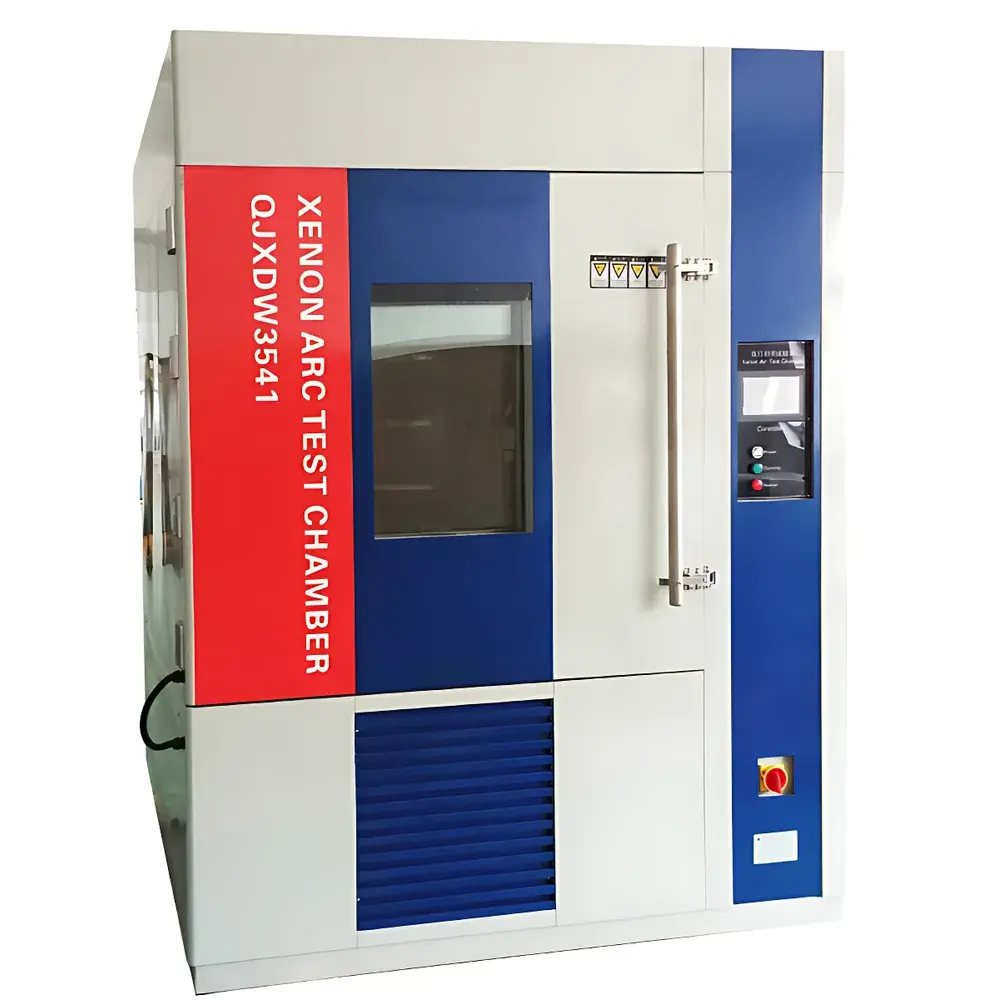
QJXDW3541 Xenon Arc Weathering Test Chamber
| Origin | Shanghai, China |
|---|---|
| Manufacturer Type | Authorized Distributor |
| Origin Category | Domestic (PRC) |
| Model | QJXDW3541 |
| Price | USD 7,700 (FOB Shanghai) |
| Xenon Lamp Power | 6 kW |
| Spectral Irradiance | 550 W/m² (300–800 nm) |
| Light Exposure Cycle | 0–240 min (adjustable on/off intervals) |
| Humidity Control Range | RT+10°C to 80°C ±1°C (programmable) |
| Rainfall Duration | 0–9999 min (adjustable) |
| Rainfall Interval | 0–240 min (adjustable) |
| Spectral Output Range | 290–800 nm |
| Lamp Lifetime | ~2000 h |
| Sample Tray Radius (inner/outer) | 100 / 220 mm |
| Turntable Speed | 5 rpm |
| Distance from Lamp Center to Sample Plane | 165 mm |
| Sample Height Capacity | 420 mm |
| Chamber Interior Dimensions | 500 × 500 × 600 mm (W×D×H) |
| Temperature Uniformity | ≤2°C |
| Cooling Method | Air-cooled (3 kW) + Water-cooled (4.5 kW) |
| Lamp Operating Voltage | 220 V ±5% |
| Lamp Operating Current | 20 A |
Overview
The QJXDW3541 Xenon Arc Weathering Test Chamber is an engineered environmental simulation system designed to accelerate the evaluation of material degradation under controlled exposure to solar radiation, thermal cycling, and moisture—key stressors in real-world outdoor aging. It employs a high-intensity 6 kW xenon arc lamp as its primary radiation source, delivering a spectral output closely matching terrestrial sunlight across the critical 290–800 nm range (including UV-B, UV-A, visible, and near-infrared). Unlike UV fluorescent or metal halide sources, xenon arc lamps provide broad-spectrum irradiance with high fidelity to natural solar irradiance, enabling compliance with internationally recognized weathering standards such as ISO 4892-2, ASTM G155, SAE J2527, and GB/T 16422.2. The chamber integrates precise temperature regulation (RT+10°C to 80°C ±1°C), programmable humidity control, and synchronized water spray/condensation cycles to replicate diurnal wet-dry transitions—including simulated rainfall, dew formation, and thermal shock—all within a single test sequence.
Key Features
- High-fidelity 6 kW air/water hybrid-cooled xenon lamp assembly, optimized for spectral stability and irradiance uniformity over extended operation (~2000 h rated lifetime)
- Digitally programmable exposure cycles: independent control of light-on duration (0–240 min), dark periods, spray duration (0–9999 min), and spray interval (0–240 min)
- Rotating sample turntable (5 rpm) with dual-radius mounting (inner 100 mm / outer 220 mm) ensuring consistent irradiance distribution across all specimens
- Integrated irradiance monitoring with real-time display and cumulative dose logging (W·h/m²) for traceable exposure quantification
- Robust stainless-steel interior chamber (500 × 500 × 600 mm) with insulated double-wall construction and PID-controlled heating/cooling systems
- Adjustable black-panel temperature sensor (BPT) and chamber air temperature control, supporting both ISO and ASTM test protocols
- Modular sample tray design accommodating standard specimen frames (e.g., ASTM D6675-compliant holders) and custom fixtures up to 420 mm height
Sample Compatibility & Compliance
The QJXDW3541 accommodates flat, rigid, and semi-flexible specimens—including coatings, automotive trim, polymer films, architectural cladding (e.g., aluminum composite panels), safety glazing, textiles, and elastomers. Its operational envelope meets the physical and metrological requirements of multiple international test standards: ISO 4892-2 (plastics), ISO 11341 (paints and varnishes), ASTM D4329 (plastics), ASTM D4459 (interior plastics), SAE J2412/J2527 (automotive), and GB/T 16422.2 (Chinese national standard). All temperature, irradiance, and humidity parameters are independently validated per IEC 60068-2-5 and ISO/IEC 17025 traceability guidelines. The system supports GLP-compliant testing when paired with audit-ready data logging and user-access controls.
Software & Data Management
Equipped with an embedded industrial-grade controller featuring a 7-inch TFT touchscreen interface, the QJXDW3541 enables intuitive setup of multi-step test profiles—including ramp-soak sequences, irradiance setpoint tracking, and conditional logic triggers (e.g., initiate spray upon reaching target surface temperature). All operational parameters—including chamber temperature, black-panel temperature, irradiance intensity, elapsed time, and cumulative radiant exposure—are logged at user-defined intervals (1 s to 60 min resolution) and exportable via USB to CSV format. Optional Ethernet connectivity allows remote monitoring and integration into centralized LIMS or MES platforms. Data integrity complies with FDA 21 CFR Part 11 requirements when configured with electronic signature and audit trail modules.
Applications
- Accelerated durability validation of automotive exterior components (bumpers, fascias, headlamp lenses) per OEM specifications
- Formulation screening and comparative ranking of pigment systems, UV stabilizers, and HALS additives in coatings and plastics
- Qualification of architectural façade materials—including ACP, PVDF-coated aluminum, and ETFE membranes—against regional climate profiles
- Regulatory submission support for medical device packaging (ISO 11607), aerospace composites (AMS 2700), and consumer electronics enclosures
- Root-cause analysis of premature chalking, gloss loss, color shift (ΔE*), cracking, or delamination in field-failed products
FAQ
What spectral filters are compatible with this chamber?
Standard configurations include Daylight-Q/B and Window-Glass-Q filters per ISO 4892-2; custom filter sets (e.g., extended UV or IR-cut) can be integrated upon request.
Is calibration certification included with shipment?
Yes—a NIST-traceable irradiance calibration report (covering 300–800 nm) and temperature uniformity verification are provided with each unit.
Can the chamber operate unattended for extended cycles?
Yes. With integrated safety interlocks (overtemperature, lamp arc failure, coolant flow loss), it supports continuous operation up to 1,000 hours per test sequence.
What maintenance is required during routine operation?
Lamp replacement every ~2000 h, quartz filter cleaning every 100 h, and annual recalibration of irradiance and temperature sensors are recommended per ISO/IEC 17025 maintenance schedules.
Does the system support multi-chamber synchronization for inter-laboratory studies?
Yes—via optional RS485 Modbus RTU or Ethernet TCP/IP interfaces, enabling time-synchronized start/stop and centralized parameter broadcast across up to 16 units.



