
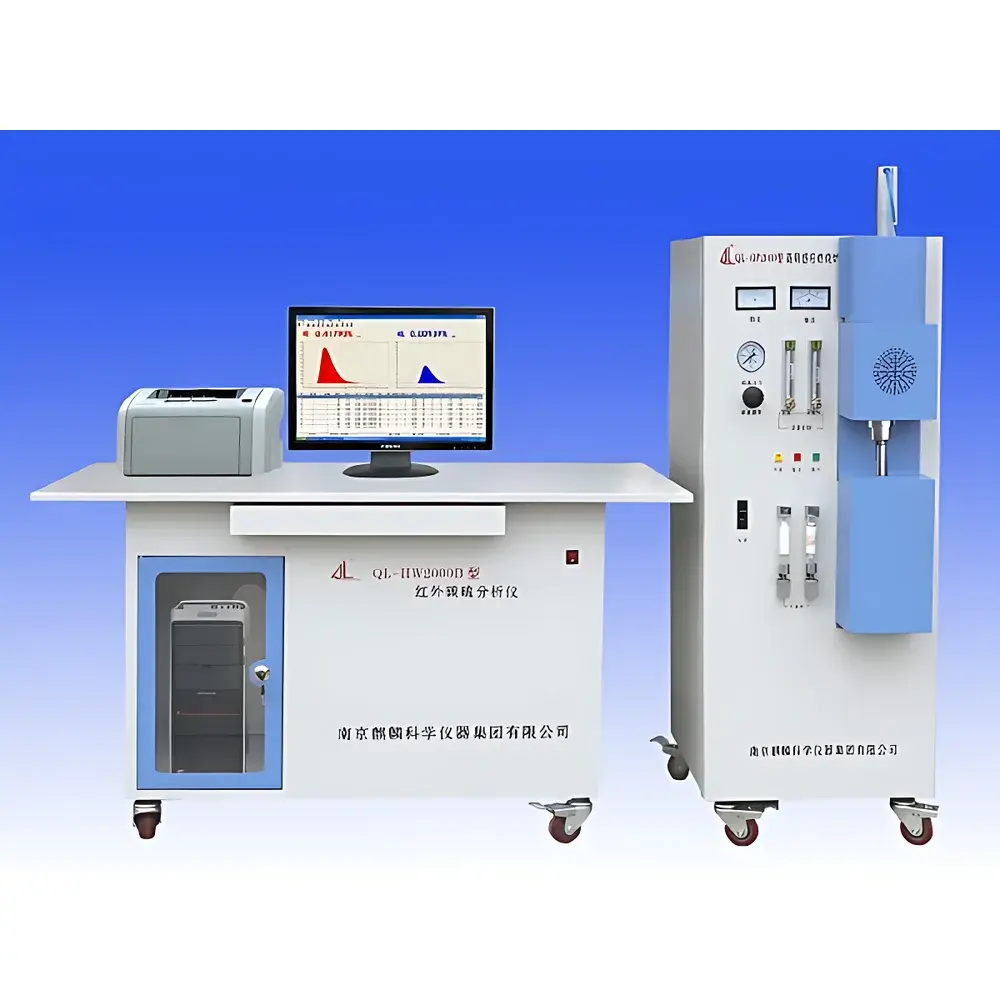
QL HW2000B High-Frequency Infrared Carbon-Sulfur Analyzer
| Brand | QL |
|---|---|
| Origin | Jiangsu, China |
| Manufacturer Type | Authorized Distributor |
| Country of Origin | China |
| Model | HW2000B |
| Price | USD 19,200 (FOB Jiangsu) |
| Measurement Principle | Non-Dispersive Infrared (NDIR) Absorption |
| Combustion System | High-Frequency Induction Furnace (2.5 kVA, 18–20 MHz) |
| Carbon Range | 0.00001–10.0000 wt% (extendable to 99.999 wt%) |
| Sulfur Range | 0.00001–0.5000 wt% (extendable to 99.999 wt%) |
| Sensitivity | 0.1 ppm |
| Precision | Carbon RSD ≤ 0.5%, Sulfur RSD ≤ 1.0% (per GB/T 20123–2006 and ISO 15350:2000) |
| Analysis Time | 25–60 s (user-adjustable |
| Balance Integration | Automatic linkage with 0–120 g capacity, 0.1 mg readability |
| Dust Removal | Motorized furnace head cleaning mechanism |
| Thermal Control | Integrated furnace head heating for uniform sulfur oxidation |
| Optical Detector | Low-noise, high-stability pyroelectric NDIR sensor |
Overview
The QL HW2000B High-Frequency Infrared Carbon-Sulfur Analyzer is a fully integrated combustion-based elemental analyzer engineered for precise, routine quantification of total carbon (C) and total sulfur (S) in solid inorganic and organic matrices. It operates on the principle of high-frequency induction combustion followed by non-dispersive infrared (NDIR) spectrophotometric detection. Sample aliquots are combusted quantitatively in a controlled oxygen-rich atmosphere within a high-frequency induction furnace (18–20 MHz, 2.5 kVA), converting carbon to CO₂ and sulfur to SO₂. Gaseous products are swept through optimized gas-handling modules—including dust filtration, H₂O and SO₃ removal, and CO-to-CO₂ conversion—before entering dual-wavelength NDIR cells calibrated for CO₂ (4.26 µm) and SO₂ (7.35 µm) absorption. This architecture ensures stoichiometric completeness, minimal spectral interference, and long-term photometric stability—critical for compliance-driven laboratories performing metallurgical QC, raw material certification, or geological survey testing.
Key Features
- Modular hardware architecture with isolated optical, electronic, and gas-path subsystems to enhance serviceability and reduce cross-contamination risk.
- Automated furnace head cleaning mechanism with programmable cycle timing, minimizing particulate carryover between analyses.
- Dedicated furnace head heating zone maintains consistent SO₂ generation efficiency across diverse sample types (e.g., low-sulfur steels vs. high-sulfur cokes), improving inter-batch reproducibility.
- High-stability pyroelectric NDIR detectors with temperature-compensated signal processing, delivering sub-ppm sensitivity and linearity over six orders of magnitude.
- Seamless integration with analytical balances (0–120 g, 0.1 mg resolution) via RS-232/USB, enabling dynamic sample mass registration and automatic normalization without manual entry.
- Adjustable high-frequency power output (0–100% in 1% increments) to optimize combustion efficiency for refractory alloys, ceramics, or volatile organics.
- Real-time graphical display of CO₂ and SO₂ evolution profiles during combustion, supporting method development and anomaly diagnosis.
Sample Compatibility & Compliance
The HW2000B accommodates heterogeneous solid samples up to 1.0 g, including ferrous and non-ferrous metals (e.g., stainless steel, cast iron, aluminum alloys), ores (iron, manganese, bauxite), coal and coke, cement clinker, catalysts, refractories, and geological specimens. Its combustion protocol meets the procedural requirements of ISO 15350:2000 and GB/T 20123–2006 for total C/S determination. The system supports GLP-compliant operation through audit-trail-enabled software logging (user actions, calibration events, result modifications), electronic signature support, and secure data archiving—fully aligned with FDA 21 CFR Part 11 expectations when deployed with validated IT infrastructure. Optional IQ/OQ documentation packages are available for regulated environments.
Software & Data Management
QL’s proprietary Windows-based analysis suite provides comprehensive instrument control, data acquisition, and reporting functionality. The interface includes real-time spectral monitoring, multi-channel calibration management (up to 16 user-defined calibration curves), statistical evaluation (RSD, SD, confidence intervals), outlier detection algorithms, and customizable report templates (PDF/Excel). All analytical sessions are timestamped and logged with full metadata: sample ID, operator, balance reading, furnace parameters, gas flow rates, peak area integrals, and raw detector voltages. Data export adheres to ASTM E1382-22 formatting standards for interoperability with LIMS platforms. Software updates are delivered via encrypted firmware packages with version-controlled release notes and backward-compatible data migration tools.
Applications
This analyzer is routinely deployed in metallurgical laboratories for incoming inspection of scrap metal and alloying additives; in cement production facilities for limestone and clinker quality control; in coal-fired power plants for fuel sulfur specification verification; and in academic geochemistry labs for trace-element correlation studies. Its extended dynamic range enables accurate measurement of ultra-low-carbon specialty steels (50 wt% C), while its sulfur sensitivity supports regulatory compliance testing for desulfurized flue gas scrubber residues or low-sulfur marine fuels. Method transfer from ASTM E1019, ISO 4935, and JIS G 1211 is straightforward due to standardized combustion conditions and detector response validation protocols.
FAQ
What combustion gases are required for operation?
Ultra-high-purity oxygen (≥99.995%, dew point ≤ –70°C) is mandatory; argon or helium may be used as carrier/purge gases depending on application-specific interference mitigation needs.
Is external cooling water required?
No—the HW2000B employs air-cooled condensers and thermoelectrically stabilized detector housings, eliminating dependency on chilled water loops.
Can the instrument analyze liquid or powder samples directly?
Only solid, non-volatile samples are supported; powders must be pelletized or mixed with tungsten oxide flux to ensure stable combustion; liquids require prior ashing or co-precipitation.
How often must the NDIR cells be recalibrated?
Factory-calibrated cells retain accuracy for ≥12 months under normal use; annual verification using certified reference materials (CRMs) traceable to NIST or IRMM is recommended.
Does the system support remote diagnostics?
Yes—via optional Ethernet module with TLS-encrypted VNC access, enabling secure technician-assisted troubleshooting without physical site visits.





