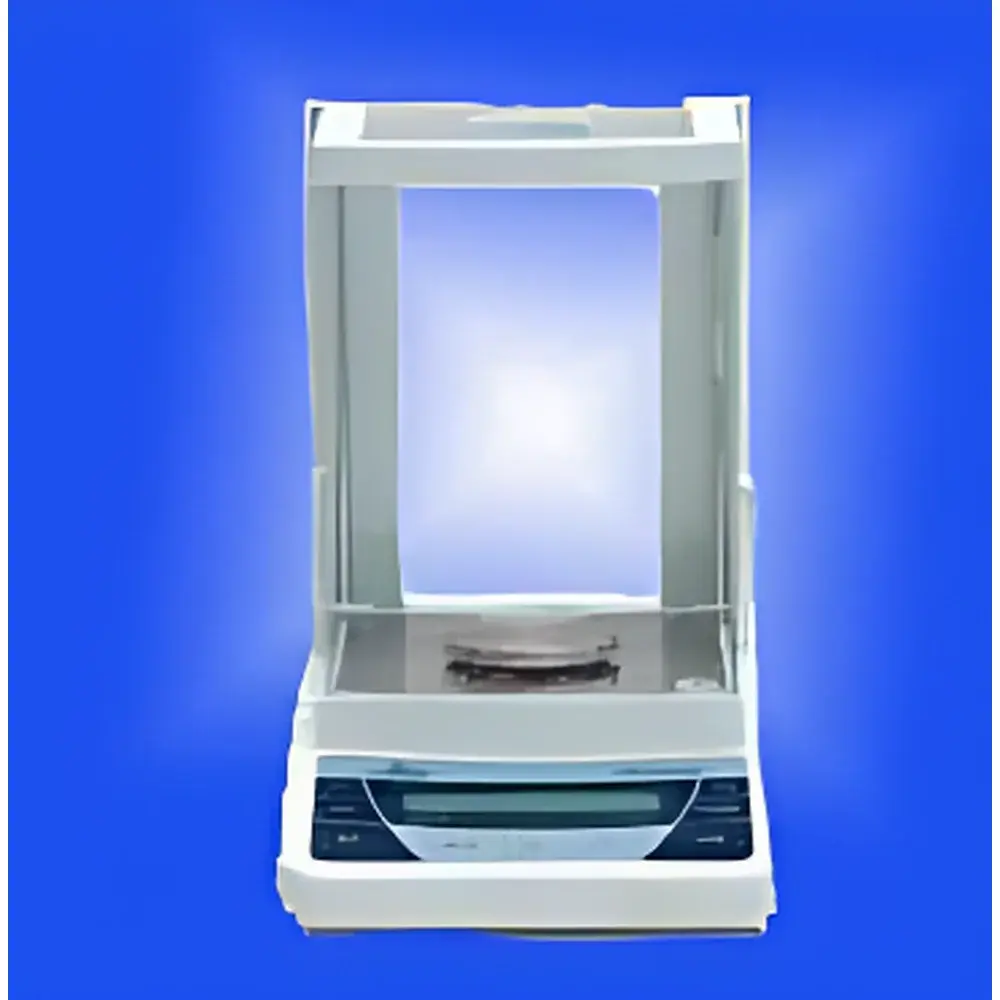
QL YP1004 Precision Analytical Balance (0.1 mg readability, 100 g capacity)
| Brand | QL |
|---|---|
| Origin | Shanghai, China |
| Manufacturer Type | Authorized Distributor |
| Country of Origin | China |
| Model | YP1004 |
| Instrument Type | Analytical Balance |
| Capacity | 0–100 g |
| Readability | 0.1 mg |
| Repeatability | ±0.1 mg |
| Calibration | Internal automatic calibration |
| Pan Size | 80 mm diameter |
| Interface | RS232C |
| Dimensions (W×D×H) | 324 × 217 × 335 mm |
| Net Weight | 7 kg |
| Power Supply | 220 V / 50 Hz |
| Units | g, ct, oz |
| Functions | Tare, cumulative weighing, piece counting, suspended weighing, adjustable integration time, adjustable sensitivity, error alarm, unit conversion, print output |
Overview
The QL YP1004 Precision Analytical Balance is a high-stability electromagnetic force compensation balance engineered for routine and quality-critical mass measurement in academic, pharmaceutical, chemical, and materials laboratories. Operating on the principle of electromagnetic force restoration—where sample weight is counterbalanced by a precisely regulated current-generated magnetic field—the instrument delivers traceable, drift-resistant measurements with 0.1 mg readability across its full 100 g capacity range. Its core architecture integrates an MCS-51–based microcontroller system optimized for real-time signal processing, thermal stability compensation, and low-noise analog-to-digital conversion. Designed to meet foundational metrological requirements for Class I analytical applications, the YP1004 supports ISO/IEC 17025-compliant weighing procedures when operated under controlled environmental conditions (temperature stability ±2 °C, humidity <70% RH, vibration isolation). The balance conforms to OIML R76-1 (2017) guidelines for non-automatic weighing instruments, with built-in diagnostics and self-monitoring routines ensuring continuous performance verification.
Key Features
- Electromagnetic force restoration mechanism for high linearity and long-term zero stability
- Internal automatic calibration with temperature-triggered recalibration routine
- Adjustable integration time and sensitivity settings to optimize response for viscous, static-prone, or thermally sensitive samples
- Full-range tare function with memory retention and sequential tare logging
- Cumulative weighing mode with programmable batch thresholds and totalized mass export
- Piece counting functionality with statistical averaging across user-defined sample counts (n ≥ 10)
- Suspended weighing capability via optional hook assembly for density determination or buoyancy correction workflows
- Multi-unit display (grams, carats, ounces) with direct toggling and persistent unit preference storage
- RS232C serial interface compliant with EIA/TIA-232-F standards, supporting ASCII-based data streaming at configurable baud rates (9600–19200 bps)
- Real-time fault detection with audible and visual alerts for overload, draft interference, sensor saturation, or unstable leveling
Sample Compatibility & Compliance
The YP1004 accommodates standard laboratory samples—including powders, granules, liquids in tared vessels, and small solid components—within its 80 mm stainless steel weighing pan. Its compact footprint and enclosed draft shield (integrated as standard) minimize air-current-induced fluctuations, enabling reliable operation in general-purpose lab environments without dedicated laminar flow hoods. While not certified for GMP-regulated production environments, the balance supports GLP-aligned documentation practices through timestamped RS232 output and manual logbook correlation. It satisfies basic traceability requirements per ISO 9001:2015 Clause 7.1.5 and aligns with ASTM E898–19 recommendations for analytical balance selection and verification. Regulatory readiness includes compatibility with 21 CFR Part 11–compliant third-party data acquisition software when paired with validated PC interfaces and audit-trail-enabled drivers.
Software & Data Management
Data output follows NIST-traceable ASCII protocol over RS232C: each stable reading transmits as a fixed-format string including timestamp (if host-synchronized), net mass, unit identifier, and status flag (e.g., “STABLE”, “OVERLOAD”). No proprietary software is bundled; however, the interface is interoperable with common laboratory informatics systems—including LabWare LIMS, Thermo Fisher SampleManager, and open-source tools such as Python-based PySerial scripts or Excel DDE configurations. Users may configure automatic data capture intervals, prefix identifiers for multi-sample batches, and delimiter selection (TAB, COMMA, SEMICOLON). All firmware updates are performed via serial bootloader using vendor-provided hex files and documented command sequences—no USB or cloud dependency.
Applications
- Quantitative preparation of reference standards and calibration solutions in QC labs
- Weighing of active pharmaceutical ingredients (APIs) during formulation development
- Quality control of catalyst loading in heterogeneous reaction studies
- Small-part inventory management via piece counting in electronics and precision machining facilities
- Density estimation of irregular solids using Archimedean suspension method
- Teaching laboratory exercises in analytical chemistry and metrology fundamentals
<li gravimetric analysis of ash content, moisture loss on drying (LOD), and residue on ignition (ROI)
FAQ
Does the YP1004 support external calibration weights?
No—it features internal automatic calibration only and does not accept external calibration masses.
Is the RS232 interface galvanically isolated?
No; users must implement appropriate grounding and surge suppression when connecting to industrial PCs or shared network peripherals.
Can the balance operate on battery power?
No; it requires continuous 220 V / 50 Hz AC input and lacks internal battery backup.
What is the warm-up time required for optimal accuracy?
Minimum 30 minutes after power-on under stable ambient conditions (20–25 °C); full metrological stability achieved after 60 minutes.
Is the firmware upgradeable in the field?
Yes—via documented serial protocol using vendor-supplied firmware binaries and terminal emulation software.