
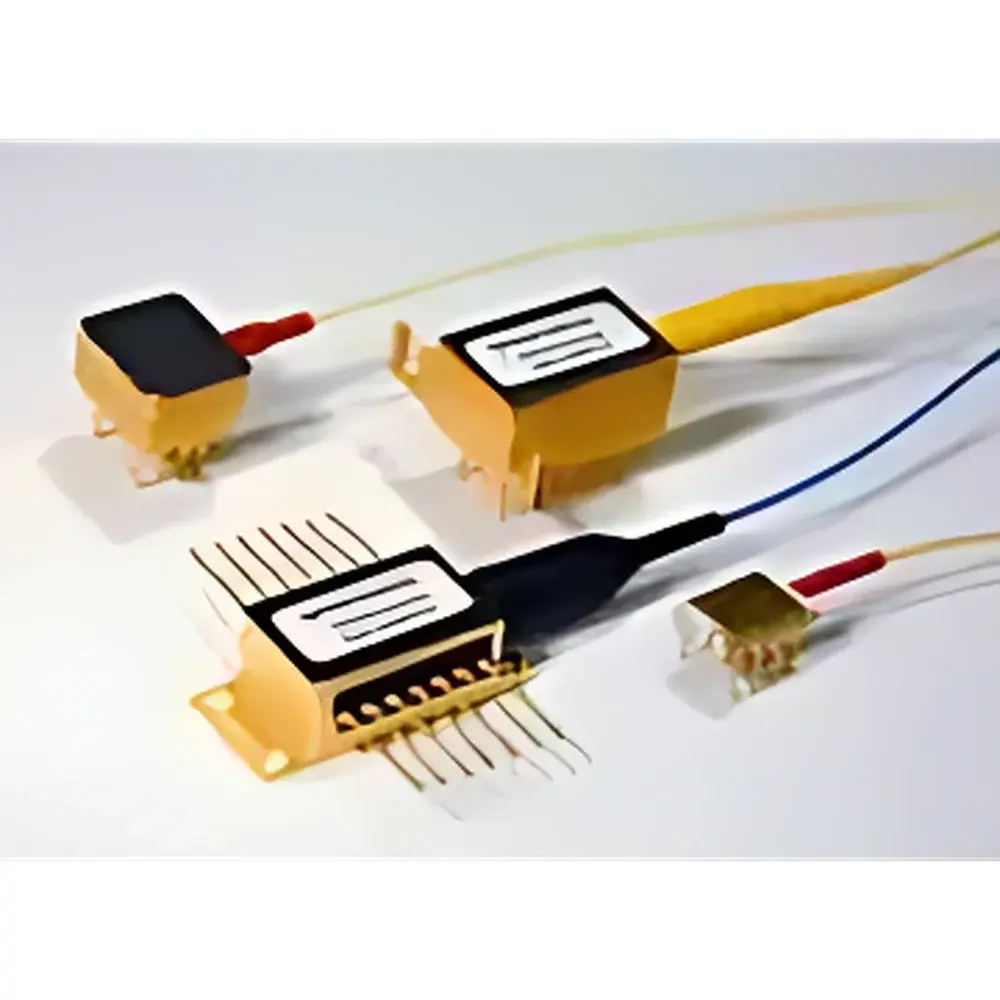
Qphotonics DFB-1550-50 Single-Frequency Distributed Feedback Laser Diode
| Brand | Qphotonics |
|---|---|
| Origin | USA |
| Manufacturer Type | Authorized Distributor |
| Product Origin | Imported |
| Model | DFB-1550-50 |
| Light Source Type | Semiconductor Laser Diode |
| Illumination Method | Internal (Fiber-Coupled) |
| Wavelength | 1550 nm ± 0.5 nm |
| Output Power | 45 mW (typ.) |
| Spectral Linewidth | < 1 MHz |
| Package | 14-pin Butterfly with TEC, Thermistor & Monitor Photodiode |
| Fiber Output | Single-Mode or Polarization-Maintaining (PM) Pigtail |
| Operating Mode | CW or Pulsed via Current/Temperature Tuning |
Overview
The Qphotonics DFB-1550-50 is a high-stability, single-frequency distributed feedback (DFB) laser diode engineered for precision optical applications requiring narrow-linewidth, wavelength-agile, and low-noise coherent light sources. Operating at a nominal center wavelength of 1550 nm — situated within the low-loss C-band transmission window of standard single-mode fiber — this device leverages monolithic DFB grating integration to achieve inherently stable longitudinal mode selection without external cavity feedback. Its design eliminates mode-hopping under controlled temperature and current conditions, enabling sub-MHz spectral linewidths (<1 MHz typical) essential for interferometric sensing, coherent optical communications, gas spectroscopy (e.g., CH₄, CO₂, H₂O detection), and fiber-optic sensor interrogation systems. The device is fabricated using InP-based quantum-well heterostructures and incorporates integrated thermoelectric cooling (TEC), NTC thermistor, and back-facet monitor photodiode — all housed in a hermetically sealed 14-pin butterfly package compliant with Telcordia GR-468-CORE reliability standards.
Key Features
- Single-longitudinal-mode (SLM) output enabled by monolithic DFB grating structure
- Center wavelength: 1550 nm ± 0.5 nm (custom wavelengths available from 760–1650 nm)
- Typical output power: 45 mW into single-mode fiber (SMF-28 or PM fiber options)
- Spectral linewidth: <1 MHz (Lorentzian fit, measured via delayed self-heterodyne interferometry)
- Side-mode suppression ratio (SMSR): >50 dB
- Integrated thermoelectric cooler (TEC) with ±0.01 °C temperature stability
- On-board NTC thermistor for closed-loop thermal control and real-time monitoring
- Monitor photodiode with linear responsivity for active power stabilization
- Hermetic 14-pin butterfly housing with fiber pigtail (FC/APC or FC/PC connector optional)
- Compatible with industry-standard laser driver modules supporting analog modulation up to 500 MHz
Sample Compatibility & Compliance
The DFB-1550-50 is designed for integration into laboratory, industrial, and field-deployable optical systems where regulatory traceability and long-term stability are critical. It meets RoHS Directive 2011/65/EU and REACH (EC 1907/2006) material compliance requirements. For applications subject to medical or aerospace qualification, the device supports full traceability through lot-controlled wafer fabrication and burn-in testing per MIL-STD-883H Method 1015. While not inherently certified to IEC 60825-1:2014 Class 1/Class 3B laser safety standards, proper system-level enclosure and interlock implementation — in accordance with ANSI Z136.1–2022 — ensures safe operation. When deployed in metrology-grade setups (e.g., optical frequency combs or cavity ring-down spectrometers), the laser’s wavelength stability (±1 pm over 8 hours at constant T/I) enables alignment with NIST-traceable wavelength references.
Software & Data Management
Qphotonics provides comprehensive operating guidelines and characterization reports (including L-I-V curves, spectral scans, and aging data) for each shipped unit. While the laser itself is analog-controlled, it is fully compatible with third-party instrumentation platforms including Thorlabs LDCxx series drivers, Newport LDX-3620 controllers, and Keysight B2900A source-measure units. Integration with LabVIEW, Python (via PyVISA), or MATLAB is supported through standard SCPI command sets when used with compatible drivers. For GxP environments, users may implement audit-trail-capable control software that logs temperature setpoints, drive current, photodiode feedback voltage, and timestamped operational states — satisfying FDA 21 CFR Part 11 requirements when paired with electronic signature validation.
Applications
- High-resolution absorption spectroscopy of trace gases (e.g., methane at 1650.9 nm, acetylene at 1530.37 nm)
- Coherent optical time-domain reflectometry (C-OTDR) for distributed acoustic sensing (DAS)
- Fiber Bragg grating (FBG) and Fabry–Pérot interferometer demodulation systems
- External cavity diode laser (ECDL) seeding and injection locking architectures
- Optical coherence tomography (OCT) light sources for ophthalmic and dermatological imaging
- Laser cooling and trapping experiments requiring narrow-linewidth near-IR excitation
- Quantum optics testbeds involving photon-pair generation via spontaneous parametric down-conversion (SPDC)
- Calibration of wavelength meters and optical spectrum analyzers (OSAs) in metrology labs
FAQ
What is the typical spectral linewidth measurement method?
Linewidth is characterized using the delayed self-heterodyne interferometry (DSHI) technique with ≥10 km of spooled SMF-28, followed by Lorentzian fitting of the beat note in RF spectrum analyzers (resolution bandwidth ≤1 kHz).
Can this laser be operated in pulsed mode?
Yes — the device supports direct current pulsing up to 500 MHz with rise/fall times <1 ns when driven by a fast-switching laser diode controller; pulse width stability is maintained within ±0.5% at 100 kHz repetition rates.
Is polarization-maintaining (PM) fiber pigtail available as standard?
PM fiber (PANDA-type, extinction ratio >25 dB) is offered as a configurable option at no additional lead time; standard delivery uses SMF-28 with >30 dB return loss.
Does Qphotonics provide wavelength calibration certificates?
Each unit ships with a factory-measured wavelength calibration report referenced to a NIST-traceable wavemeter (Bristol 621A or equivalent), valid for 12 months post-shipment.
What thermal management is required for continuous operation?
The integrated TEC requires a bipolar ±2 A / 2.5 V supply; heat sinking must maintain baseplate temperature between 15–35 °C ambient to ensure specified wavelength drift <±1 pm/hour.



