
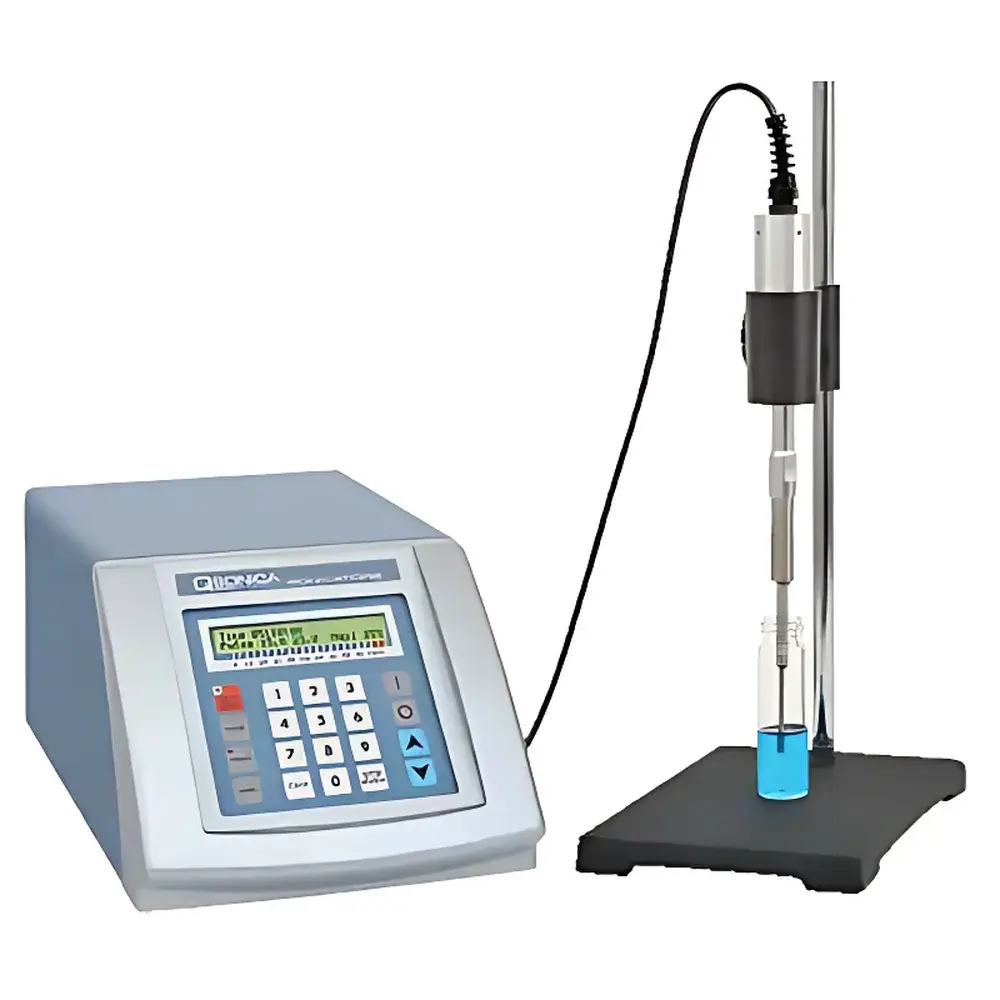
Qsonica Q125 Ultrasonic Sonicator
| Brand | Qsonica LLC |
|---|---|
| Origin | USA |
| Model | Q125 |
| Instrument Type | Ultrasonic Cell Disruptor |
| Ultrasonic Power Output | 125 W |
| Operating Frequency | 20 kHz |
| Temperature Range | 1–121 °C |
| Sample Volume Capacity | 5 µL – 100 mL |
| Number of Samples per Run | 1 |
| Pulse Duration Adjustment | 1 s – 60 s |
| Continuous Operation Limit | Up to 10 hours |
| Dimensions (W×D×H) | 20 × 35 × 15 cm |
Overview
The Qsonica Q125 Ultrasonic Sonicator is a benchtop ultrasonic processor engineered for precise, reproducible cell lysis, emulsification, homogenization, and nanoparticle dispersion in life science and bioprocessing laboratories. It operates on the principle of high-intensity ultrasonic cavitation—generating controlled acoustic energy at a fixed frequency of 20 kHz to induce rapid pressure fluctuations in liquid media, resulting in microbubble formation, growth, and violent collapse. This transient cavitation delivers localized shear forces sufficient to disrupt cellular membranes, solubilize inclusion bodies, fragment chromatin, and reduce particle size without significant thermal degradation when operated under pulsed conditions. Designed as the direct successor to the discontinued XL2000 series, the Q125 features enhanced power delivery (125 W nominal output), digital amplitude control, and integrated thermal management—making it suitable for both routine QC workflows and method-development studies requiring strict parameter traceability.
Key Features
- Digital amplitude control (20–100% of maximum output) enables precise tuning of mechanical energy input, critical for optimizing lysis efficiency across diverse sample matrices—including bacterial, yeast, mammalian, and plant cells.
- Programmable time and amplitude settings support fully automated operation with repeatable endpoint consistency; ideal for SOP-driven environments such as GLP-compliant labs or GMP-aligned process development.
- Pulse mode functionality (adjustable from 1 second to 60 seconds ON/OFF cycles) mitigates heat accumulation during extended sonication, preserving thermolabile biomolecules such as enzymes, antibodies, and RNA.
- Real-time digital display shows elapsed time, applied power (W), and cumulative energy delivered (J), facilitating energy-based protocol standardization across instruments and users.
- Integrated overload protection safeguards transducer integrity during probe misalignment, air exposure, or excessive load impedance—ensuring long-term system reliability.
- Footswitch compatibility allows hands-free activation, improving operator ergonomics and safety during repetitive or time-sensitive procedures.
Sample Compatibility & Compliance
The Q125 accommodates sample volumes ranging from 5 µL (microcentrifuge tubes) to 100 mL (with optional magnetic stirring integration using the CL18 transducer and compatible stirrer). Its modular probe architecture supports interchangeable titanium alloy horns—including microtips (2 mm), standard probes (3.2 mm and 6.4 mm), multi-tip arrays (8-position), and non-contact cup horns—enabling scalable processing from single-tube lysates to parallelized screening or small-batch formulation. All accessories are autoclavable and chemically resistant to common laboratory solvents and buffers. The instrument complies with IEC 61000-6-3 (EMC emission standards) and IEC 61000-6-2 (immunity requirements); its firmware architecture supports audit trail generation and user access control when deployed in regulated environments governed by FDA 21 CFR Part 11, ISO/IEC 17025, or USP guidelines.
Software & Data Management
While the Q125 operates via standalone front-panel controls, its digital interface provides timestamped operational logs stored in non-volatile memory. These logs include start/stop timestamps, set amplitude (%), actual power (W), total run time (s), and cumulative energy (J)—all exportable via manual transcription for inclusion in electronic lab notebooks (ELNs) or LIMS records. When paired with Qsonica’s optional data acquisition modules (e.g., Q-Log Pro), users can achieve full traceability aligned with ALCOA+ principles (Attributable, Legible, Contemporaneous, Original, Accurate, Complete, Consistent, Enduring, Available). Firmware updates are performed via USB interface and validated per change control protocols.
Applications
- Cell disruption for protein extraction (E. coli, S. cerevisiae, CHO, HEK293)
- Chromatin shearing for ChIP-seq and ATAC-seq library preparation
- Nanoparticle deagglomeration and dispersion in drug delivery formulations
- Emulsification of lipid-based nanocarriers and microemulsions
- Homogenization of tissue lysates for metabolomics and proteomics workflows
- Preparation of viral vectors and exosome suspensions
- Accelerated solvent extraction of natural products
FAQ
What is the maximum recommended continuous run time for the Q125?
The device supports up to 10 hours of uninterrupted operation under optimal cooling and load conditions; however, pulsed operation is strongly advised for temperature-sensitive applications.
Can the Q125 be used for RNA isolation without significant degradation?
Yes—when configured with short pulse durations (e.g., 5 s ON / 10 s OFF) and maintained at 4 °C using ice-water baths or chilled cup horns, RNA integrity (RIN > 8.5) is routinely preserved.
Is the Q125 compliant with FDA 21 CFR Part 11 for electronic records?
The base unit does not include built-in electronic signature or audit trail software; however, its logged parameters meet data integrity prerequisites when integrated into validated third-party ELN or LIMS platforms.
Which probe should I select for processing 50 mL bacterial cultures?
The 6.4 mm diameter probe (P/N 4435) is recommended; for volumes exceeding 50 mL, pairing with a magnetic stirrer (CL18 transducer mount) ensures uniform energy distribution and prevents localized overheating.
Does the Q125 require external cooling during operation?
Ambient air cooling suffices for most protocols; however, active cooling (e.g., recirculating chiller or ice bath immersion) is required for extended runs (>3 min continuous) or high-amplitude settings (>70%).



