
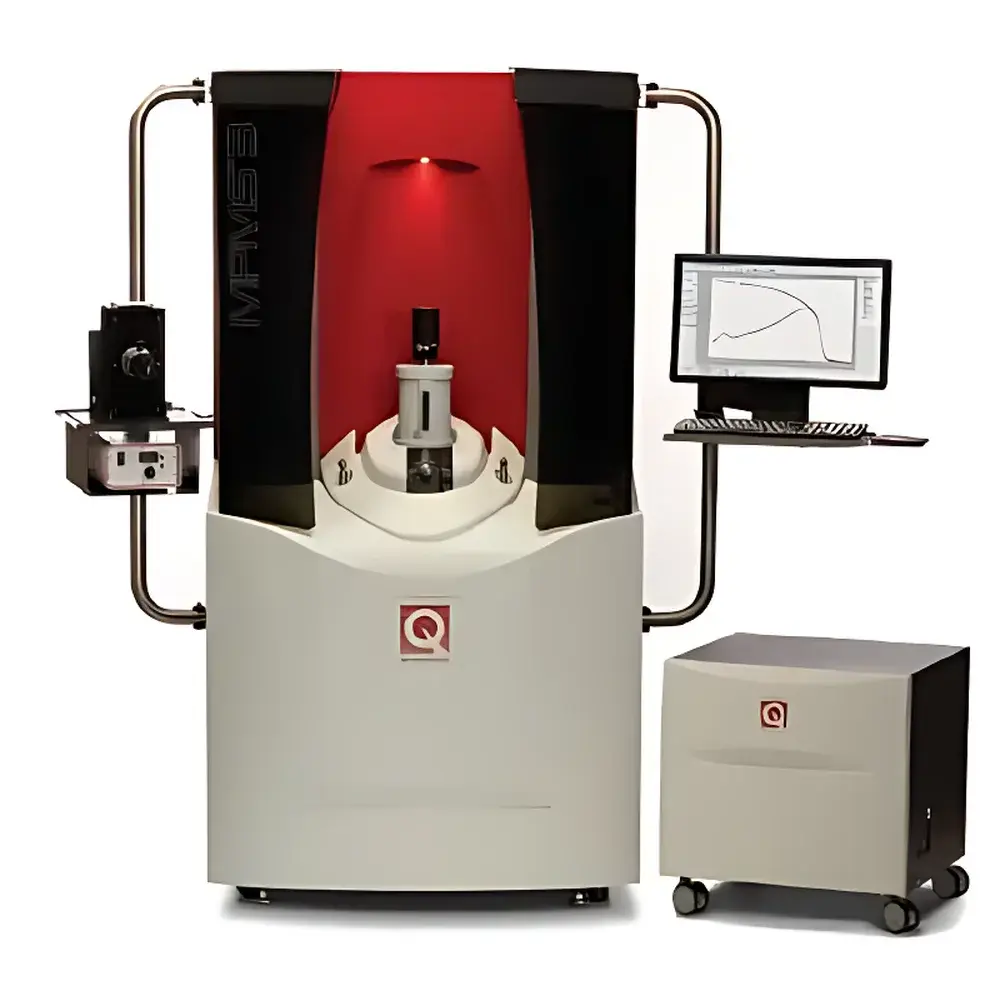
Quantum Design MPMS3 Magnetic Property Measurement System
| Brand | Quantum Design |
|---|---|
| Origin | USA |
| Manufacturer Type | Original Equipment Manufacturer (OEM) |
| Product Origin | Imported |
| Model | MPMS3 |
| Magnet Type | Superconducting Solenoid |
| Measurement Principle | Superconducting Quantum Interference Device (SQUID) |
| Temperature Range | 1.9–400 K (continuous control) |
| Magnetic Field Range | ±7 T |
| Magnetic Moment Sensitivity | ≤5×10⁻⁸ emu (DC Scan, ≤2500 Oe), ≤1×10⁻⁸ emu (VSM, ≤2500 Oe) |
| Cooling Rate | 30 K/min (300 K → 10 K), 10 K/min (10 K → 1.9 K) |
| Field Sweep Rate | 4–700 Oe/s |
| Sample Vibration Amplitude | 0.1–8 mm (peak-to-peak) |
| Max Measurable Moment | 2 emu (DC Scan), >100 emu (VSM) |
| Homogeneity | ≤0.01% over 4 cm DSV |
| RapidTemp Cooling Time | 15 min (300 K → 10 K), 5 min (10 K → 1.9 K) |
| QuickSwitch Transition Time | <1 s (superconducting ↔ normal state) |
Overview
The Quantum Design MPMS3 Magnetic Property Measurement System is a high-precision, cryogen-free-capable SQUID-based magnetometer engineered for quantitative DC and AC magnetic characterization across broad thermodynamic and field parameter spaces. Operating on the principle of superconducting quantum interference, the MPMS3 employs a low-noise, multi-channel SQUID sensor array coupled to a high-stability superconducting solenoid magnet (±7 T), enabling ultra-sensitive detection of magnetic moment changes down to 1×10⁻⁸ emu in VSM mode and 5×10⁻⁸ emu in DC Scan mode under optimal field conditions. Unlike legacy platforms, the MPMS3 integrates three complementary measurement paradigms—DC Scan (point-by-point field/temperature stepping with raw data access), VSM (vibrating sample magnetometry with real-time harmonic analysis), and AC susceptibility (0.1 Hz–1 kHz, amplitude up to 10 Oe)—within a single, unified hardware architecture. Its dual-gradient thermal design supports continuous, programmable temperature control from 1.9 K to 400 K, with rapid cooldown enabled by RapidTemp technology and seamless field ramping via FastLab-compatible electronics. The system meets rigorous metrological requirements for reproducible, traceable magnetic measurements in research environments governed by GLP, ISO/IEC 17025, and ASTM A977/A1056 standards.
Key Features
- RapidTemp thermal management: Achieves 300 K → 10 K in ≤15 minutes and 10 K → 1.9 K in ≤5 minutes with active helium gas cooling and optimized heat exchanger geometry.
- QuickSwitch superconducting switch: Enables sub-second transition between persistent and driven magnet modes, ensuring field stability during long-duration DC measurements and minimizing thermal drift.
- FastLab acquisition engine: Supports 700 Oe/s field sweep rates with real-time signal averaging; attains ≤1×10⁻⁸ emu sensitivity in VSM mode within 4 s averaging time at zero field.
- Triple-mode operation: Native support for DC Scan (high-resolution hysteresis, isothermal remanence), VSM (high-speed M(H)/M(T) mapping), and AC susceptibility (in-phase/out-of-phase χ′/χ″ with harmonic distortion analysis).
- Evercool helium-gas-only option: Eliminates liquid helium dependency via closed-cycle cryocooler integration, enabling fully automated startup, cooldown, and operation using only gaseous helium (≥99.999% purity).
- Modular expandability: Compatible with OEM-certified add-ons including high-temperature oven (up to 1000 K), ultra-low-field shield (<0.005 G), AC susceptibility module, He-3 insert (down to 0.3 K), horizontal rotation rod (±90°, 0.01° resolution), and combined magneto-optical/electrical transport accessories.
Sample Compatibility & Compliance
The MPMS3 accommodates diverse sample geometries—including bulk solids, thin films (on substrates or free-standing), powders, single crystals, nanoparticles, colloidal suspensions, and organic/inorganic hybrids—within a 9 mm internal bore. Sample holders are standardized per ASTM E1451 and ISO 11270 specifications for magnetic property testing. All measurement protocols comply with FDA 21 CFR Part 11 requirements when paired with optional audit-trail-enabled software licensing. Data integrity is ensured through hardware-level timestamping, sensor calibration traceability to NIST SRM 754 (Ni reference standard), and built-in field homogeneity verification (≤0.01% over 4 cm diameter spherical volume). The system satisfies ISO 17025 clause 5.4.2 for instrument calibration and supports third-party validation against IEC 60404-5 for magnetic material classification.
Software & Data Management
MPMS3 is controlled via Quantum Design’s MultiVu platform—a Windows-based, modular application supporting Python API integration (PyMultiVu), batch script automation, and remote SSH access. Raw data export conforms to HDF5 v1.10+ format with embedded metadata (field, temperature, time, sensor gain, lock-in parameters). Software features include real-time FFT-based noise filtering, automatic baseline correction using polynomial interpolation, and compliance-ready reporting templates aligned with ASTM E1451 Annex A3. Audit trail functionality records all user actions, parameter changes, and calibration events with digital signatures and immutable timestamps—fully compliant with GLP/GMP documentation requirements. Data security adheres to NIST SP 800-53 Rev. 4 controls for scientific instrumentation.
Applications
The MPMS3 serves as a foundational tool across condensed matter physics, quantum materials science, metallurgy, and functional ceramics development. It enables precise determination of critical parameters including Curie/Néel temperatures, magnetic anisotropy constants (K₁, K₂), exchange bias fields, spin-glass freezing temperatures, superconducting critical fields (Hc1, Hc2), and topological Hall effect signatures. Peer-reviewed applications include antiskyrmion stabilization in tetragonal Heusler compounds (Nature 2017), Dirac node characterization in ZrSiS (PNAS 2017), anomalous Hall conductivity quantification in kagome semimetals (Nat. Phys. 2018), and pressure-tuned superconductivity studies (PNAS 2019). Its high sensitivity and thermal-field flexibility make it indispensable for probing emergent phenomena in frustrated magnets, 2D van der Waals magnets, molecular spin systems, and multiferroics.
FAQ
What is the lowest base temperature achievable with the standard MPMS3 configuration?
The base system achieves 1.9 K using pumped liquid helium; with the iQuantum He-3 insert option, the operational floor extends to 0.3 K.
Can the MPMS3 perform simultaneous magnetic and electrical transport measurements?
Yes—via the optional electrical transport probe (ETP) accessory, which integrates four-wire resistivity, Hall effect, and magnetoresistance capabilities synchronized with magnetic field and temperature sweeps.
Is AC susceptibility measurement available without additional hardware?
No—the AC Susceptibility Measurement option requires a dedicated drive coil, lock-in amplifier interface, and calibrated field modulation unit, sold separately as a factory-installed module.
How does MPMS3 ensure measurement reproducibility across laboratories?
Through NIST-traceable sensor calibration, automated field homogeneity mapping, and standardized sample mounting fixtures compliant with ASTM E1451, enabling inter-laboratory comparison with <±2% relative uncertainty.
Does the Evercool option affect magnetic field stability or homogeneity?
No—Evercool replaces the liquid helium bath with a two-stage pulse-tube cryocooler while retaining the original superconducting magnet and SQUID sensor assembly; field stability remains ≤10 ppm/hour and homogeneity unchanged.



