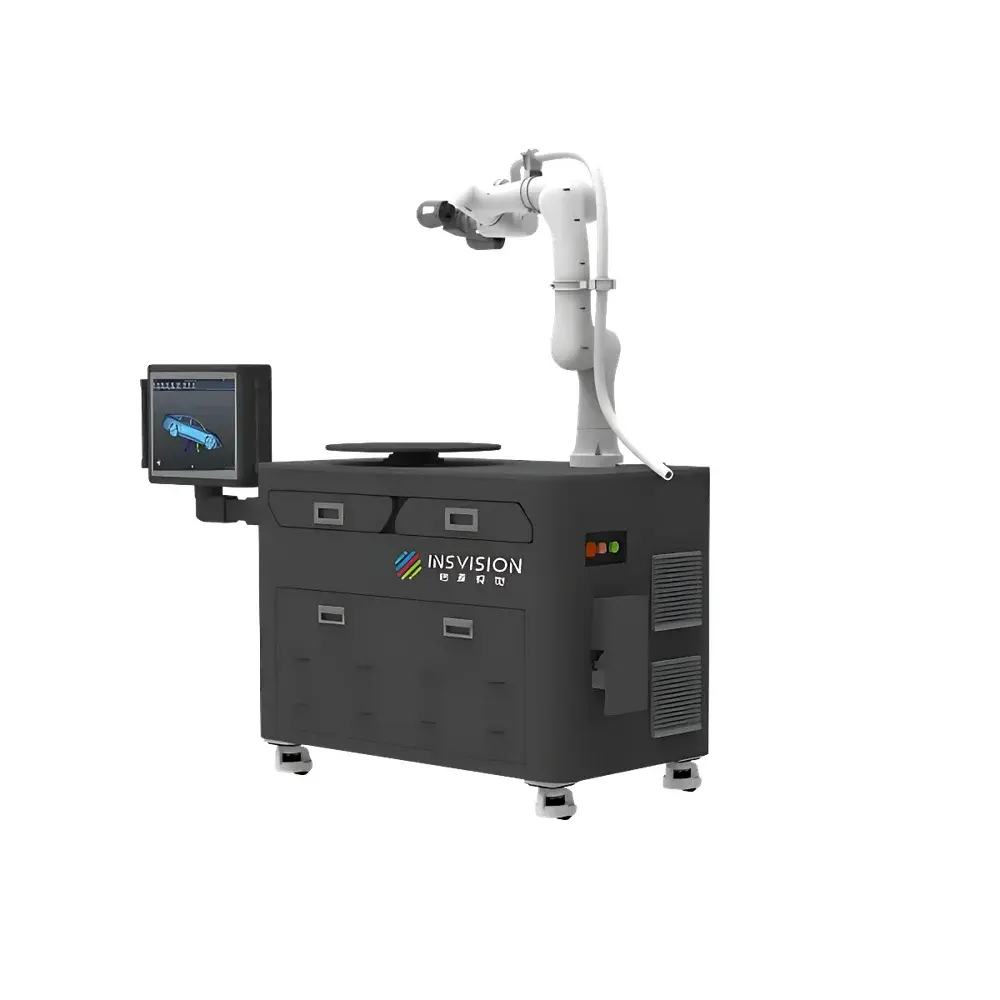
Radiant Vision Systems TrueTest™ Automated Optical Inspection System for LCD/OLED Displays
| Brand | Radiant Vision Systems |
|---|---|
| Model | TrueTest™ |
| Origin | USA |
| Type | Imaging Photometer-Based AOI System |
| Compliance | CIE 1931 Standard Observer, ISO 9241-307, ASTM E308, USP <1058> (for instrument qualification), FDA 21 CFR Part 11 (software audit trail enabled) |
| Detection Capabilities | Pixel defects, line defects, Mura (JND-mapped), luminance uniformity, chromaticity uniformity, contrast ratio, gamma, and spatial nonuniformity analysis |
| Software Platform | TrueTest™ Suite v6.0+ with JND-based defect quantification engine, GLP/GMP-compliant reporting, and automated pass/fail classification |
Overview
The Radiant Vision Systems TrueTest™ Automated Optical Inspection (AOI) System is a metrology-grade imaging photometer platform engineered for objective, human-vision-correlated optical evaluation of flat panel displays (FPDs), including LCD, OLED, microLED, plasma, and projection displays. Unlike conventional machine vision systems—whose algorithms rely on arbitrary grayscale thresholds or edge-detection heuristics—the TrueTest system employs a CIE 1931 standard observer–calibrated imaging photometer. This enables physically accurate measurement of luminance (cd/m²), chromaticity (CIE x,y or u’v’), and their spatial distribution across the full display surface at pixel-level resolution. The system operates on the principle of photometric and colorimetric traceability: each pixel’s radiometric response is calibrated against NIST-traceable standards, ensuring that measured values directly correspond to human visual perception under standardized viewing conditions. As such, TrueTest does not merely detect “differences”—it quantifies *visually significant* deviations in brightness and color using the Just-Noticeable Difference (JND) metric, a psychophysically validated scale where JND = 1 represents the statistical threshold of human detection. This foundational alignment with perceptual science makes TrueTest uniquely qualified for final quality assurance in high-volume FPD manufacturing, where regulatory compliance (e.g., ISO 9241-307 for display ergonomics) and customer-facing visual performance are non-negotiable.
Key Features
- CIE 1931 standard observer–calibrated scientific-grade imaging photometer with ≥16-bit dynamic range and <0.5% photometric repeatability (per ASTM E308)
- TrueTest™ Suite v6.0 software featuring JND-mapping engine for spatially resolved perceptual defect grading—supporting luminance Mura, chromaticity Mura, streaks, blotches, and localized nonuniformities
- Automated pixel-level defect classification: dead/stuck pixels, line defects (horizontal/vertical), cluster defects, and edge leakage—each assigned root-cause likelihood based on spatial signature and photometric profile
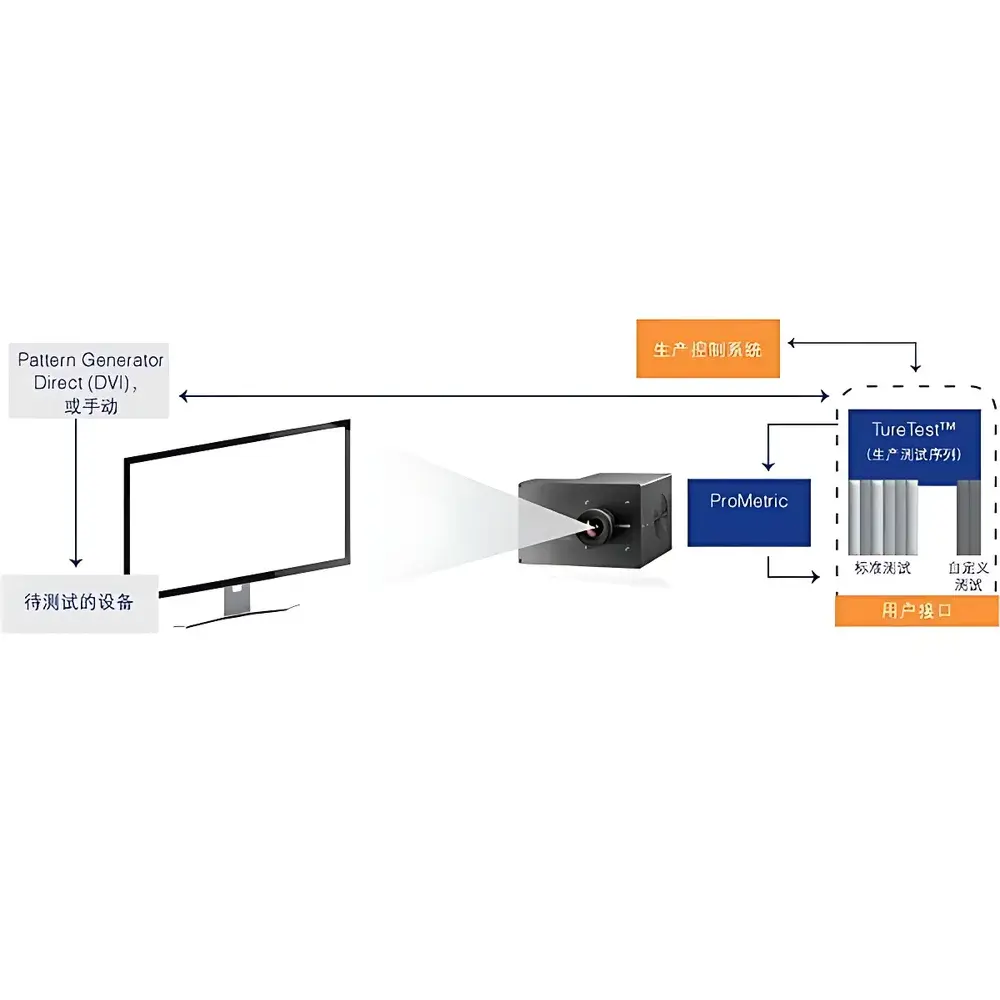
- Integrated test pattern generation and synchronization: software-controlled stimulus delivery via HDMI/DisplayPort or native GPU rendering, ensuring precise temporal alignment between image capture and frame output
- GLP/GMP-ready data management: full electronic audit trail (21 CFR Part 11 compliant), version-controlled test recipes, PDF/CSV/XLSX report export with embedded JND heatmaps and pass/fail annotations
- Modular hardware integration: supports motorized XY stages, rotary indexers, and environmental enclosures for inline or end-of-line deployment
Sample Compatibility & Compliance
The TrueTest system accommodates display sizes from 0.5″ to 100″+ diagonal, including rigid, flexible, and foldable OLED panels. It supports all major FPD technologies—TFT-LCD (IPS, VA, TN), AMOLED, PMOLED, QD-OLED, and microLED—with no hardware modification required. Calibration is performed per display type using proprietary adaptive reference frames and multi-point uniformity correction. Regulatory alignment includes conformance to ISO 9241-307 (evaluation of display image quality), ASTM E308 (standard practice for computing photometric quantities), and IEC 62341-6-3 (OLED display measurements). For pharmaceutical or medical device display validation, the system satisfies USP analytical instrument qualification (AIQ) requirements and supports IQ/OQ/PQ documentation packages. All measurement data is traceable to NIST standards through Radiant’s accredited calibration laboratory (A2LA Accredited, Certificate No. 2361.01).
Software & Data Management
TrueTest™ Suite provides a unified environment for test definition, acquisition, analysis, and reporting. Test sequences are built using drag-and-drop workflow logic, supporting conditional branching (e.g., “if JND > 3.0 in Region A, trigger secondary inspection at 45° angle”). Defect analysis leverages multi-scale spatial filtering, local contrast normalization, and JND-weighted clustering algorithms—not simple thresholding—to distinguish true Mura from benign texture or sensor noise. Raw photometric data is stored in vendor-neutral HDF5 format with embedded metadata (exposure time, lens ID, calibration timestamp, operator ID). Audit logs record every parameter change, user login/logout, report generation, and software update—fully searchable and exportable. Reports comply with internal QA protocols and external audits: each includes measurement uncertainty budgets (k=2), confidence intervals for JND distributions, and annotated overlay images showing defect location, size, shape, and perceptual severity.
Applications
TrueTest is deployed across three critical manufacturing stages: incoming material inspection (backlight units, TFT substrates), in-process verification (cell assembly, encapsulation), and final outgoing quality control (OQC). Specific use cases include: validating luminance uniformity across automotive HUDs per ISO 15008; certifying contrast ratio and black level stability in premium TV panels; detecting sub-pixel-level color shift in VR microdisplays; quantifying Mura severity for yield binning in foldable smartphone OLEDs; and generating FA reports linking defect maps to lithography or deposition process parameters. In R&D labs, it supports display technology benchmarking—e.g., comparing angular color shift between different CF architectures—or validating perceptual models used in display driver IC design.
FAQ
How does TrueTest differentiate Mura from normal display texture?
TrueTest applies spatial frequency masking aligned with human contrast sensitivity functions (CSF), suppressing high-frequency grain while amplifying low-to-mid frequency nonuniformities perceptible at typical viewing distances.
Can the system validate HDR performance (e.g., PQ curve adherence)?
Yes—when paired with Radiant’s ProMetric® i-Series imaging colorimeters and optional HDR test patterns, TrueTest measures EOTF deviation, peak luminance accuracy, and tone mapping fidelity per SMPTE ST 2084.
Is remote operation and multi-site data aggregation supported?
TrueTest Cloud Connect enables secure TLS-encrypted remote monitoring, centralized recipe management, and federated analytics across global fabs—without compromising local data sovereignty.
What is the typical measurement time per 6.5″ OLED panel at 2K resolution?
Full-field photometric + chromaticity acquisition takes ≤12 seconds; JND mapping and defect classification add ≤8 seconds—total cycle time <20 s, scalable to <5 s with region-of-interest (ROI) prioritization.
Does the system support custom defect classification rules?
Yes—users define rule-based classifiers using Python scripting within TrueTest’s open API, enabling integration with MES/SPC platforms and proprietary yield models.