
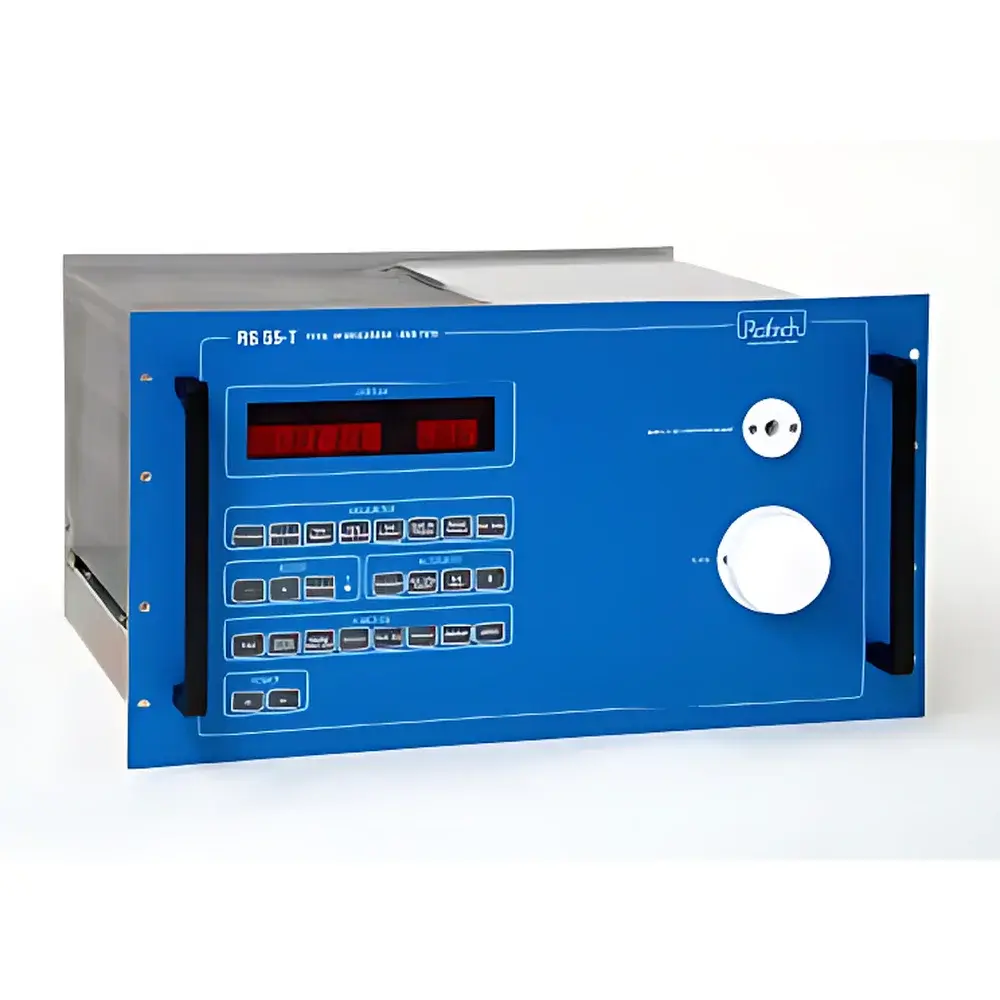
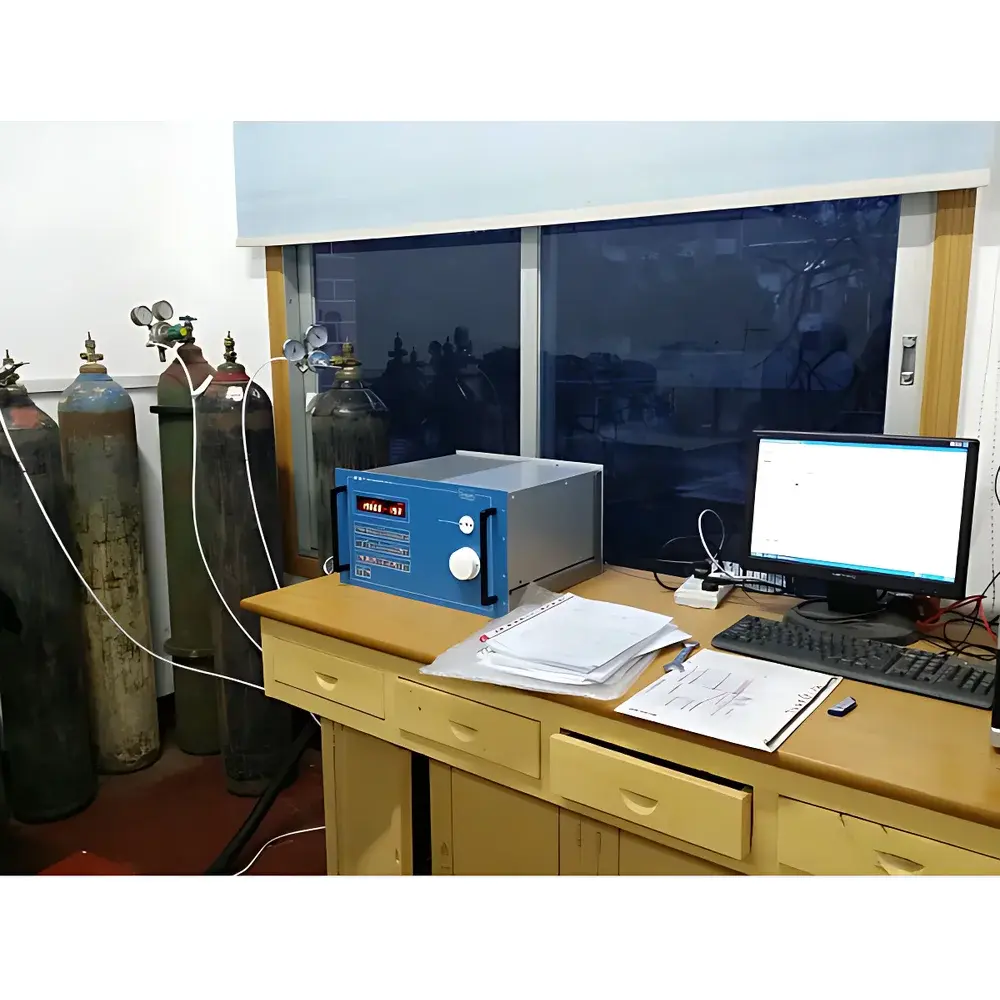
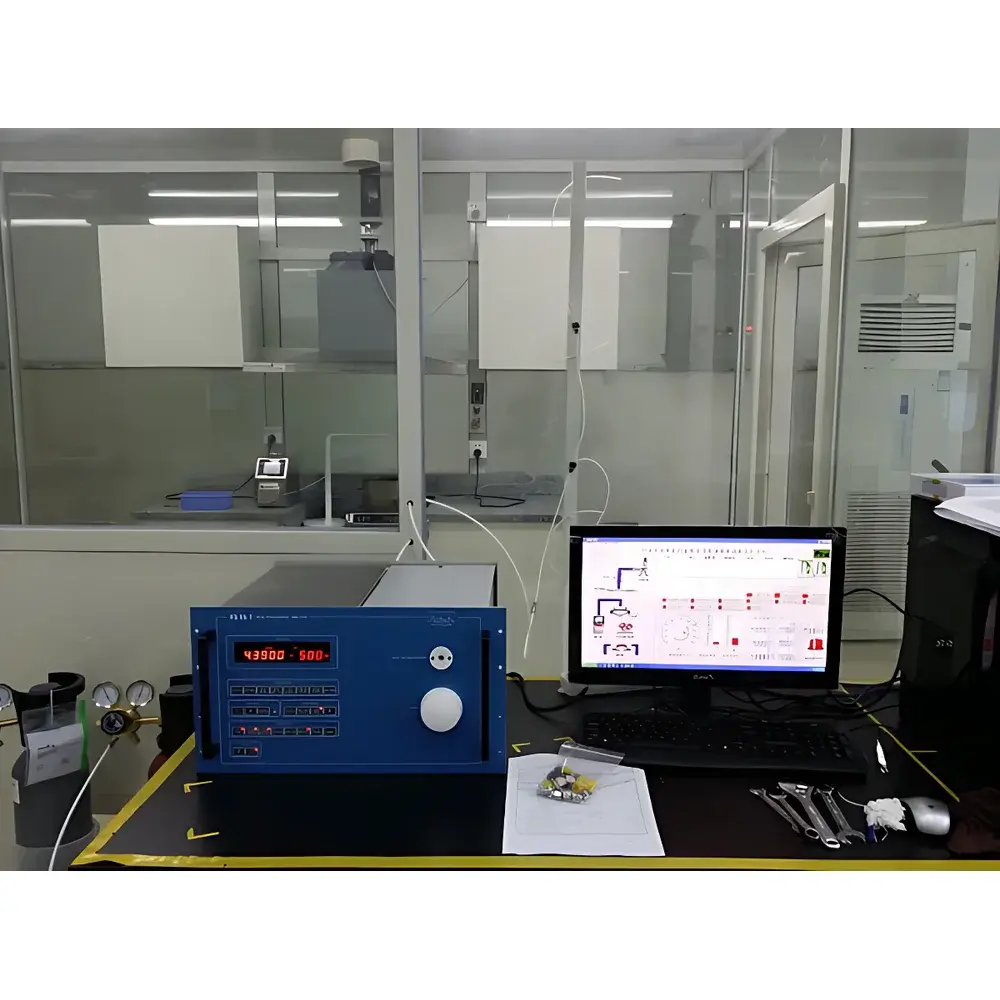
Ratfisch RS55-T Odor Reduction Efficiency Analyzer
| Brand | Ratfisch |
|---|---|
| Origin | Germany |
| Model | RS 55-T |
| Instrument Type | Online Analyzer |
| Typical Configuration | TVOC Analyzer |
| Measurement Principle | Catalytic Combustion (Catalytic Bead) with Propane Calibration |
| Range | 0–10 / 100 / 1,000 / 10,000 / 100,000 ppm (propane) |
| Linearity | ±2% of full scale (up to 10,000 ppm) |
| Cross-Sensitivity | ±2% of full scale @ O₂ |
| Detection Limit | <2% of lowest full-scale range |
| Zero Drift | <2% FS/week |
| Span Drift | <4% FS/week |
| Response Time (T₉₀) | ~1–2 s (without sampling line) |
| Sample Flow Rate | ~220 L/h |
| Output Signals | 0–10 V or 0/4–20 mA |
| Alarm Contacts | Pre-alarm, Main Alarm, Range Identification, Flame-Out Indication, Status Recognition (Zero Gas, Calibration Gas), Pressure/Temperature/Flame Monitoring |
| Operating Ambient Temperature | +5 °C to +35 °C |
| Power Supply | 230 V / 50 Hz, 800 W |
| Dimensions (W×H×D) | 483 mm × 267 mm × 500 mm (19″ rack-mountable) |
| Weight | ~26.5 kg |
| Certification | TÜV-certified per German 17. BImSchV |
| Regulatory Compliance | EPA-compliant methodology for odor reduction quantification |
Overview
The Ratfisch RS55-T Odor Reduction Efficiency Analyzer is an online catalytic combustion-based gas analyzer engineered for quantitative assessment of transient and steady-state odor reduction performance in residential and commercial kitchen ventilation systems. Designed specifically for R&D laboratories of range hood manufacturers, the RS55-T implements a flame-ionization-adjacent detection principle—catalytic bead combustion—calibrated against propane as a representative volatile organic compound (VOC) surrogate. Its core function is to determine odor reduction efficiency (ORE) as defined by DIN EN 16636 and aligned with German 17. BImSchV regulatory requirements for odor emission control. The instrument operates via continuous sampling of exhaust air streams under controlled thermal conditions, enabling real-time evaluation of odor abatement efficacy across dynamic airflow profiles and cooking cycle simulations.
Key Features
- Heated analysis chamber with adjustable temperature up to 200 °C—ensures consistent vapor-phase stability of semi-volatile compounds and prevents condensation-related measurement artifacts.
- Auto-ranging capability with five selectable full-scale ranges (0–10 ppm to 0–100,000 ppm propane), configurable via front-panel interface or remote command protocol.
- Integrated safety monitoring: automatic flame extinction detection, fuel shutoff logic, and real-time supervision of chamber temperature, sample pressure, and catalytic flame integrity.
- Rack-mountable 19″ industrial enclosure (483 mm × 267 mm × 500 mm) compliant with IEC 60297-3-100 mechanical standards; designed for integration into automated test benches or permanent installation in HVAC validation labs.
- Optional accessories include heated sample lines (to prevent adsorption losses), particulate pre-filters (for high-dust kitchen exhaust), built-in zero-air and combustion air supply modules, and automated calibration sequencers.
- Dual analog output (0–10 V and 4–20 mA) with isolated status relay contacts for alarm signaling—including pre-alarm, main alarm, range identification, flame-out, and diagnostic states (e.g., zero-gas delivery active, span gas verification in progress).
Sample Compatibility & Compliance
The RS55-T is validated for use with complex, humid, and thermally variable exhaust matrices typical of domestic kitchen environments. It maintains measurement fidelity across total VOC (TVOC) loadings dominated by aldehydes (e.g., acrolein), ketones (e.g., acetone), esters (e.g., ethyl acetate), and short-chain hydrocarbons—compounds whose collective sensory impact correlates strongly with propane-equivalent response under catalytic oxidation. The analyzer meets TÜV certification criteria per German Technical Instructions on Air Quality Control (17. BImSchV), and its measurement methodology conforms to U.S. EPA Method TO-15 and ASTM D6196-22 frameworks for VOC quantification in source testing applications. While not a GLP/GMP-grade system, its data traceability supports ISO/IEC 17025-accredited laboratory workflows when paired with optional audit-ready data acquisition software featuring time-stamped event logging and user-access controls.
Software & Data Management
An optional Windows-based data acquisition suite enables synchronized timestamping of ORE metrics with auxiliary sensor inputs (e.g., airflow velocity, fan RPM, temperature gradients). The software supports configurable averaging intervals (1–60 seconds), statistical reporting (min/max/mean/stdev per test phase), and export to CSV or Excel-compatible formats. All calibration events—including zero/span verification, manual range changes, and system diagnostics—are logged with operator ID, timestamp, and result pass/fail status. When deployed in regulated environments, the software optionally complies with FDA 21 CFR Part 11 requirements through electronic signature enforcement, audit trail retention (>18 months), and role-based access permissions.
Applications
- Quantitative odor reduction testing of range hoods per DIN EN 16636 Annex C and IEC 61591:2021 test protocols.
- Development and validation of activated carbon filters, plasma-assisted oxidation modules, and photocatalytic reactors used in residential air cleaning systems.
- Long-term stability assessment of catalytic sensors under repeated thermal cycling (e.g., 25–200 °C ramp profiles simulating cooktop duty cycles).
- Source characterization of cooking emissions during standardized test meals (e.g., frying bacon, boiling onions, stir-frying vegetables) in climate-controlled test kitchens.
- Support for CE marking documentation and technical files demonstrating conformity with EU Directive 2014/30/EU (EMC) and 2014/35/EU (LVD).
FAQ
What gases does the RS55-T detect, and how is selectivity ensured?
The RS55-T responds to combustible VOCs via catalytic oxidation on a heated bead sensor. It is calibrated to propane, but provides proportional response to most hydrocarbons and oxygenated VOCs. Selectivity is managed through thermal conditioning (200 °C chamber), cross-sensitivity compensation algorithms, and optional前置 filtration to exclude inorganic interferents (e.g., H₂S, NH₃).
Can the RS55-T be integrated into an automated test rig?
Yes—the device features Modbus RTU over RS-485, analog outputs, and dry-contact relays compatible with PLC-based control systems. Optional software SDK supports TCP/IP communication for custom LabVIEW or Python-based orchestration.
Is field calibration possible without external gas cylinders?
Manual zero calibration using ambient air is supported. Full span calibration requires certified propane standard gas; however, the optional auto-calibration module integrates internal zero-air generation and solenoid-controlled span gas injection for unattended recalibration at user-defined intervals.
How does the RS55-T handle high-humidity kitchen exhaust samples?
The heated sample path (standard or optional heated line) maintains dew point margin above operating temperature, minimizing condensation. An integrated water trap and coalescing filter are recommended for sustained operation above 85% RH.
What maintenance schedule is recommended for long-term reliability?
Sensor bead replacement every 12–18 months under continuous operation; quarterly verification of zero/span drift; annual inspection of combustion air filter, flame nozzle, and thermal insulation integrity. Full service documentation and spare parts kits are available directly from Ratfisch’s European service network.
Related Products







