
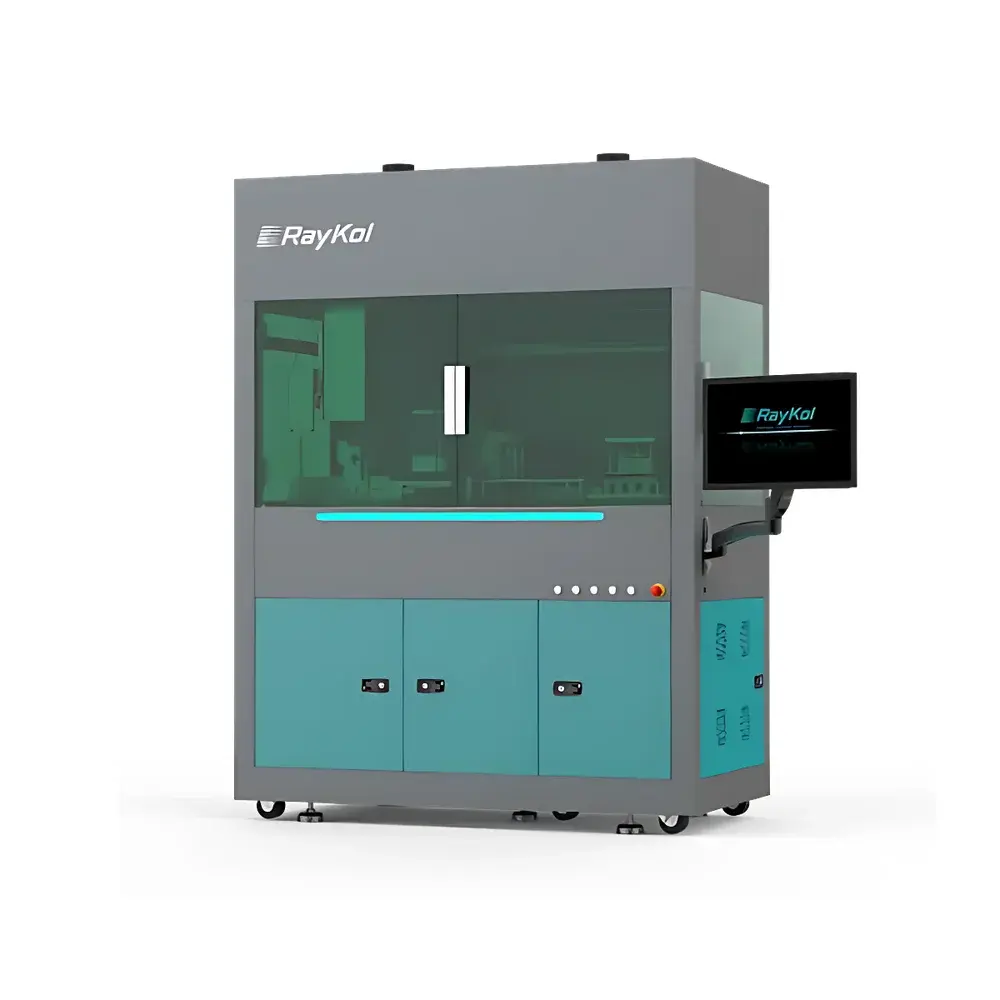
Raykol DRQ Automated QuEChERS Sample Preparation Workstation
| Brand | Raykol |
|---|---|
| Origin | Guangdong, China |
| Manufacturer Type | Original Equipment Manufacturer (OEM) |
| Country of Origin | China |
| Model | DRQ |
| Pricing | Available Upon Request |
Overview
The Raykol DRQ Automated QuEChERS Sample Preparation Workstation is an integrated, benchtop platform engineered for precision, reproducibility, and safety in high-throughput pesticide residue analysis. Built upon the standardized QuEChERS (Quick, Easy, Cheap, Effective, Rugged, Safe) methodology, the DRQ automates the full sequence of sample preparation steps—including solvent addition, homogenizer bead dispensing, extraction, dispersive solid-phase extraction (d-SPE) cleanup, and fractionated transfer—without manual intervention. Unlike semi-automated or modular systems, the DRQ implements closed-loop motion control and synchronized actuation to maintain strict adherence to method-defined timing, mixing intensity, temperature constraints, and volumetric accuracy. Its design directly addresses critical pain points in regulatory-compliant residue testing: operator variability, exposure to hazardous solvents (e.g., acetonitrile, acetone), thermal degradation of thermolabile analytes during salt-induced exothermic reactions, and inter-batch inconsistency in recovery and precision.
Key Features
- Pendulum Oscillation Module: Delivers high-amplitude, high-frequency mechanical agitation (up to 1,200 oscillations/min) to maximize mass transfer during extraction and d-SPE, ensuring uniform contact between sample matrix, solvent, and sorbent.
- Integrated Water-Jacketed Cooling System: Maintains sample temperature below 15 °C throughout extraction and cleanup phases, mitigating analyte degradation caused by heat generated from MgSO₄ hydration exotherms.
- Independent Homogenizer Bead Dispensing Unit: Programmable bead count (1–6 per vial) and bead type selection (e.g., stainless steel, ceramic) accommodate heterogeneous matrices such as leafy greens, dried herbs, tobacco, and root tissues.
- Dual-Mode Liquid Handling: High-accuracy positive-displacement pipetting (±0.8% CV at 100 µL) with real-time liquid level sensing prevents clogging and solid carryover; supports both fixed-needle aspiration and disposable tip-based transfer.
- Modular Salt Dispensing System: Individual, sealed salt reservoirs allow concurrent use of different QuEChERS buffer formulations (e.g., AOAC, EN 15662, CIT) within a single run—critical for multi-matrix studies involving fruits, cereals, and medicinal plants.
- Adaptable Centrifugation Integration: Compatible with horizontal centrifuges accepting both 15 mL and 50 mL conical tubes; rotor speed (1,000–4,500 rpm) and dwell time are fully programmable via workstation software.
Sample Compatibility & Compliance
The DRQ supports diverse biological matrices requiring QuEChERS-based cleanup prior to GC-MS/MS or LC-MS/MS analysis—including fresh and dried plant tissues, herbal medicines, tea leaves, tobacco, and botanical dietary supplements. It complies with method requirements specified in Chinese Pharmacopoeia (ChP) 2020 Edition, General Chapter 2341 (Method V), GB 23200.113–2018, and GB 23200.121–2021. All fluidic pathways are chemically resistant to organic solvents and acidic/basic buffers. The system architecture enables full audit trail generation (user actions, timestamps, parameter logs), supporting GLP and GMP environments aligned with FDA 21 CFR Part 11 principles when paired with validated LIMS integration.
Software & Data Management
The DRQ operates under Raykol’s proprietary QuEChERS Workflow Manager™ software—a Windows-based interface enabling method creation, batch scheduling, real-time monitoring, and electronic record retention. Each method stores complete parameter sets: reagent volumes, oscillation profiles, cooling setpoints, centrifugation protocols, and bead configurations. Export formats include CSV and XML for traceability; raw log files include instrument status codes, error flags, and sensor diagnostics. Software validation packages (IQ/OQ/PQ documentation templates) are available for regulated laboratories.
Applications
- Routine pesticide multiresidue screening in food safety laboratories performing >50 samples/day
- Reference labs conducting method validation per ISO/IEC 17025:2017 for QuEChERS-based workflows
- Pharmaceutical QC labs analyzing pesticide contamination in traditional Chinese medicine (TCM) raw materials
- Research institutions developing matrix-matched calibration strategies for complex botanical extracts
- Contract testing organizations requiring 21 CFR Part 11–compliant electronic records for regulatory submissions
FAQ
Does the DRQ support method customization beyond standard QuEChERS protocols?
Yes—users can define custom oscillation durations, temperature ramps, multi-step solvent additions, and conditional logic (e.g., “if sample weight >5 g, add 2 extra beads”).
Can the system handle viscous or fibrous samples such as ginger root or ginseng powder?
Yes—the independent homogenizer bead module allows dynamic adjustment of bead quantity and material, while the pendulum oscillator maintains consistent energy input across variable rheologies.
Is remote monitoring or integration with laboratory information management systems (LIMS) possible?
The DRQ provides OPC UA and RESTful API interfaces for bidirectional data exchange with major LIMS platforms and centralized lab monitoring dashboards.
What maintenance is required for long-term operational stability?
Scheduled quarterly calibration of pipetting accuracy and annual verification of temperature uniformity across the water bath chamber are recommended; no consumables beyond standard QuEChERS kits are required.



