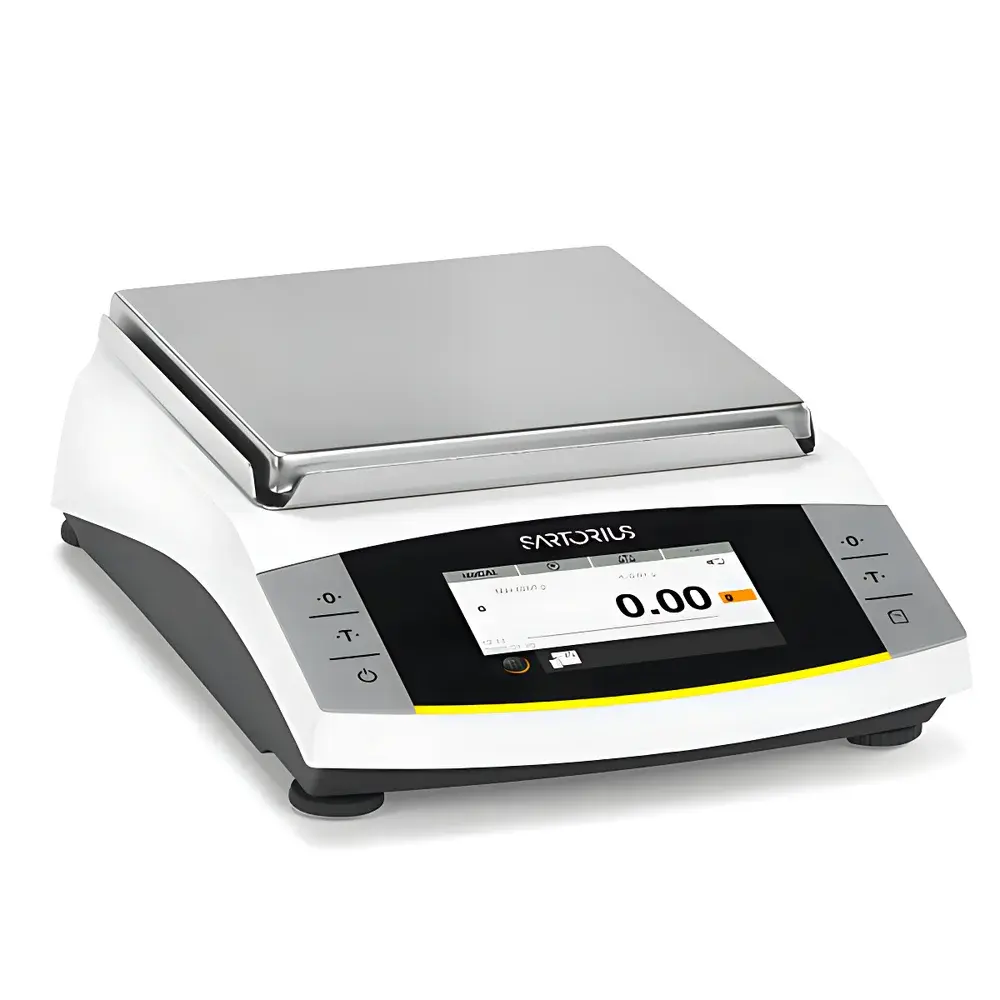
Sartorius BCA2202i-1OCN Precision Balance
| Key | Brand: Sartorius |
|---|---|
| Origin | Shanghai, China |
| Model | BCA2202i-1OCN |
| Type | Precision Balance |
| Max Capacity | 2200 g |
| Readability | 10 mg |
| Repeatability | ≤ ±10 mg |
| Calibration | Internal (isoCAL) |
| Pan Size | Rectangular |
| Compliance | GLP/GMP-compliant data output, CalAuditTrail, ISO/IEC 17025-supportive operation |
| Connectivity | Dual USB-C, RS-232 (9-pin), optional printer/U-disk interface |
| Display | Graphical touchscreen with LED backlight |
| Languages | 13 built-in (including English, German, French, Spanish, Chinese, Japanese, Korean, etc.) |
| User Management | Up to 10 user profiles with multi-level password protection |
Overview
The Sartorius BCA2202i-1OCN is a high-reliability precision balance engineered for routine laboratory and quality control environments where consistent 10 mg readability, operational traceability, and regulatory compliance are essential. Based on the Entris® II platform—designed and validated in accordance with Sartorius’ global quality system—the BCA2202i-1OCN integrates German-engineered sensor architecture with application-specific firmware to deliver stable, reproducible mass measurements across demanding workflows. Its core transduction principle relies on electromagnetic force compensation (EMFC) technology, ensuring linearity, minimal drift, and immunity to environmental thermal gradients typical of general-purpose lab settings. With a maximum capacity of 2200 g and a readability of 10 mg (0.01 g), it meets the definition of a Class II precision balance per OIML R 76 and ASTM E898–22 standards. The unit is manufactured in Shanghai under Sartorius’ licensed production agreement and conforms to the same design, testing, and calibration protocols applied to instruments assembled in Germany.
Key Features
- isoCAL™ fully automatic internal calibration and adjustment—triggered by time intervals or temperature fluctuations (±1.5 °C), eliminating manual recalibration and supporting SOP-driven operation.
- Real-time level monitoring with interactive on-screen guidance: integrated electronic inclinometer detects tilt >0.5°, displays visual alerts, and walks users through leveling via adjustable feet.
- CalAuditTrail™: automatically logs all calibration events—including date/time, operator ID (if assigned), calibration weights used, deviation values, and pass/fail status—exportable as PDF or CSV for audit readiness.
- Robust mechanical architecture: stainless steel weighing pan, PBT polymer housing, and coated tempered glass draft shield resist chemical splashes, abrasion, and static-induced measurement artifacts.
- Large-volume weighing chamber with top/side sliding doors and full draft shield removal—enabling seamless handling of tall containers, reaction vessels, or irregularly shaped samples up to 2200 g.
- Dual USB-C ports: one dedicated to host PC/data export (e.g., weight streams, calibration reports), the other supporting U-disk storage, direct printer connection, or firmware updates—ensuring long-term interoperability without legacy adapter dependency.
Sample Compatibility & Compliance
The BCA2202i-1OCN accommodates a broad range of sample forms—from powders and granules to liquids in beakers or flasks—and supports below-pan weighing via integrated lower hook (optional accessory). Its rectangular pan (approx. 180 × 180 mm) provides ample surface area for volumetric containers and multi-step preparation tasks. All firmware operations comply with Good Laboratory Practice (GLP) and Good Manufacturing Practice (GMP) documentation requirements: timestamps are hardware-generated and non-editable; user access is controlled via role-based authentication (up to 10 profiles); and all critical events—including zeroing, taring, calibration, and data export—are immutably recorded in internal memory. Data output formats meet FDA 21 CFR Part 11 Annex 11 expectations for electronic records when paired with compliant LIMS or ELN systems. The balance is CE-marked and conforms to EN ISO 9001, EN ISO/IEC 17025:2017 (for calibration laboratories), and USP accuracy verification criteria.
Software & Data Management
No proprietary software installation is required: the balance operates autonomously with embedded firmware supporting 13 preconfigured weighing applications—including parts counting, percentage weighing, density determination (with optional kit), animal weighing, statistical analysis (n ≥ 2, SD, CV%), peak hold, checkweighing, and unit conversion. All results—including raw weight values, metadata (operator, timestamp, method ID), and calibration history—can be exported in real time via RS-232 or USB-C to spreadsheets, databases, or enterprise QA systems. Eight printing templates are configurable per application, enabling standardized label generation (e.g., batch ID + net weight + operator signature). Audit-ready reports include CalAuditTrail summaries, GLP headers, and digital signatures when used with authorized printers. Firmware updates are delivered via encrypted .bin files loaded from U-disk—fully traceable and version-controlled.
Applications
This balance serves as a primary mass measurement tool in pharmaceutical QC labs (raw material receipt, formulation checks, stability study sample prep), academic research facilities (reagent dispensing, gravimetric titration, catalyst loading), food safety testing (moisture content, additive dosing), and industrial R&D (polymer blending, battery electrode coating mass verification). Its 10 mg readability and ≤±10 mg repeatability make it suitable for ISO 17025-accredited testing where uncertainty budgets must remain below 0.5% relative standard deviation at 200 g load. The integrated draft shield and anti-static glass minimize electrostatic interference during low-mass powder handling—a common challenge in API processing. Optional accessories include printer kits, connectivity modules for Ethernet/WiFi gateways, and validation kits for IQ/OQ/PQ documentation.
FAQ
What does “1%” in the product description refer to?
It denotes readability of 10 mg (0.01 g) at full scale—equivalent to 0.001% of 2200 g—not measurement uncertainty. Accuracy specifications follow OIML R 76 Class II tolerances.
Is isoCAL compatible with external temperature sensors?
No—isoCAL uses the balance’s internal thermistor array; no external probe integration is supported.
Can CalAuditTrail data be exported without a PC connection?
Yes—via USB-C to U-disk in CSV or PDF format, including digital signature fields for reviewer approval.
Does the balance support dynamic weighing (e.g., filling operations)?
Yes—through the “Fill Level” and “Net Total” applications, with programmable stabilization delay and auto-tare triggers.
Is the firmware validated for 21 CFR Part 11 compliance?
The device supports Part 11 controls (audit trail, electronic signatures, role-based access); formal validation remains the responsibility of the end-user per their QMS.