
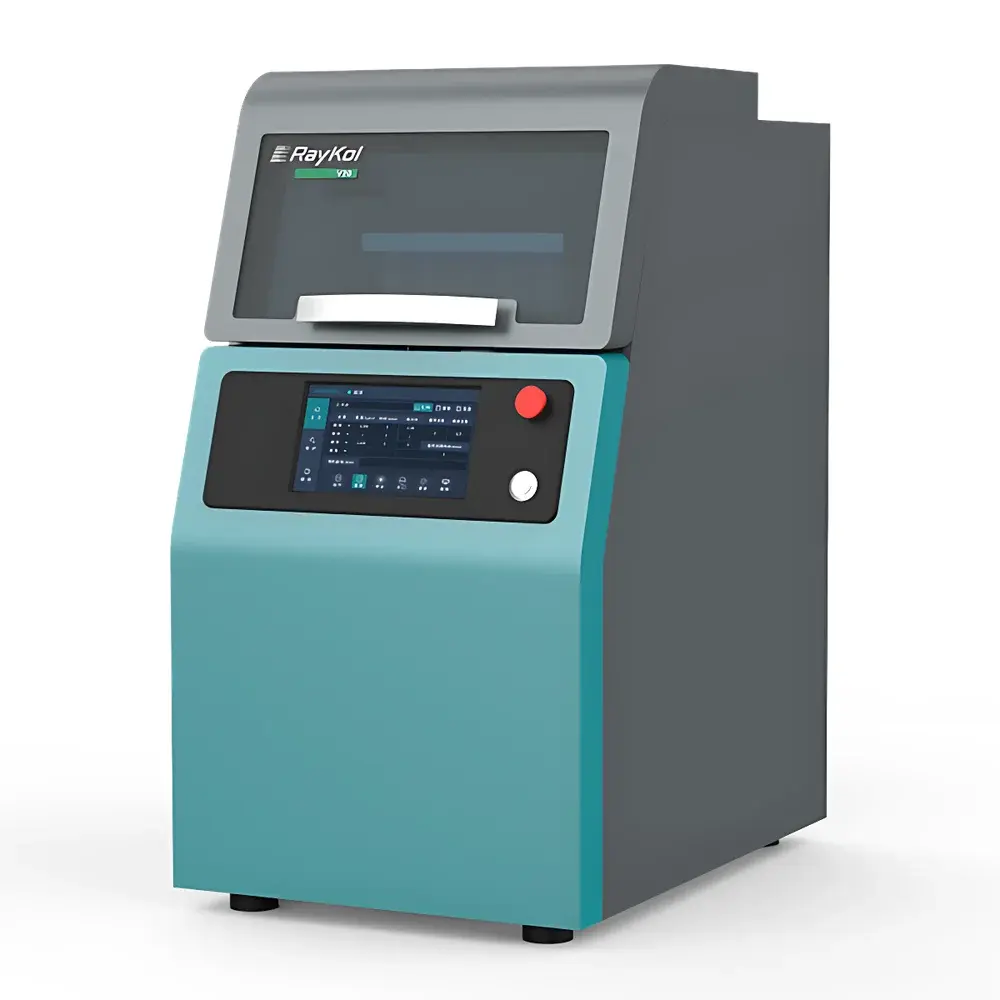
Raykol V20 Vertical Orbital Shaker
| Brand | Raykol |
|---|---|
| Origin | Fujian, China |
| Manufacturer Type | Direct Manufacturer |
| Country of Origin | China |
| Model | V20 |
| Price Range | USD 9,800 – 27,800 (FOB) |
| Operation Mode | Continuous Vibration |
| Speed Range | 100–1800 rpm |
| Vibration Orientation | Vertical |
| Display | Full-Color Touchscreen Interface |
Overview
The Raykol V20 Vertical Orbital Shaker is an engineered laboratory shaker designed for high-throughput, reproducible sample homogenization, cell lysis, tissue disruption, and QuEChERS-based extraction workflows. Unlike conventional horizontal vortex mixers or orbital shakers, the V20 employs a precisely controlled vertical oscillation motion—characterized by a fixed-axis, sinusoidal displacement perpendicular to the bench surface—enabling uniform energy transfer across multi-well plates, deep-well blocks, and conical tubes without cross-contamination or splashing. Its mechanical architecture integrates a brushless DC motor with closed-loop speed feedback control, ensuring ±2 rpm speed stability across the full 100–1800 rpm range under variable load conditions. The device is optimized for routine use in regulated analytical laboratories where consistency, traceability, and method compliance are critical—particularly in food safety testing, pharmaceutical QC, and molecular biology sample preparation.
Key Features
- High-throughput capacity: Supports simultaneous processing of up to 576 samples per run using standardized 96-well plate carriers or customizable deep-well rack configurations.
- Vertical oscillation mechanism: Delivers consistent shear force distribution ideal for fragile biological matrices (e.g., plant leaves, animal liver, seed tissues) and viscous QuEChERS extracts.
- Safety-integrated design: Equipped with electromagnetic door interlock—motor halts immediately upon lid opening—and auto-restart prevention until manual reset.
- Intuitive human-machine interface: 7-inch full-color capacitive touchscreen displays real-time speed, elapsed time, remaining time, and active protocol ID; supports multi-language UI (English, Spanish, French, Chinese).
- Programmable operation: Enables up to 9-step multi-segment protocols with independent speed/time settings per segment; includes delayed start, cycle repeat, and pause/resume functionality.
- Optimized visibility and monitoring: Front-facing transparent polycarbonate window with integrated LED illumination (5000 K CCT, 150 lux at sample level) allows unobstructed observation during operation without interrupting vibration.
Sample Compatibility & Compliance
The V20 accommodates a broad range of container formats—including 0.2–50 mL tubes, 96-well PCR plates, 24- and 48-deep-well blocks, and custom aluminum or polypropylene racks—via interchangeable platform inserts. All contact surfaces are constructed from electropolished 316 stainless steel and chemical-resistant PTFE-coated components, compliant with ISO 13485 cleanroom-grade material specifications. The system meets IEC 61010-1:2010 safety requirements for laboratory electrical equipment and supports GLP/GMP documentation through optional audit-trail-enabled firmware (v3.2+). It is routinely validated for use in methods aligned with AOAC Official Method 2007.01, EN 15662:2018, and US EPA Method 8270D, particularly in pesticide residue analysis per GB 23200.110–23200.121, GB 31660.8–31660.9, and GB 31658.6.
Software & Data Management
The V20 operates natively on embedded Linux-based firmware with local protocol storage (≥200 user-defined methods). Optional Ethernet/Wi-Fi connectivity enables integration into LIMS environments via TCP/IP or MODBUS RTU protocols. When paired with Raykol’s LabLink Suite (v2.4), users gain remote scheduling, electronic signature support (21 CFR Part 11 compliant), automatic log export (CSV/Excel), and real-time deviation alerts. All operational logs—including timestamped speed deviations >±3 rpm, door open events, and thermal shutdowns—are retained for ≥12 months with SHA-256 hash integrity verification.
Applications
- Food safety: QuEChERS extraction of pesticide residues from fruits, vegetables, grains, and animal-derived matrices prior to LC-MS/MS or GC-MS analysis.
- Pharmaceutical QA/QC: Rapid homogenization of herbal materials for residual solvent screening and mycotoxin extraction per Chinese Pharmacopoeia General Chapter 2341.
- Life sciences: Mechanical lysis of mammalian cells, plant tissues, and microbial pellets for downstream nucleic acid isolation (e.g., RNA integrity preservation in leaf samples).
- Environmental testing: Soil and sediment homogenization for amide herbicide analysis (NY/T 3835-2021) and heavy metal leaching studies.
- Clinical research: Uniform mixing of whole blood, plasma, or serum aliquots prior to biomarker quantification assays.
FAQ
What is the maximum load capacity per run, and how is balance maintained across high-density racks?
The V20 supports up to 4 kg total mass per platform when evenly distributed; dynamic imbalance detection triggers automatic deceleration if RMS acceleration exceeds 0.8 g.
Does the device support validation documentation (IQ/OQ/PQ) and calibration certificates?
Yes—Raykol provides factory-issued OQ reports traceable to NIST standards; PQ templates and calibration SOPs are included with the instrument qualification package.
Can the V20 be integrated into automated sample preparation lines?
It features dual RS-485 ports and dry-contact I/O terminals for synchronization with robotic arms, liquid handlers, and track-based systems.
Is the touchscreen interface compatible with gloved operation in biosafety cabinets?
Yes—the capacitive screen responds reliably to standard nitrile and latex gloves; haptic feedback and audio cues are configurable.
What maintenance intervals are recommended for long-term reliability?
Brushless motor requires no scheduled maintenance; annual verification of door interlock function and speed accuracy (using certified tachometer) is advised per ISO/IEC 17025 guidelines.



