
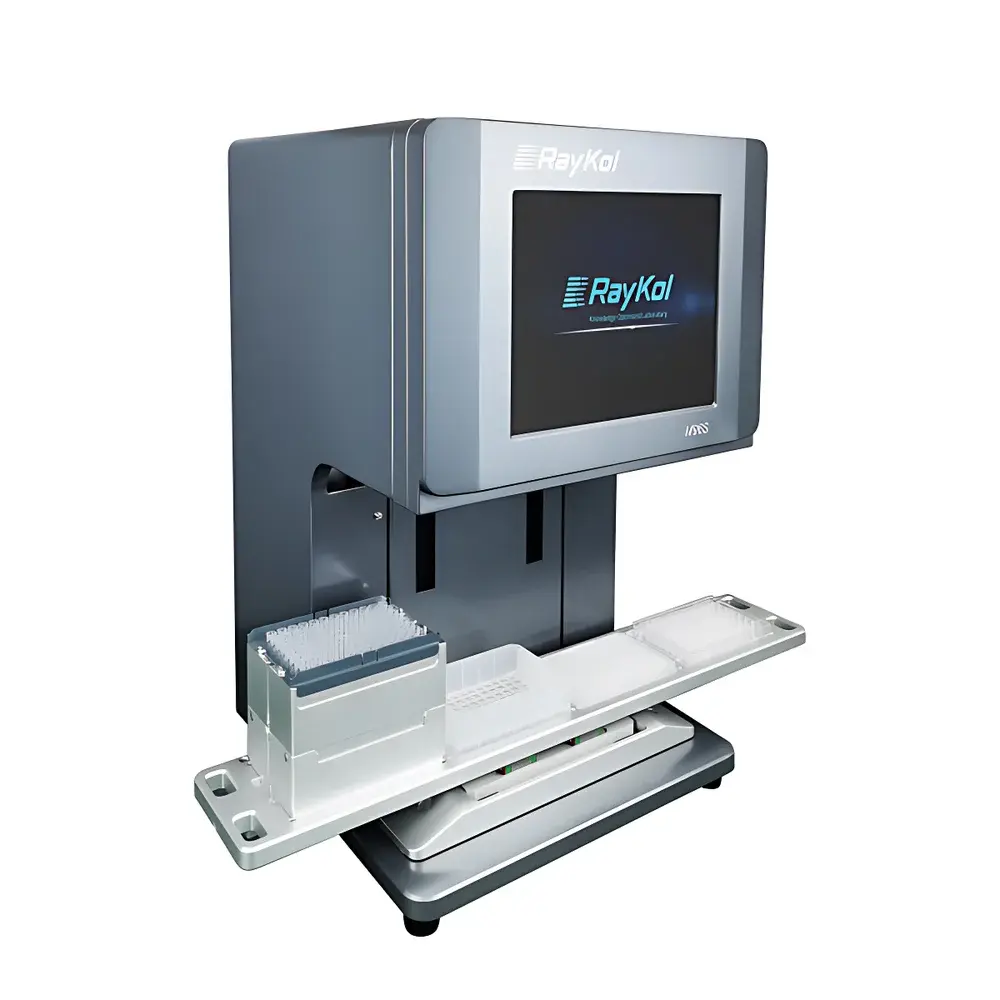
Raykol Vitae M96S 96-Channel Fully Automated Liquid Handling Workstation
| Brand | Raykol |
|---|---|
| Origin | Fujian, China |
| Manufacturer Type | Authorized Distributor |
| Country of Origin | China |
| Model | Vitae M96S |
| Plate Positions | 4 |
| Pipetting Precision | CV ≤ 0.5% |
| Pipetting Range | 0.5–1000 µL (with three interchangeable pump modules) |
| Throughput | 1–96 or 1–384 samples per run |
| Dimensions (W×D×H) | 650 × 352 × 540 mm |
Overview
The Raykol Vitae M96S is a high-precision, 96-channel fully automated liquid handling workstation engineered for reproducible, walk-away processing of microplate-based assays in regulated and research laboratory environments. Built upon positive-displacement pipetting architecture with motorized Z-axis control and independent channel calibration, the system delivers traceable volumetric accuracy across its full operational range—critical for applications demanding strict adherence to GLP, GMP, and ISO/IEC 17025 quality frameworks. Its modular pump design supports three distinct volume ranges (0.5–30 µL, 2.5–200 µL, and 20–1000 µL), enabling seamless adaptation to low-volume assay development and high-volume sample preparation without hardware reconfiguration. The workstation operates on an open SBS-compliant deck layout, facilitating integration with third-party labware—including deep-well plates, PCR strips, reservoirs, and assay-specific consumables—while maintaining compatibility with standard biosafety cabinets and laminar flow hoods due to its compact footprint.
Key Features
- Four independently programmable plate positions support unattended workflow execution, minimizing manual intervention during tip loading, reagent replenishment, and plate staging.
- Three user-swappable positive-displacement pipetting modules ensure optimal accuracy and carryover control across low-, mid-, and high-volume transfer tasks.
- Advanced liquid handling modes include single dispense, continuous dispensing, air-gap aspiration, reverse pipetting, suspended dispensing, and multi-cycle mixing via controlled blow-out and aspiration cycles.
- Integrated 10.1-inch capacitive touchscreen interface provides intuitive drag-and-drop protocol building, real-time status monitoring, and on-device method validation—no external PC required for routine operation.
- Robust mechanical architecture features stepper-motor-driven X-Y-Z motion control with optical position feedback, ensuring long-term repeatability and positional fidelity within ±0.1 mm.
- Compliance-ready audit trail logging captures all user actions, parameter changes, and system events with timestamped records, supporting FDA 21 CFR Part 11 compliance when deployed with networked authentication and electronic signature modules.
Sample Compatibility & Compliance
The Vitae M96S accommodates standard SBS-format microplates (96-well, 384-well, and custom formats), tube racks, and reservoirs up to 120 mL capacity. It supports both sterile and non-sterile workflows, with optional UV-C decontamination cycles for tip ejector and deck surfaces. The system meets IEC 61000-6-2 (EMC immunity) and IEC 61000-6-4 (EMC emission) standards. While not certified as Class II medical device under EU MDR or FDA 510(k), it is routinely deployed in CLIA-certified laboratories, ISO 15189-accredited clinical testing facilities, and pharmaceutical QC labs where instrument qualification (IQ/OQ/PQ) is performed per ASTM E2500 and USP . All pipetting performance data are traceable to NIST-traceable gravimetric standards.
Software & Data Management
The embedded VitaeControl software enables protocol creation via visual workflow editor or import from CSV/Excel templates. Method files include embedded calibration coefficients, error-handling logic (e.g., liquid level detection timeout, tip clog recognition), and conditional branching. Raw operation logs export in .csv format; metadata-rich JSON exports are available for LIMS integration. Optional VitaeLink middleware supports HL7 and RESTful API connectivity to enterprise systems including LabVantage, Thermo Fisher SampleManager, and Agilent OpenLab ECM. Audit trails are encrypted and write-protected, with configurable retention policies aligned with 21 CFR Part 11 requirements for electronic records and signatures.
Applications
- Clinical Diagnostics: ELISA setup, serum dilution series, PBMC isolation workflows, and nucleic acid extraction pre-aliquoting in biobanking operations.
- Drug Discovery: Compound library plating, CYP450 metabolic stability assays, cytotoxicity screening (e.g., MTT, CellTiter-Glo), and ADME-Tox plate formatting.
- Molecular Biology: qPCR master mix preparation, NGS library normalization, CRISPR guide RNA complex assembly, and digital PCR droplet generation support.
- Quality Control: Reference standard dilution, impurity spike recovery testing, and stability-indicating assay prep in pharmaceutical manufacturing environments.
- Public Health Testing: High-throughput pathogen screening (e.g., SARS-CoV-2 RT-qPCR setup), food allergen testing, and environmental toxin quantification in CDC and FAO-accredited labs.
FAQ
What pipette tips are compatible with the Vitae M96S?
The system accepts universal-fit, low-retention, filtered tips conforming to ANSI/SBS standards (e.g., 96-well tip boxes with 0.5–1000 µL capacity). Tip compatibility is verified per module specification; no proprietary tip requirement exists.
Can the Vitae M96S be integrated into a robotic arm–based automation ecosystem?
Yes—the workstation includes RS-232, USB Device, and Ethernet interfaces with Modbus TCP and custom ASCII command protocols for integration with third-party robotic handlers and scheduling engines.
Is calibration documentation provided with the instrument?
Each unit ships with factory calibration certificates covering positional accuracy, pipetting precision (CV ≤ 0.5% at specified volumes), and temperature stability of the onboard electronics. Full IQ/OQ documentation kits are available upon request.
Does the system support barcode scanning for plate tracking?
An optional 2D barcode reader module can be mounted on the gantry, enabling automatic plate identification, lot traceability, and LIMS synchronization during run initiation.
How frequently must the pipetting modules be recalibrated?
Raykol recommends recalibration every six months or after 10,000 pipetting cycles—whichever occurs first—using the included gravimetric verification kit and VitaeCal software module.



