
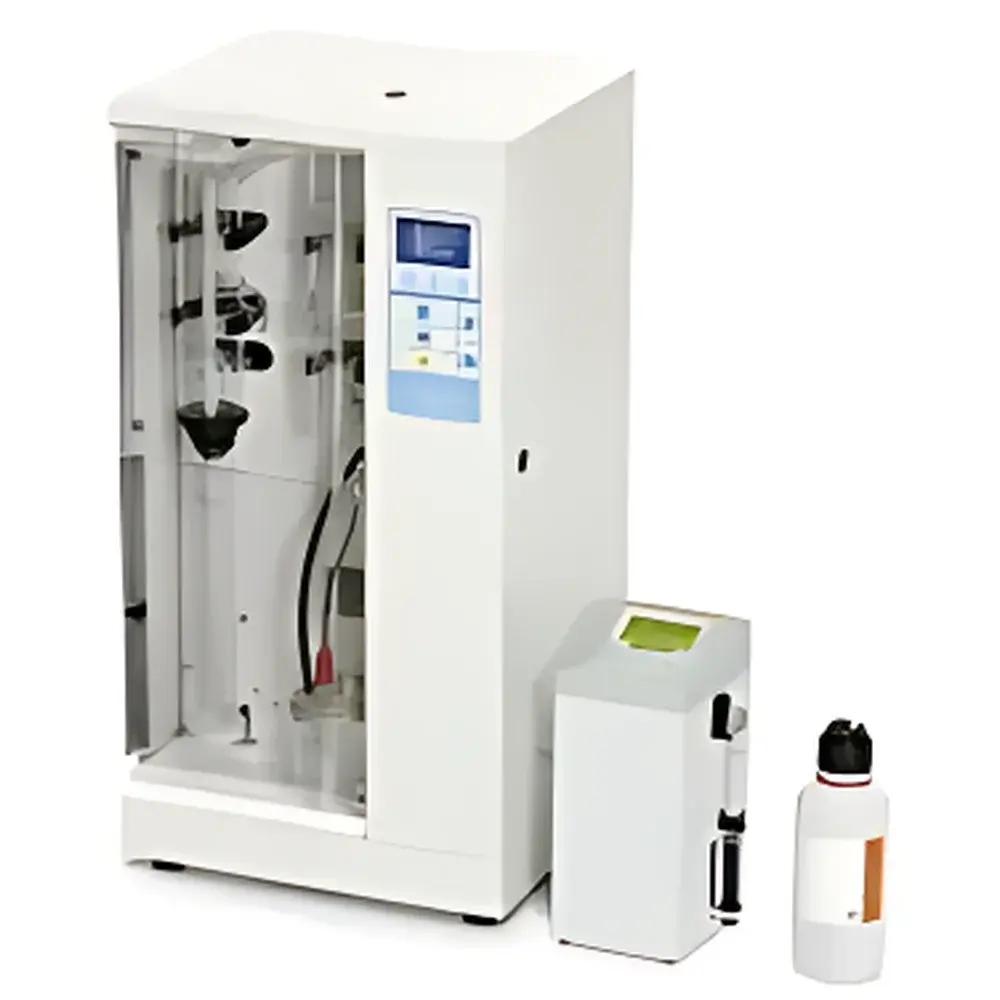
Raypa DNP-3000 Kjeldahl Distillation Unit
| Brand | Raypa |
|---|---|
| Origin | Spain |
| Model | DNP-3000 |
| Instrument Type | Quartz Glass Kjeldahl Distillation Apparatus |
| Nitrogen Measurement Range | 0.1–200 mg |
| Recovery Rate | 99.5% |
| Repeatability | ±1% |
| Distillation Time (100 mL) | 4 min |
| Cooling Water Consumption | 70 L/h |
| Power Rating | 2000 W |
| Programmable Parameters | Dilution Water (0–200 mL), NaOH Volume (0–200 mL), H₃BO₃ Volume (0–200 mL), Reaction Time (0–30 min), Digestion Time (0–30 min), Steam Intensity (30–100%) |
| Titration Resolution | 0.01 pH, 1 mV, 0.1 °C |
| Temperature Compensation | CAT Pt100 probe |
| Predefined Programs | 3 fixed + 20 user-definable |
| Safety Features | Open-tube detection, digestion tube presence sensor, overtemperature cut-off thermostat |
Overview
The Raypa DNP-3000 Kjeldahl Distillation Unit is a fully automated, microprocessor-controlled system engineered for precise and reproducible nitrogen determination in accordance with standardized Kjeldahl methodology (ISO 8968, AOAC 981.10, ASTM D1122, USP ). Designed and manufactured in Spain, the DNP-3000 integrates steam distillation, condensation, and potentiometric titration into a single platform—eliminating manual intervention while maintaining full traceability and analytical integrity. Its core operation relies on controlled alkaline distillation of ammonium salts liberated during sample digestion, followed by quantitative capture of evolved ammonia in boric acid solution and subsequent automatic titration with standardized sulfuric or hydrochloric acid. The unit employs an electric steam generator with dynamic water-level regulation to ensure consistent steam pressure and thermal stability across extended operational cycles. All critical process parameters—including steam intensity, reagent dosing volumes, reaction timing, and titration endpoints—are programmable and logged with timestamped audit trails, supporting compliance with GLP and FDA 21 CFR Part 11 requirements when paired with validated software configurations.
Key Features
- Integrated electric steam generator with real-time water level monitoring and adjustable steam intensity (30–100% range) for optimized energy efficiency and method robustness
- Automated sample aspiration and reagent delivery system for NaOH, H₃BO₃, and dilution water (0–200 mL per step), minimizing operator variability
- Built-in magnetic stirring mechanism within the receiving flask ensures homogeneous mixing during titration, enhancing endpoint detection accuracy
- Potentiometric titration module featuring pH/mV/temperature sensing (Pt100 probe), automatic electrode calibration, and burette volume calibration
- Three factory-programmed methods (ammonium sulfate verification, system preheating, cleaning cycle) plus 20 customizable user protocols for diverse matrices (feed, food, soil, wastewater)
- Dual-safety architecture: open-tube detection prevents operation without proper condenser alignment; digestion tube presence sensor verifies correct placement prior to steam initiation
- Overtemperature protection via independent thermostat circuitry, compliant with IEC 61010-1 safety standards for laboratory equipment
Sample Compatibility & Compliance
The DNP-3000 accommodates standard 100–500 mL digestion tubes (including borosilicate and quartz variants) and supports both macro- and semi-micro Kjeldahl workflows. It is compatible with samples ranging from high-protein dairy products and cereals to low-nitrogen environmental solids and liquid effluents. Method validation data confirm ≥99.5% nitrogen recovery across certified reference materials (e.g., BCR-68, NIST SRM 8414), meeting ISO 5983-1 and AOAC 984.13 repeatability criteria (±1% RSD). The system’s hardware design and firmware architecture are aligned with CE marking directives (2014/30/EU EMC, 2014/35/EU LVD) and support integration into ISO/IEC 17025-accredited laboratories conducting routine QC/QA testing under GMP or HACCP frameworks.
Software & Data Management
Operation is managed via an intuitive front-panel interface with alphanumeric LCD display and tactile keypad navigation. All method parameters, run logs, titration curves, and final results (reported as %N or %protein using standard conversion factors) are stored internally with date/time stamps. Export options include RS-232 serial output for connection to LIMS or spreadsheet applications. When used with Raypa’s optional PC-based control software (v3.2+), the system enables full electronic recordkeeping, user access controls, digital signature capability, and audit trail generation—facilitating adherence to 21 CFR Part 11 Subpart B requirements for electronic records and signatures in regulated environments.
Applications
- Protein quantification in food and feedstuffs (e.g., milk powder, soy flour, pet food) per AOAC 981.10 and ISO 20483
- Nitrogen content analysis in agricultural soils and fertilizers (ISO 11261, EN 15936)
- Wastewater and sludge characterization in environmental compliance labs (EPA Method 351.2, ISO 14253-1)
- Pharmaceutical excipient testing where total nitrogen serves as purity indicator (USP , Ph. Eur. 2.5.2)
- Research applications requiring high-throughput, low-RSD nitrogen profiling across biological matrices
FAQ
What safety interlocks does the DNP-3000 incorporate to prevent hazardous operation?
The unit features three independent hardware-level safeguards: (1) open-tube detection that halts steam generation if the condenser is not correctly seated; (2) digestion tube presence sensor verifying physical contact before initiating distillation; and (3) redundant overtemperature cutoff via calibrated thermostat, independent of main controller logic.
Can the DNP-3000 be validated for use in a regulated pharmaceutical quality control lab?
Yes—when operated with documented IQ/OQ/PQ protocols, configured with electronic signature-enabled software, and maintained under a formal change control system, the DNP-3000 meets key elements of FDA 21 CFR Part 11 and EU Annex 11 for computerized system validation in GxP environments.
Is quartz glass construction standard for all wetted components?
The condenser and distillation chamber are constructed from high-purity quartz glass to withstand prolonged exposure to concentrated alkali and acidic vapors; auxiliary tubing and reagent reservoirs utilize chemically resistant PTFE and PP materials.
How is titration endpoint determined, and what is the resolution of pH measurement?
Endpoint detection uses first-derivative analysis of potentiometric titration curves recorded at 0.01 pH resolution (±0.01 pH repeatability), with automatic temperature compensation via integrated Pt100 sensor.
Does the system support remote diagnostics or firmware updates?
Firmware updates require local USB interface connection; remote diagnostics are not supported natively but may be enabled via third-party secure VNC solutions compliant with organizational IT policies.



