
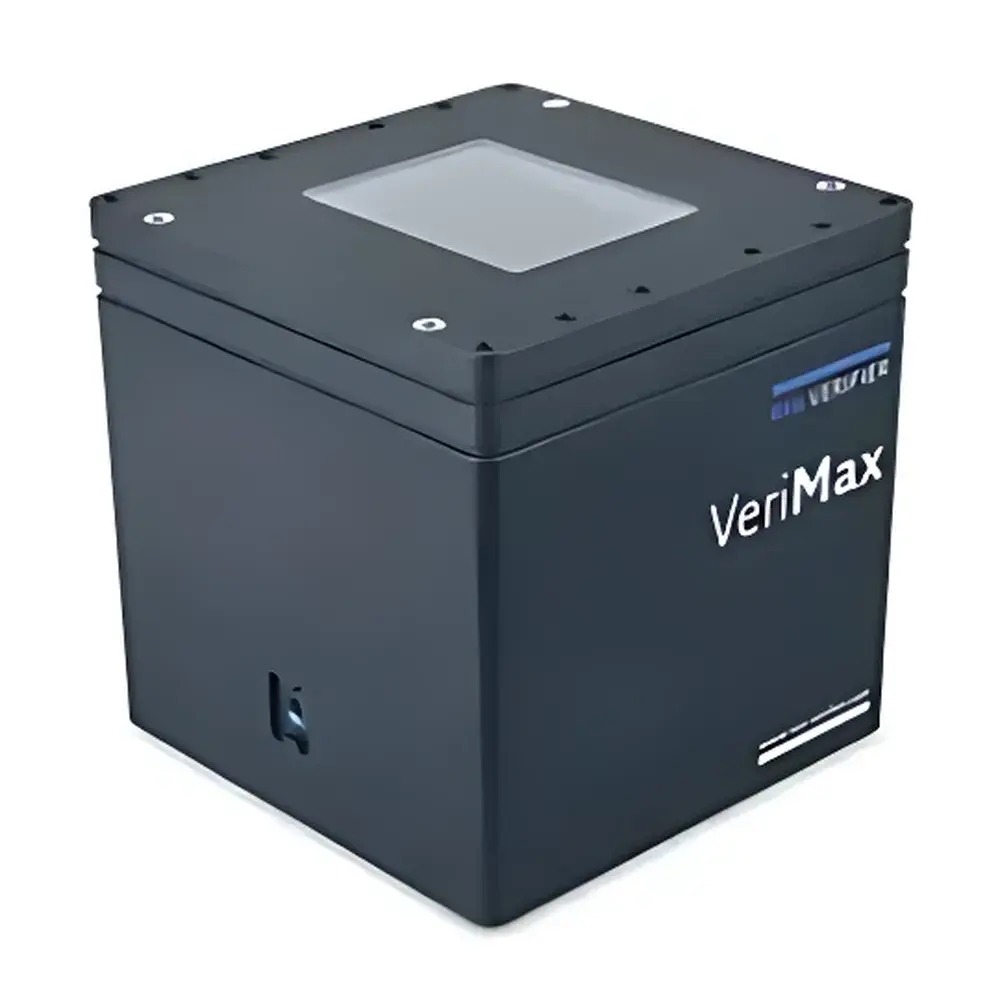
REA VeriMax Barcode Verification System
| Brand | REA |
|---|---|
| Origin | Germany |
| Model | VeriMax |
| Measurement Principle | ISO/IEC-compliant optical verification using high-resolution CMOS imaging |
| Illumination | 660 nm red LED, quad-directional, 45° angle |
| Detection Capability | 1D barcodes (ISO/IEC 15416), 2D matrix codes (ISO/IEC 15415), DPM codes (ISO/IEC TR 29158), GS1-128 & GS1 General Specifications |
| Enclosure | Light-tight measurement chamber |
| Power Supply | 24 V DC (machine-integrated or standalone operation) |
| Compliance | ISO/IEC 15415, ISO/IEC 15416, ISO/IEC TR 29158, ISO/IEC 15418, ANSI MH10.8.2, GS1 General Specifications |
| Software Interface | Multi-language GUI with profile-based configuration storage |
| Mounting | Fixed-lens, rigid optical module for OEM integration |
| Optional Features | DPM verification module, pharmaceutical-grade data structure validation, process optimization analytics |
Overview
The REA VeriMax Barcode Verification System is a precision-engineered optical inspection platform designed for full compliance with international barcode quality standards. It operates on the principle of standardized optical verification—capturing high-fidelity images of printed, etched, or directly marked (DPM) symbologies under controlled illumination and geometric conditions defined by ISO/IEC 15415, ISO/IEC 15416, and ISO/IEC TR 29158. Unlike generic scanners, the VeriMax functions as a metrological instrument: it quantifies symbol parameters—including modulation, reflectance margin, decodability, fixed pattern damage, and axial non-uniformity—against normative thresholds to generate pass/fail verdicts and graded quality scores (e.g., A–F grades per ISO). Its core optical engine integrates a high-sensitivity CMOS sensor with a fixed-focus lens assembly, engineered for sub-pixel spatial resolution and consistent depth-of-field across variable working distances. The system’s light-tight measurement cavity eliminates ambient light interference, while its 660 nm quad-directional 45° red LED illumination ensures repeatable contrast generation for both reflective and low-contrast DPM surfaces.
Key Features
- Compliance-certified verification engine supporting ISO/IEC 15415 (2D matrix), ISO/IEC 15416 (1D linear), and ISO/IEC TR 29158 (DPM) — all executed in a single hardware platform
- Integrated light-tight enclosure with precisely calibrated 660 nm red LED illumination at 45° incidence angles to minimize specular reflection and maximize symbol contrast
- Rigid, fixed-optics architecture with industrial-grade CMOS imaging module — optimized for long-term stability in machine-integrated environments
- 24 V DC power architecture enabling seamless integration into automated production lines or standalone use via optional evaluation kit
- Modular design with field-replaceable components: transparent cover plate, threaded top lid, and interchangeable glass mounting surfaces for fixture adaptation
- Multi-language graphical user interface with profile-based configuration management — allowing rapid recall of application-specific settings (e.g., pharmaceutical labeling, automotive DPM, logistics packaging)
Sample Compatibility & Compliance
The VeriMax accommodates a broad spectrum of marking methods and substrates without mechanical contact: thermal-transfer printed labels, inkjet-coded cartons, laser-etched metal parts, dot-peened automotive components, and electrochemical etchings on medical devices. Its optical geometry supports omnidirectional orientation — samples may be presented upright, inverted, or laterally rotated, with automatic symbol localization and orientation correction. Regulatory alignment includes full support for GS1 General Specifications and GS1-128 data structure validation, as well as ISO/IEC 15418 and ANSI MH10.8.2 syntax parsing for structured appendages. In regulated industries, the system enables audit-ready verification reporting with timestamped results, operator ID logging, and configurable digital signatures — facilitating adherence to FDA 21 CFR Part 11 requirements when deployed with validated software configurations.
Software & Data Management
The embedded verification software provides real-time grade calculation, defect mapping visualization, and parametric trend analysis. All verification reports are exportable in PDF, CSV, and XML formats, with metadata including measurement date/time, operator ID, sample ID, grade summary, and individual parameter scores. Configuration profiles — encompassing lighting presets, decoding algorithms, grading thresholds, and report templates — are stored locally and can be duplicated across multiple units for cross-site consistency. Optional process optimization modules correlate verification failures with print-process variables (e.g., printhead voltage, conveyor speed, ink viscosity), supporting root-cause analysis in high-speed packaging lines. Data integrity is maintained through internal checksum validation and write-once archival modes compatible with GLP/GMP documentation workflows.
Applications
The VeriMax serves mission-critical roles across regulated and high-volume manufacturing sectors. In pharmaceutical packaging, it verifies human-readable + machine-readable (HRI+MRI) 2D codes on blister cards and vials per EU Falsified Medicines Directive (FMD) requirements. In automotive Tier-1 supply chains, it validates DPM codes on engine blocks and transmission housings against AIAG B-17 specifications. Electronics manufacturers deploy it for verifying micro-sized QR codes on PCBs and semiconductor trays where conventional scanners fail due to limited depth of field or reflectivity variation. Logistics hubs utilize its GS1-128 verification capability to ensure SSCC-18 compliance on shipping containers prior to dispatch. Its compact footprint and OEM-ready mounting interface make it suitable for integration into label applicators, case packers, and robotic end-of-line stations.
FAQ
Does the VeriMax require annual recalibration?
No — the system employs factory-traceable optical calibration stored in firmware; periodic verification using NIST-traceable test targets is recommended per ISO/IEC 15426-1.
Can it verify stacked or truncated barcodes?
Yes — the decoding engine supports all GS1-approved symbology variants, including truncated DataMatrix and stacked PDF417, with full syntax validation per GS1 General Specifications.
Is remote diagnostics supported?
Yes — optional Ethernet/IP or Modbus TCP connectivity enables remote status monitoring, log retrieval, and firmware updates without physical access.
What environmental conditions does it tolerate?
Rated IP54 for dust and splash resistance; operational temperature range is 5–40 °C with relative humidity up to 80% non-condensing.
How is DPM verification different from standard 2D verification?
DPM verification applies specialized algorithms to assess symbol quality on low-contrast, textured, or curved surfaces — requiring enhanced illumination control and adaptive thresholding per ISO/IEC TR 29158 Annex B.




