
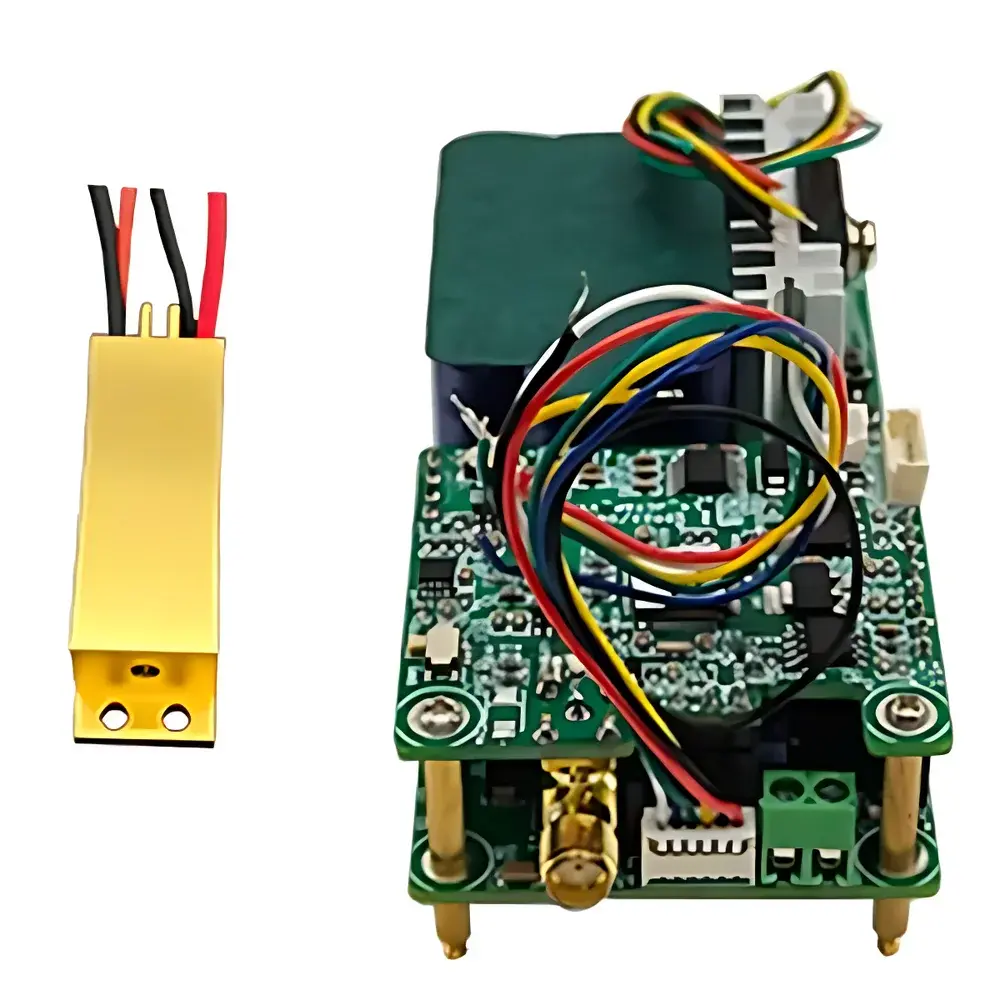
RealLight MCM Series High-Energy Microchip Laser
| Brand | RealLight |
|---|---|
| Origin | Beijing, China |
| Manufacturer Type | Authorized Distributor |
| Product Category | Domestic |
| Model | MCM |
| Core Components | Semiconductor Pump Laser Module + Monolithic Nd:YAG/Cr:YAG Passive Q-Switched Solid-State Laser |
| Wavelength | 1064 nm |
| Repetition Rate | 10 Hz |
| Pulse Energy | >10 mJ |
| Pulse Width | <3 ns |
| Beam Divergence (Full Angle, 1/e²) | 3 mrad (Horizontal) / 3 mrad (Vertical) |
| Power Stability (RMS) | <3% |
| Cooling Method | Air-Cooled |
| Laser Head Dimensions (W×H×L) | 17 × 16.1 × 58.5 mm |
| Operating Temperature | 15–35 °C |
| Storage Temperature | −20–60 °C |
| Electrical Input | 12 VDC |
| Control Interface | RS-232 + TTL I/O |
| Max System Power Consumption | 15 W |
| Driver Board Dimensions (W×H×L) | 45 × 39.6 × 110.3 mm |
| Trigger Mode | Internal or External |
Overview
The RealLight MCM Series is a line of passively Q-switched, diode-pumped microchip lasers engineered for high pulse energy, compact integration, and robust field operation. Based on monolithic Nd:YAG/Cr:YAG composite crystal architecture, the laser generates nanosecond pulses at 1064 nm through intracavity saturable absorption—eliminating the need for active electronics in the Q-switching mechanism. This design ensures intrinsic timing stability, low jitter (<1 ns), and high pulse-to-pulse reproducibility—critical for time-resolved applications such as laser-induced breakdown spectroscopy (LIBS) and ablation-based material analysis. Unlike conventional lamp-pumped or water-cooled solid-state lasers, the MCM series employs an integrated semiconductor pump module and thermally optimized microchip gain medium, enabling air-cooled operation in a footprint under 60 mm in length. Its mechanical and thermal stability supports continuous duty cycles within ambient temperature ranges of 15–35 °C, making it suitable for portable instrumentation, embedded OEM systems, and laboratory-grade benchtop analyzers requiring turnkey ns-pulse sources.
Key Features
- Passive Q-switching with Cr:YAG saturable absorber for sub-3 ns pulse width and <1 ns timing jitter
- Single-pulse energy exceeding 10 mJ at 1064 nm, with RMS power stability better than 3% over 8 hours
- Air-cooled, conduction-dominated thermal management—no water lines, chillers, or forced-air ducting required
- Monolithic microchip resonator design ensures alignment-free operation and long-term pointing stability
- OEM-optimized control board (45 × 39.6 × 110.3 mm) with dual-trigger capability (internal clock or external TTL sync)
- RS-232 serial interface for remote parameter configuration, status monitoring, and firmware updates
- Compact laser head (17 × 16.1 × 58.5 mm) compatible with handheld enclosures and space-constrained optical benches
Sample Compatibility & Compliance
The MCM series is designed for use with standard optical components rated for 1064 nm nanosecond pulses, including fused silica lenses, broadband dielectric mirrors, and calibrated photodiodes traceable to NIST standards. Beam parameters comply with ISO 11146-1:2005 for beam width and divergence measurement (1/e² definition), and pulse energy calibration follows ISO 13695:2022 for laser energy meters. The device meets CE marking requirements under Directive 2014/35/EU (Low Voltage Directive) and 2014/30/EU (EMC Directive). While not classified as a medical laser product per IEC 60601-2-22, its output characteristics are compatible with Class 4 laser safety protocols per IEC 60825-1:2014. Full documentation—including test reports, RoHS compliance certificates, and EU Declaration of Conformity—is provided with each unit shipment.
Software & Data Management
The included RealLight Laser Control Suite (v3.2+) runs on Windows 10/11 and enables real-time monitoring of pulse count, internal temperature, driver voltage, and fault status via ASCII-based RS-232 commands. All operational logs—including timestamped trigger events, energy readbacks (via optional external sensor integration), and thermal history—are exportable in CSV format for traceability. The software supports batch configuration across multiple MCM units and includes programmable delay generators for synchronized multi-laser experiments. For regulated environments (e.g., GLP-compliant labs), audit-trail functionality records user actions, parameter changes, and system errors with ISO 8601 timestamps—fully compliant with FDA 21 CFR Part 11 requirements when deployed with validated Windows domain authentication.
Applications
- Laser-Induced Breakdown Spectroscopy (LIBS): Stable 10 mJ pulses enable reliable plasma generation on metallic, ceramic, and geological samples with minimal shot-to-shot matrix effects
- Laser Ablation ICP-MS: Compact form factor facilitates direct coupling into ablation cells; consistent pulse energy improves elemental fractionation control
- Optical Damage Threshold Testing: Sub-3 ns pulses meet ISO 21254-1:2018 criteria for nanosecond laser damage testing of coatings and optics
- Time-of-Flight LIDAR Prototyping: Low-jitter triggering and air-cooled operation support mobile platform integration
- Nonlinear Frequency Conversion: High peak power (>3 MW) enables efficient SHG in BBO or KTP crystals for 532 nm generation
- Calibration Source for Fast Photodetectors: Precise temporal profile and stable amplitude serve as reference for oscilloscope and streak camera validation
FAQ
What is the maximum recommended pulse repetition rate for continuous operation?
The MCM-1064-0.01-10 variant is rated for 10 Hz sustained operation. Higher rates may be supported in burst mode (≤5 s duration) with adequate thermal recovery intervals.
Can the laser head be mounted in any orientation?
Yes—the monolithic cavity and conduction-cooled design allow mounting in any spatial orientation without performance degradation.
Is external energy monitoring supported?
Yes. The RS-232 interface accepts analog input from calibrated pyroelectric or photodiode sensors for closed-loop energy feedback and auto-adjustment.
Does the system include safety interlocks?
The control board features TTL-compatible enable/disable lines and hardware-based shutter control outputs compatible with commercial laser safety interlock systems.
What is the expected lifetime of the pump diode?
Based on accelerated life testing per Telcordia GR-468-CORE, the pump diode exhibits >10,000 hours MTTF at nominal drive current and 25 °C case temperature.





