
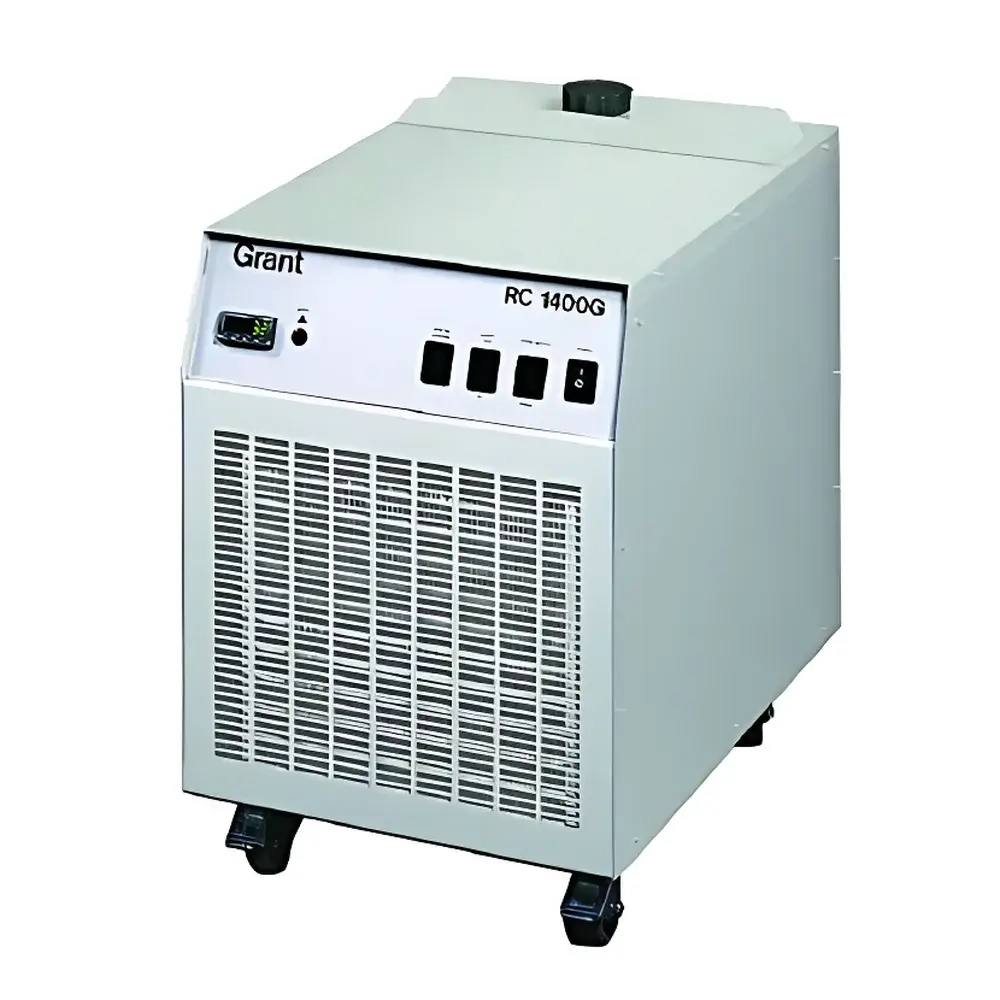
Recirculating Chiller RC350G / RC400G / RC1400G / RC3000G – Precision Temperature-Controlled Cooling System for Laboratory and Industrial Applications
| Origin | United Kingdom |
|---|---|
| Manufacturer Type | Authorized Distributor |
| Origin Category | Imported |
| Models | RC350G, RC400G, RC1400G, RC3000G |
| Temperature Range | −10 °C to 60 °C (RC1400G, RC3000G) or −5 °C to 60 °C (RC350G, RC400G) |
| Temperature Stability | ±0.25 °C (DIN 58966, with 10 L water at 20 °C) or ±0.5 °C (with 25 L water at 20 °C) |
| Cooling Capacity | 350–3000 W (at 20 °C ambient) |
| Heating Capacity | 0.75 kW (RC350G), 1.5 kW (RC400G), none (RC3000G) |
| Max. Flow Rate | 12–15 L/min |
| Reservoir Volume | 1.1–17.7 L |
| Pump Pressure @ 1 L/min | 0.62–1.6 bar |
| Power Supply | 230 V, 50 Hz |
| EMC Class | B (RC350G, RC400G, RC3000G), A (RC1400G) |
Overview
The RC Series Recirculating Chillers are engineered for precision thermal management in demanding laboratory, academic, and industrial environments. These units operate on a closed-loop refrigeration cycle—utilizing a hermetic compressor, condenser, expansion valve, and evaporator—to deliver stable, controllable coolant flow across a wide temperature range. Unlike passive cooling methods, the RC series actively regulates fluid temperature via integrated PID-controlled refrigeration and optional resistive heating (on RC350G and RC400G models), enabling both cooling and heating functions for bidirectional thermal control. Designed for integration with open- or closed-loop systems—including spectrometers, lasers, X-ray diffractometers, SEMs, and industrial process equipment—the chillers maintain consistent thermal conditions critical for instrument stability, measurement repeatability, and component longevity. Their compact footprint, corrosion-resistant construction, and DIN-compliant temperature stability make them suitable for GLP-compliant labs and ISO 17025-accredited testing facilities.
Key Features
- Dual-mode temperature control: Refrigeration-only (RC1400G, RC3000G) or refrigeration + heating (RC350G, RC400G) for enhanced flexibility in thermal cycling applications.
- Digital LED controller with ±0.25 °C stability (per DIN 58966) under defined test conditions—ensuring high reproducibility for time-sensitive experiments.
- TUNE function for adaptive PID parameter optimization, allowing users to fine-tune response characteristics for specific heat loads or fluid dynamics in closed-loop configurations.
- Integrated safety architecture: Over-temperature cutoff, low-level float switch, flow failure detection, and user-configurable high/low temperature alarms—all compliant with IEC 61010-1 safety standards.
- Corrosion-resistant reservoir and wetted components (e.g., stainless steel, EPDM seals) compatible with deionized water, glycol/water mixtures, and other non-aggressive coolants.
- Lockable castor wheels for ergonomic mobility and secure positioning in shared lab spaces or production lines.
Sample Compatibility & Compliance
The RC series supports a broad range of heat-transfer fluids—including tap water, deionized water, and aqueous ethylene glycol solutions (up to 30% v/v)—without compromising thermal efficiency or system integrity. All models meet CE marking requirements and conform to electromagnetic compatibility (EMC) Class B (domestic/residential environment) or Class A (industrial environment) per EN 61000-6-3. The RC1400G is rated Class A for use in electromagnetically noisy industrial settings. Safety design complies with IEC 61010-1 for electrical equipment used in measurement, control, and laboratory applications. While not inherently 21 CFR Part 11 compliant, audit-ready data logging (via optional RS485/Modbus interface) supports traceability in regulated environments when integrated with validated LIMS or SCADA platforms.
Software & Data Management
The RC chillers feature a standalone digital controller with real-time display of setpoint, actual temperature, flow status, and alarm history. For advanced integration, an optional RS485 serial interface enables Modbus RTU communication with external PLCs, SCADA systems, or custom LabVIEW-based monitoring suites. Users may log temperature profiles, alarm events, and runtime statistics for post-experiment analysis or QA documentation. Though no proprietary software is bundled, the protocol stack permits seamless incorporation into enterprise-wide environmental monitoring systems adhering to ISO/IEC 17025 Clause 7.7 (result reporting) and FDA guidance on electronic records.
Applications
- Academic & Research Laboratories: Cooling of CCD detectors in astronomical instrumentation, cryostat pre-cooling circuits, potassium salt crystallization studies requiring seawater temperature modulation, and thermal stabilization of laser cavities in ultrafast optics setups.
- Materials Characterization: Thermal conditioning of X-ray fluorescence (XRF) and scanning electron microscope (SEM) detectors to minimize thermal noise and drift during extended acquisition cycles.
- Industrial Process Control: Temperature regulation of inkjet print heads in textile manufacturing, etchant bath cooling in semiconductor photolithography, and thermal calibration of metrology probes in aerospace sensor validation.
- Pharmaceutical & Biotech: Support of controlled-temperature reactors and chromatographic column ovens where precise thermal gradients impact separation resolution and method robustness.
FAQ
What is the maximum allowable coolant temperature deviation during continuous operation?
Stability is specified as ±0.25 °C (RC350G/RC400G with 10 L system volume) or ±0.5 °C (RC1400G/RC3000G with 25 L system volume), measured per DIN 58966 under steady-state conditions with constant ambient (20 °C) and load.
Can the RC3000G be used with glycol-based coolants?
Yes—its wetted materials (stainless steel reservoir, EPDM seals, brass fittings) are compatible with up to 30% ethylene glycol/water mixtures; however, viscosity and heat capacity changes must be accounted for in flow rate and cooling capacity calculations.
Is remote monitoring supported out-of-the-box?
Standard units include local LED control only; RS485/Modbus connectivity is available as a factory-installed option for integration with third-party supervision systems.
Does the chiller require regular refrigerant servicing?
No—the sealed refrigeration circuit uses R404A or R507 (model-dependent) and is designed for maintenance-free operation over 10,000 hours; annual visual inspection of condenser coils and coolant level is recommended.
How does the TUNE function improve temperature control in custom applications?
TUNE automatically adjusts PID gain, integral time, and derivative action based on observed system response to step changes, optimizing settling time and overshoot for non-standard thermal masses or long fluid path lengths.



