
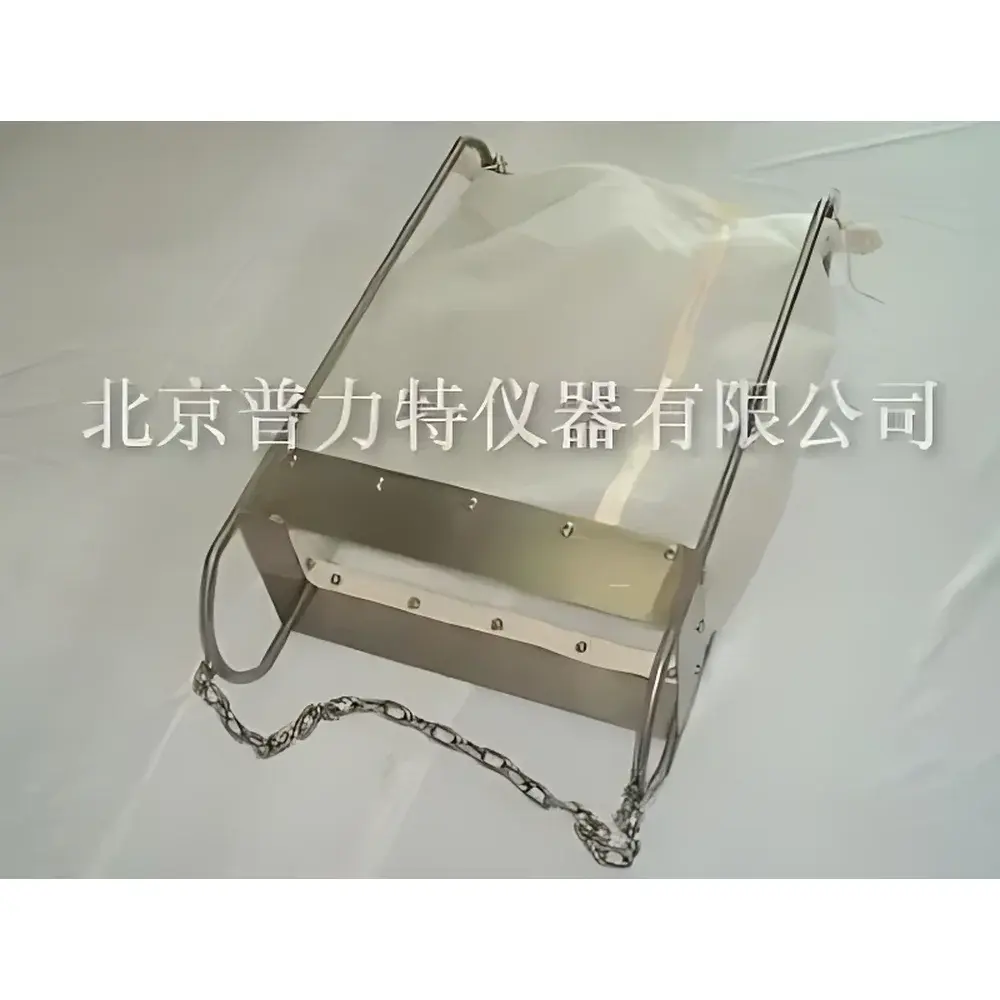
Rectangular Benthic Trawl BD-R40
| Origin | Beijing |
|---|---|
| Manufacturer Type | Distributor |
| Origin Category | Domestic (China) |
| Model | BD-R40 |
| Pricing | Upon Request |
Overview
The Rectangular Benthic Trawl BD-R40 is a standardized, manually deployable bottom-sampling instrument engineered for qualitative and semi-quantitative collection of benthic macroinvertebrates and epibenthic organisms from soft-bottom aquatic habitats. Designed in accordance with widely adopted field protocols for ecological monitoring—including those referenced in ISO 5667-13 (Water quality — Sampling — Part 13: Guidance on sampling of benthic macroinvertebrates) and EPA Method 3100A—the BD-R40 operates on the principle of controlled horizontal towing along the sediment–water interface. Its rectangular frame geometry ensures consistent cross-sectional area during deployment, minimizing flow distortion and improving spatial representativeness compared to conical or triangular trawl configurations. The device is intended for use in shallow freshwater systems (e.g., rivers, lakes, reservoirs) and sheltered coastal zones (depth ≤ 5 m), where vessel-based or hand-pulled operations are feasible.
Key Features
- Stainless steel frame constructed from ASTM A240 Type 304 stainless steel—resistant to corrosion in freshwater and brackish environments, with high structural rigidity to maintain net mouth geometry under drag load.
- Rectangular aperture measuring 40 cm × 20 cm (0.08 m² total opening area), enabling standardized areal sampling for comparative benthic surveys across time and location.
- 40-mesh nylon netting (monofilament, knotted weave) with nominal pore size of 0.5 mm—optimized to retain macroinvertebrate taxa including oligochaetes, chironomid larvae, amphipods, gastropods, and small bivalves while permitting fine sediment passage.
- Integrated towing bridle with reinforced stainless steel eyelets and low-stretch polypropylene tow line attachment points—designed to minimize lateral deformation and ensure stable orientation during retrieval.
- Modular construction allows for rapid disassembly, cleaning, and replacement of netting without tools—supporting field-deployable maintenance and GLP-aligned traceability of consumables.
Sample Compatibility & Compliance
The BD-R40 is validated for use in lotic and lentic freshwater ecosystems, as well as low-energy marine/estuarine sediments (mud, silt, sandy mud). It is not suitable for rocky, gravelly, or highly vegetated substrates due to entanglement risk and reduced capture efficiency. The device complies with methodological requirements outlined in ISO 5667-13 for qualitative benthic assessment and aligns with national Chinese environmental monitoring standards (HJ 91.2–2022, Technical Specifications for Surface Water and Wastewater Monitoring). While not certified to ISO/IEC 17025, its design supports auditable sampling procedures when used within documented SOPs—including pre-deployment calibration checks, tow speed documentation (recommended: 0.3–0.5 m/s), and post-retrieval sample handling per HJ 494–2009 (Guidelines for Water Sampling Techniques).
Software & Data Management
The BD-R40 is a field-operated mechanical sampler with no embedded electronics, firmware, or onboard data logging capability. Sample metadata—including GPS coordinates, depth, substrate type, tow duration, vessel speed (measured via handheld GPS or acoustic Doppler velocimeter), and operator ID—must be recorded externally using standardized electronic datasheets (e.g., ESRI Field Maps, ODK Collect) or paper-based chain-of-custody forms compliant with ISO/IEC 17025 Annex A.2 (recording of environmental conditions and procedural deviations). Integration with laboratory information management systems (LIMS) is supported through structured CSV export of field logs and taxonomic identification records generated during subsequent lab sorting and analysis.
Applications
- Baseline benthic community characterization for environmental impact assessments (EIA) and regulatory compliance reporting (e.g., China’s Environmental Protection Law Article 19).
- Long-term ecological monitoring programs tracking changes in macroinvertebrate assemblages as indicators of organic enrichment, eutrophication, or contaminant stress.
- Validation of remote sensing or acoustic seabed classification outputs through ground-truthing of sediment biota composition.
- Educational field training for university-level limnology and marine biology courses requiring hands-on experience in standardized benthic sampling methodology.
- Supporting development of biotic indices such as the Biological Monitoring Working Party (BMWP) score or the Chinese Biotic Index (CBI) through reproducible specimen collection.
FAQ
What is the recommended tow speed for optimal benthic capture efficiency?
Field validation studies indicate that sustained towing at 0.3–0.5 m/s maximizes organism retention while minimizing net clogging and substrate resuspension.
Can the BD-R40 be used in marine environments?
Yes—provided salinity remains below 30 ppt and bottom currents are negligible; however, prolonged exposure to full seawater requires post-use desalination rinsing to prevent chloride-induced pitting of the 304 stainless frame.
How often should the netting be replaced?
Nylon mesh should be inspected before each deployment; replacement is required if >5% of apertures show abrasion, knot failure, or dimensional distortion exceeding ±0.1 mm tolerance.
Is the BD-R40 compatible with ISO/IEC 17025-accredited laboratories?
Yes—when deployed within a documented sampling plan that includes equipment verification, personnel competency records, and traceable environmental metadata, it satisfies Clause 7.5.1 (Sampling) of ISO/IEC 17025:2017.
Does the frame include mounting provisions for auxiliary sensors?
No—the BD-R40 is a passive sampling tool; integration with CTD, turbidity, or DO sensors requires external mounting on the tow cable or vessel platform, not on the frame itself.







