
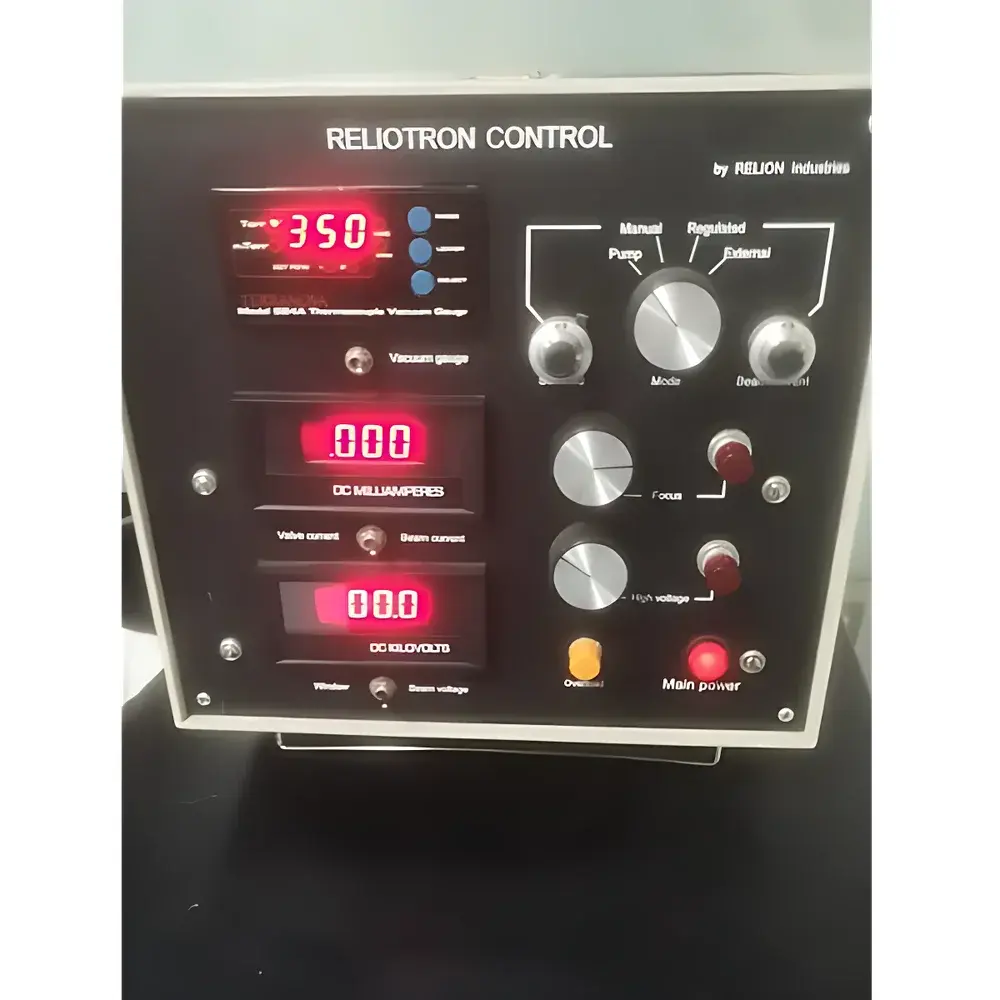
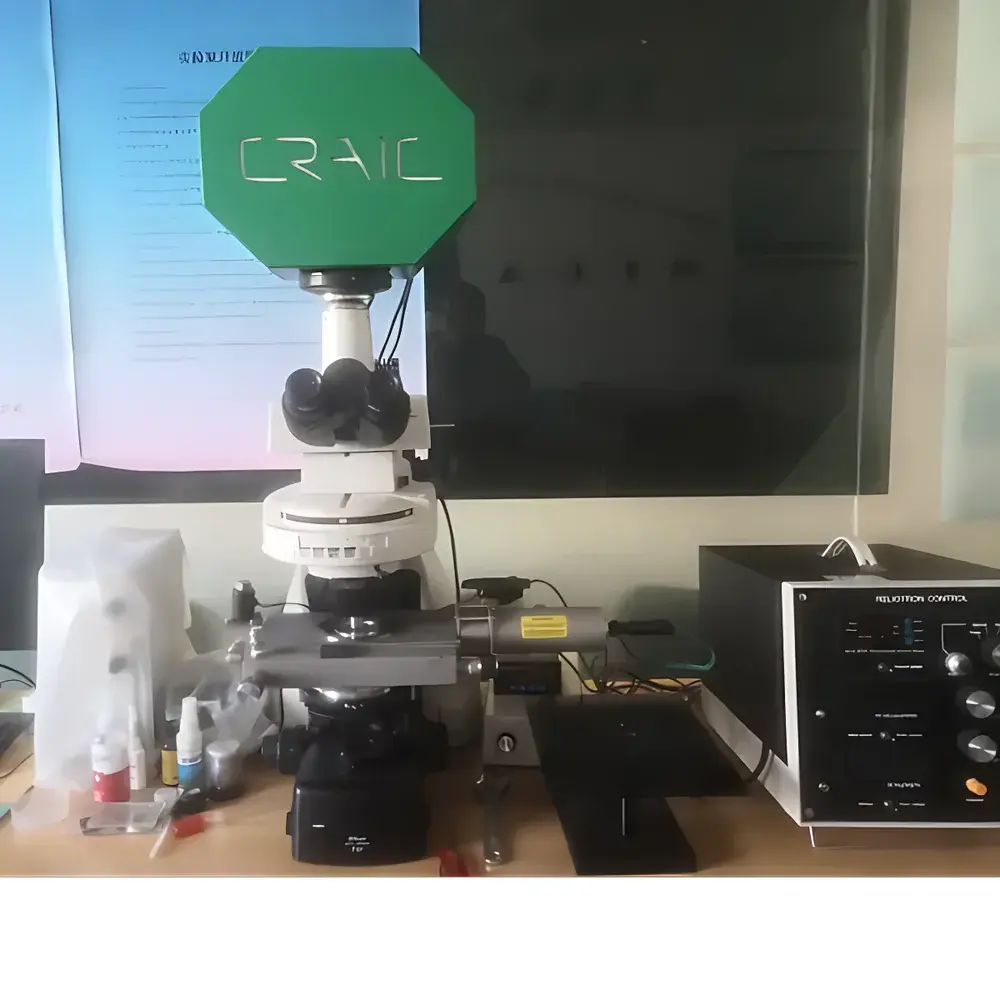
RELION VII CL Cathodoluminescence System
| Brand | RELION |
|---|---|
| Origin | USA |
| Manufacturer Type | Authorized Distributor |
| Origin Category | Imported |
| Model | RELION VII CL |
| Pricing | Available Upon Request |
| Beam Voltage | 0–30 kV (continuously adjustable, typically operated ≤25 kV) |
| Beam Current | 0–1 mA (continuously adjustable, with overload protection) |
| Vacuum Chamber Material | Non-magnetic stainless steel (inert-gas welded) |
| Observation Windows | Standard 40 mm Ø leaded glass window (3 mm thick) + optional 20 mm concave macro window |
| Sample Stage Capacity | Accommodates up to three standard thin sections (50.8 mm × 76.2 mm) or two elongated wafers |
| Focusing Range | Spot focus (down to 0.1 mm), field focus, and defocused modes |
| Beam Deflection | Electromagnetic scanning via precision deflection magnets |
| Vacuum Performance | Dual-stage rotary vane pump with mist eliminator |
| Power Rating | ≥800 W |
| Microscope Compatibility | Designed for integration with optical microscopes (reflected/transmitted light), SEMs, and custom vacuum-compatible imaging platforms |
| Compliance | Engineered for GLP-aligned laboratory environments |
Overview
The RELION VII CL Cathodoluminescence System is a high-performance, vacuum-integrated cathodoluminescence (CL) excitation platform engineered for quantitative luminescence analysis of inorganic materials under electron beam irradiation. Operating on the principle of electron–solid interactions, the system accelerates electrons to energies between 0 and 30 kV, inducing band-to-band or defect-related photon emission in semiconductors, minerals, ceramics, and geological specimens. Unlike photoluminescence or electroluminescence techniques, CL provides spatially resolved optical signatures correlated directly with microstructural features—enabling sub-micron correlation between crystallographic defects, trace-element zoning, radiation damage, and optical activity. The RELION VII CL is not a standalone microscope but a modular CL source designed for seamless integration with transmitted/reflected-light optical microscopes, scanning electron microscopes (SEMs), or custom vacuum chambers—making it suitable for both routine petrographic analysis and advanced materials R&D.
Key Features
- Continuously adjustable electron beam voltage (0–30 kV) with stable regulation below 25 kV—optimized for reproducible CL excitation across diverse mineral phases (e.g., quartz, feldspar, zircon) without excessive surface charging or thermal damage.
- Precisely controllable beam current (0–1 mA) with real-time digital readout and hardware-based overload protection to safeguard filament life and sample integrity.
- Integrated main control console featuring simultaneous digital display and analog adjustment of beam voltage, beam current, chamber vacuum pressure, electromagnetic focusing current, and deflection coil current.
- Electromagnetic focusing coil enabling dynamic transition from spot focus (≤0.1 mm diameter) to full-field illumination and controlled defocusing—supporting both high-resolution mapping and wide-area qualitative survey.
- Programmable electromagnetic beam deflection system permitting precise rastering, point targeting, and region-of-interest positioning without mechanical stage movement.
- Vacuum chamber constructed entirely from non-magnetic, ultra-high-purity stainless steel, inert-gas welded to minimize magnetic hysteresis and outgassing—critical for maintaining beam stability and minimizing spectral interference.
- Dual observation ports: a 40 mm Ø leaded glass viewport (3 mm thickness, PbO content ≥60%) for standard optical coupling, plus an optional 20 mm concave macro window for enhanced light collection efficiency in low-light CL conditions.
- Robust dual-stage rotary vane vacuum system with integrated mist eliminator, achieving ≤0.25 Pa base pressure and sustaining stable operation at 20 mTorr (≈2.66 Pa)—compatible with ambient gas purging (N₂, Ar) for charge compensation in insulating samples.
Sample Compatibility & Compliance
The RELION VII CL accommodates standard petrographic thin sections (50.8 mm × 76.2 mm), polished rock slabs, semiconductor wafers, and metallurgical cross-sections. Its open-sample architecture allows rapid exchange without breaking vacuum when used with compatible load-lock configurations. All high-voltage and vacuum subsystems comply with IEC 61010-1:2010 for laboratory electrical safety. While the system itself does not carry CE or FDA certification, its design supports integration into ISO/IEC 17025-accredited laboratories and facilitates audit-ready documentation for GLP-compliant geological surveys and metallurgical QA/QC workflows. Vacuum interlocks, beam shutdown protocols, and real-time pressure monitoring ensure operational consistency across extended acquisition sessions.
Software & Data Management
The RELION VII CL operates via a dedicated Windows-based control interface supporting synchronized parameter logging (voltage, current, pressure, time stamp) at 10 Hz resolution. Export formats include CSV and HDF5 for downstream processing in MATLAB, Python (NumPy/Pandas), or commercial spectral analysis packages. Optional API access enables integration with third-party microscope control software (e.g., Zeiss ZEN, Thermo Scientific Velox) for coordinated stage positioning and CL signal triggering. Audit trails record all user-initiated parameter changes, aligning with 21 CFR Part 11 requirements when deployed in regulated GMP environments—provided local IT infrastructure implements appropriate electronic signature and data retention policies.
Applications
- Geological provenance studies: CL intensity and spectral variation in detrital zircons reveal magmatic history, metamorphic overprinting, and sedimentary recycling pathways.
- Mineralogical phase identification: Distinguishing hydrothermal vs. magmatic quartz, identifying Mn²⁺-activated feldspars, and detecting REE-doped apatite in ore deposits.
- Semiconductor defect characterization: Mapping dislocation loops, stacking faults, and grain boundary recombination centers in GaN, SiC, and perovskite thin films.
- Archaeometric material sourcing: Differentiating volcanic glass sources based on Ti⁴⁺/Fe³⁺-related CL signatures in obsidian artifacts.
- Metallurgical inclusion analysis: Correlating oxide/sulfide inclusion composition (via EDS) with localized CL quenching behavior in high-strength steels and superalloys.
FAQ
What vacuum level is required for stable CL operation?
Stable electron beam transmission and minimal scattering require a working pressure ≤20 mTorr (≈2.66 Pa). The dual-stage pump achieves ≤0.25 Pa base pressure, ensuring long-term stability even during extended acquisitions.
Can the RELION VII CL be retrofitted onto an existing SEM?
Yes—provided the SEM has a compatible vacuum flange (CF-63 or larger), sufficient port clearance, and electrical feedthrough capacity for beam control lines. Integration requires coordination with RELION’s application engineering team for custom mounting and signal synchronization.
Is leaded glass necessary for all CL detection setups?
Leaded glass (≥60% PbO) is mandatory for primary viewport construction to attenuate bremsstrahlung X-rays generated at >15 kV. Standard borosilicate glass is insufficient for operator safety and detector protection.
How is beam current calibrated and verified?
Beam current is measured in real time using a Faraday cup circuit integrated into the sample stage assembly. Calibration is traceable to NIST-standard current shunts and validated annually per internal metrology protocol.
Does the system support spectral CL (CL spectroscopy)?
The RELION VII CL provides broadband CL excitation only. For spectral acquisition, users integrate externally mounted monochromators (e.g., Horiba iHR320) or hyperspectral cameras (e.g., PrismSpec) via the standard C-mount or fiber-optic coupling port.






