
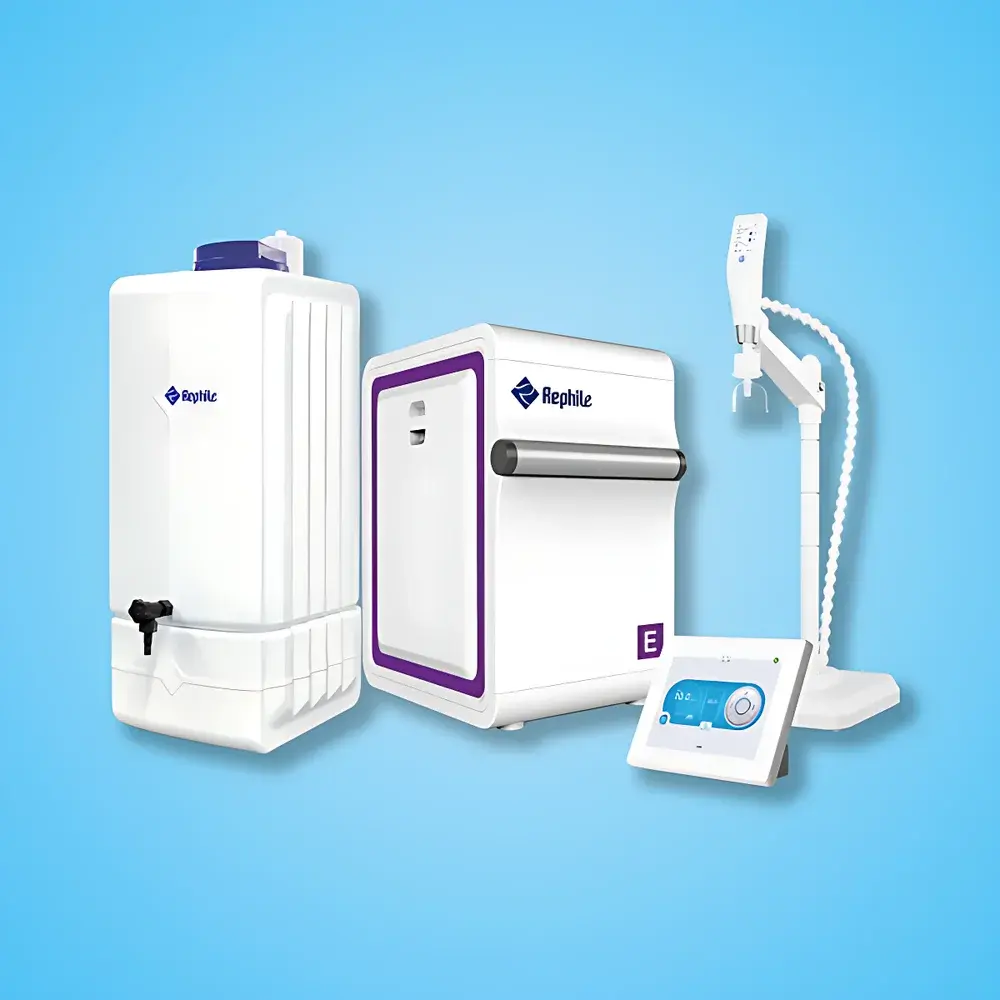
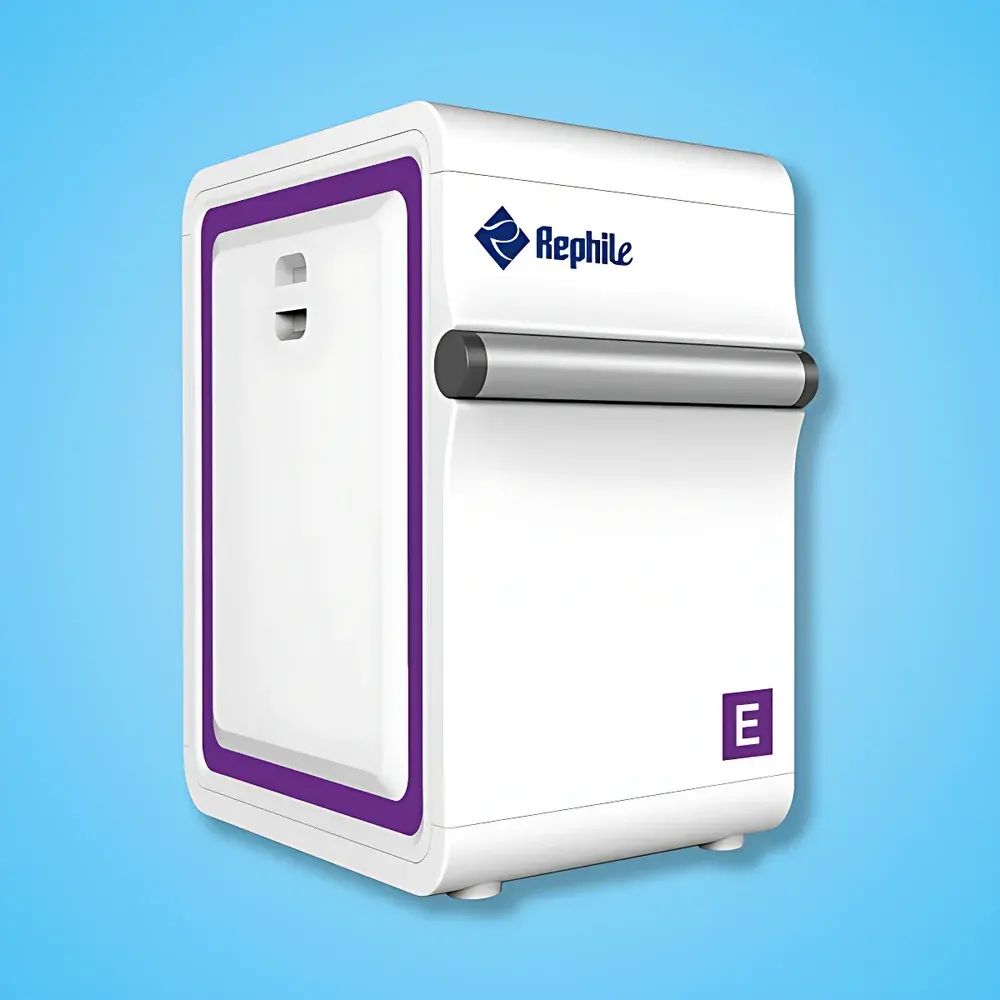
RephiLe Genie E Benchtop Laboratory Pure Water System
| Brand | RephiLe |
|---|---|
| Origin | Zhejiang, China |
| Manufacturer Type | Manufacturer |
| Regional Category | Domestic (China) |
| Model | Genie E |
| Price Range | USD 7,000 – 14,000 (FOB) |
| Feed Water Requirement | Municipal tap water (conductivity ≤ 2000 µS/cm |
| Product Water Grade | ASTM Type II / ISO 3696 Grade 2 / GB/T 6682-2008 Grade II |
| Resistivity (25 °C) | >5 MΩ·cm (typical 10–16 MΩ·cm) |
| Heavy Metals & Soluble Silica | <0.01 ppb |
| Total Organic Carbon (TOC) | <30 ppb |
| Microbial Count | <1 CFU/mL |
| Endotoxin | <0.001 EU/mL |
| Particles (>0.1 µm) | <1 particle/mL |
| Flow Rate (EDI Product Water) | 5 / 10 / 15 L/h (selectable) |
| Dispense Flow Rate | 0–2 L/min |
| UV Wavelength | 265 nm (UVC LED, mercury-free) |
| Dimensions (H×W×D) | 54 × 32 × 44 cm (main unit) |
| Wireless Communication | Proprietary 2.4 GHz RF between main unit, touchscreen controller, and up to 10 remote dispensers |
| Integrated Sensors | Optional pH, DO, turbidity probes with real-time data overlay on HMI |
Overview
The RephiLe Genie E is a benchtop laboratory pure water system engineered for consistent, high-reliability production of ASTM Type II / ISO 3696 Grade 2 / GB/T 6682-2008 Grade II analytical grade water. It employs a multi-stage purification architecture anchored by reverse osmosis (RO) pre-treatment followed by electrodeionization (EDI) as the primary polishing stage—eliminating dependence on consumable mixed-bed ion exchange cartridges. Unlike conventional ion exchange systems requiring periodic chemical regeneration or cartridge replacement, the Genie E’s EDI module sustains continuous deionization via electrochemical regeneration of ion-exchange resins under direct current, ensuring stable resistivity (>5 MΩ·cm at 25 °C, typically 10–16 MΩ·cm), low TOC (<30 ppb), and minimal endotoxin (<0.001 EU/mL). The system operates independently of ambient temperature fluctuations, maintaining constant flow rates across its 5, 10, or 15 L/h configurations. Its modular design integrates AC Pack and P Pack pre-filtration stages to protect RO membranes and EDI cells from scaling and organic fouling, significantly extending service intervals and reducing total cost of ownership.
Key Features
- Proprietary “1+N” architecture: One central Genie E unit supports up to 10 wireless, battery-powered dispensing handles—enabling distributed access across lab benches without plumbing constraints.
- Real-time multi-parameter monitoring: Optional integration of external pH, dissolved oxygen (DO), and turbidity sensors; raw sensor data synchronized and displayed alongside core water quality metrics on the main HMI screen.
- Mercury-free UVC LED technology: Dual 265 nm ultraviolet emitters—one inline for continuous microbial inactivation in the EDI loop, another inside the integrated water tank for periodic recirculation disinfection.
- Capacitive touch interface: IP65-rated, glove-compatible, water-resistant 7-inch color touchscreen with intuitive navigation and full audit trail logging (user actions, alarms, maintenance events).
- Intelligent water management: Continuous non-contact liquid level sensing in the tank; programmable circulation mode with adjustable frequency and duration; automatic leak detection with immediate shutdown and visual/audible alerts.
- Chemical-free maintenance: Built-in automated cleaning cycles—including chlorine-based and pH-adjusted regenerations—designed to restore EDI performance without operator intervention or hazardous reagents.
Sample Compatibility & Compliance
The Genie E is validated for use in environments requiring adherence to GLP and GMP principles. Its firmware supports time-stamped, user-identifiable event logging compliant with FDA 21 CFR Part 11 requirements when paired with appropriate network authentication protocols. All output water meets or exceeds the specifications defined in ASTM D1193-20 (Type II), ISO 3696:1987 (Grade 2), CLSI EP21-A (water for clinical laboratory reagents), and Chinese national standard GB/T 6682-2008 (Grade II). The system is routinely deployed in applications where trace-level contamination must be controlled—including preparation of microbiological culture media, HPLC mobile phase diluents, buffer stock solutions, and feed water for autoclaves, clinical chemistry analyzers, and washer-disinfectors. Its low endotoxin and particle counts make it suitable for cell culture support workflows where pyrogenic risk must be minimized.
Software & Data Management
The Genie E’s embedded control software provides local data storage for ≥12 months of operational history, including daily flow totals, resistivity/TOC trends, UV lamp operating hours, and alarm logs. Export is supported via USB flash drive in CSV format for offline analysis or LIMS integration. Remote diagnostics are accessible via secure HTTPS-enabled web interface (optional Ethernet/WiFi module). Audit trails record all configuration changes, user logins, calibration adjustments, and maintenance interventions—including timestamps, operator IDs, and reason codes. System firmware updates are delivered through digitally signed packages to ensure integrity and traceability. For regulated laboratories, optional electronic signature modules and role-based access control (RBAC) can be configured to align with internal SOPs and regulatory expectations.
Applications
- Preparation of bacteriological and fungal culture media for routine microbiology and antimicrobial susceptibility testing.
- Dilution and formulation of enzymatic assays, ELISA reagents, and molecular biology buffers (e.g., TE, PBS, Tris-HCl).
- Feed water for steam sterilizers, glassware washers, and environmental test chambers requiring non-corrosive, low-mineral input.
- Mobile phase preparation and instrument rinsing for UV-Vis spectrophotometers, atomic absorption spectrometers (AAS), and ICP-OES systems.
- Pharmaceutical manufacturing support: generation of Purified Water (PW) per USP and Ph. Eur. 2.2.44 specifications when used as a pretreatment source for downstream distillation or WFI generation systems.
- Research-grade applications demanding reproducible background conditions—such as nanoparticle synthesis, surface plasmon resonance (SPR) sensor calibration, and electrochemical cell filling.
FAQ
What is the expected service life of the RO membrane and EDI module under typical municipal feed water conditions?
With proper pre-treatment using AC Pack and P Pack cartridges—and adherence to scheduled cleaning protocols—the RO membrane typically lasts 2–3 years, while the EDI stack maintains stable performance for 4–5 years before requiring refurbishment.
Can the Genie E be connected to a building’s central water distribution system?
Yes, provided inlet pressure remains within 0.1–0.6 MPa and feed water meets specified conductivity, temperature, and particulate limits. A dedicated pressure regulator and sediment filter are recommended upstream of the unit.
Is the wireless communication between the main unit and dispensers encrypted?
All RF transmissions between the host controller and dispensers use AES-128 encryption with rolling session keys to prevent unauthorized access or spoofing.
Does the system support third-party LIMS integration?
Yes—via Modbus TCP or HTTP RESTful API (available with optional communication module), enabling bidirectional data exchange for sample tracking, QC flagging, and preventive maintenance scheduling.
How is TOC measured and verified on-site?
The Genie E does not include an onboard TOC analyzer; however, its design ensures TOC <30 ppb under validated operating conditions. Users performing in-house TOC verification should follow ASTM D5542 or ISO 8245 using calibrated, low-dead-volume sampling protocols to avoid atmospheric contamination.



