
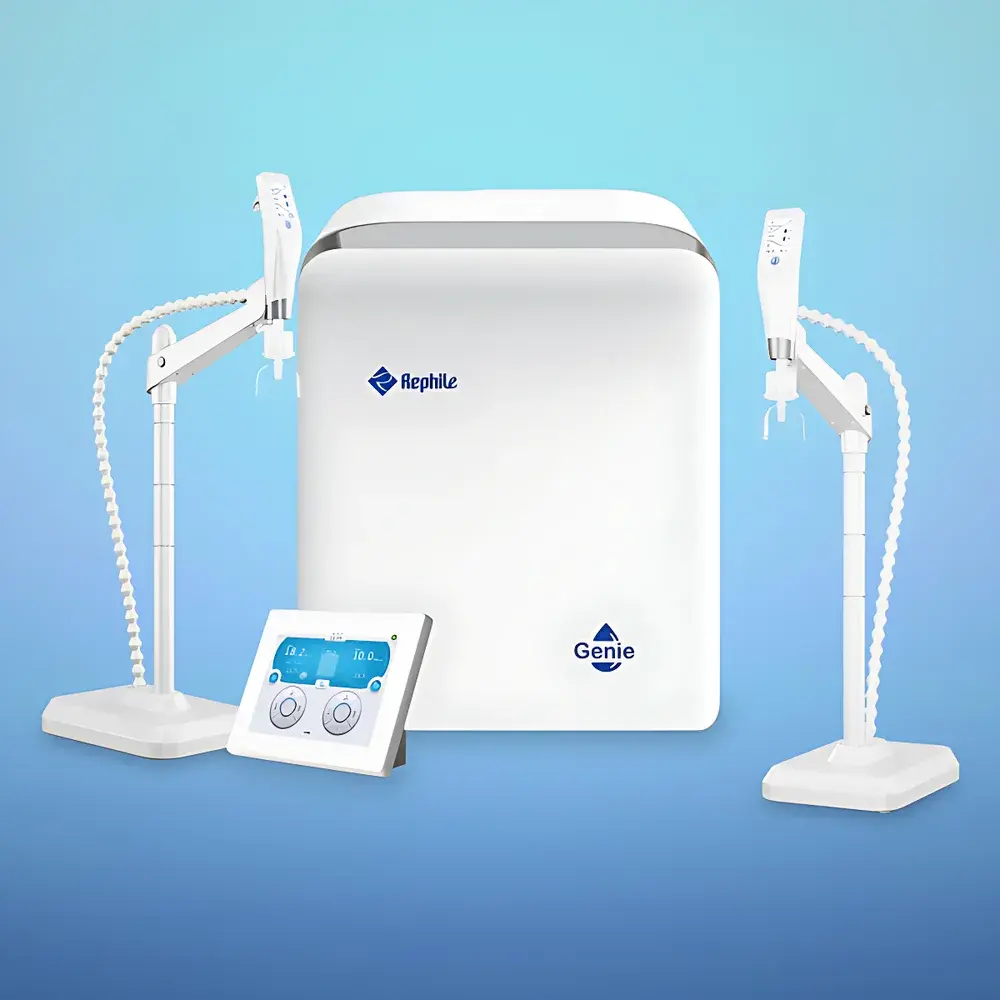
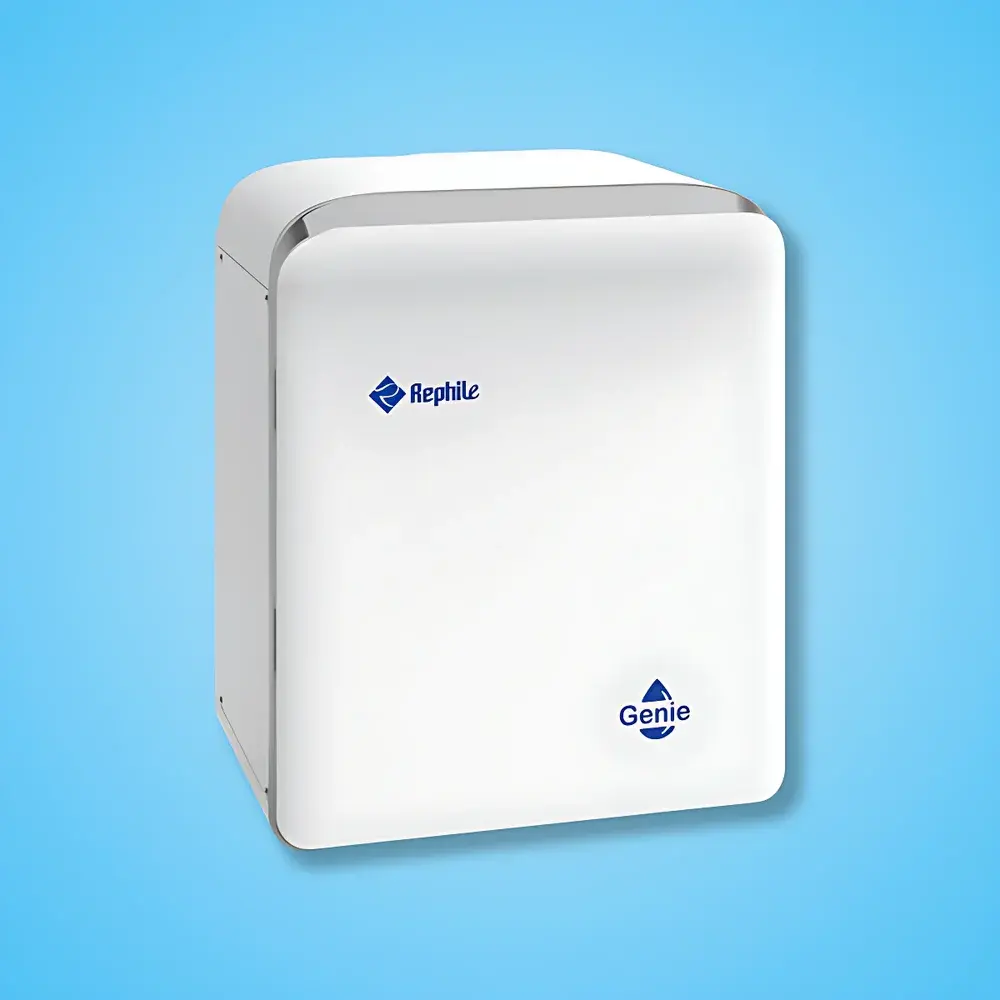
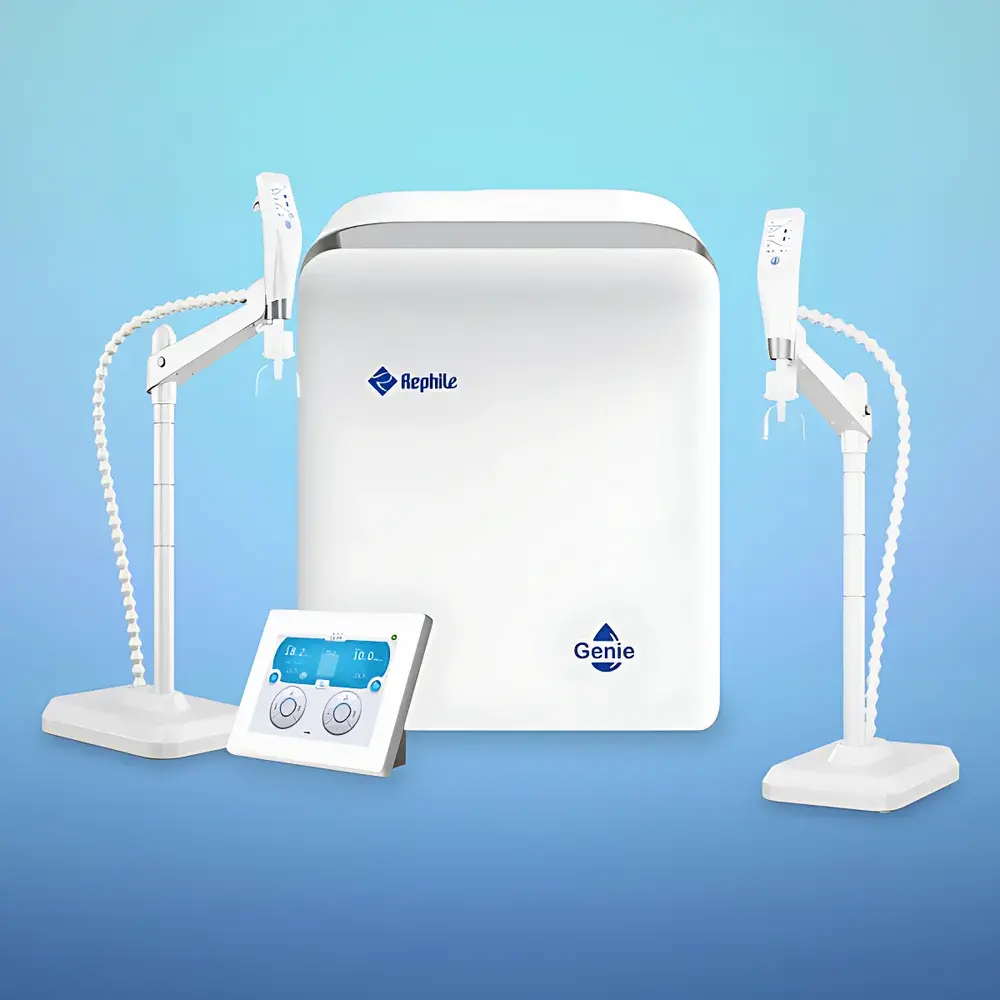
RephiLe Genie R Series High-Flow RO Pure Water System
| Brand | RephiLe |
|---|---|
| Origin | Shanghai, China |
| Manufacturer Type | Direct Manufacturer |
| Regional Classification | Domestic (China) |
| Model | RG0R04000 / RG0R08000 |
| Pure Water Grade | ASTM Type III / ISO 3696 Grade 3 |
| Conductivity | < 20 µS/cm @ 25 °C |
| Flow Rate | 40 L/hr or 80 L/hr |
| RO Dispensing Flow | 0–2 L/min |
| Feed Water Requirements | TDS < 1000 ppm, Temp. 5–35 °C, Pressure 0.1–0.6 MPa |
| Dimensions (L×D×H) | 57 × 46 × 70 cm |
| Power Consumption | < 250 W |
Overview
The RephiLe Genie R Series is a modular, high-flow reverse osmosis (RO) pure water system engineered for consistent, reliable production of ASTM Type III / ISO 3696 Grade 3 laboratory-grade water. Designed for central utility distribution in mid-to-high throughput laboratories, it employs a multi-stage pretreatment architecture—including reinforced RephiAC activated carbon, antiscalant dosing, and sub-micron filtration—followed by high-efficiency, temperature-stabilized RO membranes. Unlike conventional RO systems subject to seasonal flux variation, the Genie R utilizes proprietary low-volume, high-flux RO elements that maintain constant permeate flow across the full operational temperature range (5–35 °C). Non-compliant RO water is automatically diverted and rejected, ensuring only water meeting conductivity specifications (< 20 µS/cm at 25 °C) enters downstream storage or distribution. Integrated UVC LED technology (265 nm emission peak) provides mercury-free, low-power microbial control without ozone generation or lamp warm-up delays.
Key Features
- Modular “host + storage + distribution” architecture enables flexible installation—on benchtop, wall-mounted, or stacked atop optional reservoir modules—minimizing footprint in space-constrained labs.
- Tool-free maintenance design with triple-error-proof consumable identification: color-coded labels, visual icons, and embedded RFID chips ensure correct installation of RO membranes, purification cartridges, and UV lamps.
- 8-inch waterproof, detachable touchscreen HMI displays real-time conductivity, pressure differentials, pump/valve status, UV intensity, and scheduled maintenance alerts; supports 9 languages including English and Chinese.
- Intelligent dispensing interface with ergonomic handle screen: adjustable flow (dropwise to 2 L/min), programmable volume delivery, and on-demand printout of tamper-proof water quality reports via integrated thermal printer or USB export.
- Comprehensive data governance: two years of timestamped operational logs—including feed/RO conductivity, runtime hours, alarm events, and consumable life cycles—are stored onboard and exportable in immutable CSV format for GLP audit compliance.
- RephiLink mobile application enables remote monitoring and synchronized fleet management of multiple Genie R units, with push notifications for critical alerts and predictive maintenance cues.
Sample Compatibility & Compliance
The Genie R system delivers water suitable for non-critical laboratory applications requiring Type III purity per ASTM D1193 and ISO 3696. It meets feedwater specifications outlined in CLSI EP23-A and complies with general laboratory infrastructure requirements for autoclave, steam generator, water bath, and animal husbandry supply. All electronic logging functions adhere to ALCOA+ principles (Attributable, Legible, Contemporaneous, Original, Accurate, Complete, Consistent, Enduring, Available), supporting GLP-regulated environments. While not certified for USP Purified Water or EP WFI, its data integrity architecture—including user-access logs, electronic signatures (via optional authentication module), and audit-trail-enabled firmware—aligns with foundational elements of FDA 21 CFR Part 11 readiness.
Software & Data Management
Firmware includes embedded SQLite-based logging with cyclic overwrite protection and time-stamped event tagging. Data fields include: system uptime, RO rejection ratio, UV lamp operating hours, cartridge saturation indicators, and manual intervention timestamps. USB exports generate cryptographically sealed CSV files with SHA-256 checksums, preventing post-export modification. No cloud dependency: all processing occurs locally; optional Ethernet/Wi-Fi connectivity enables secure LAN-based access via RephiLink without external server reliance. Audit trail records include operator ID (if configured), action type (e.g., “cartridge replacement”, “system calibration”), and confirmation signature.
Applications
- Routine glassware and instrument cleaning where residual ion content is non-critical
- Preparation of buffers, saline solutions, and non-analytical reagents
- Feed water for autoclaves, steam generators, ultrasonic cleaners, and environmental chambers
- Hydration media for non-sterile cell culture support systems and aquaculture facilities
- Source water for downstream polishing systems (e.g., EDI or mixed-bed deionization) requiring stable, low-TDS influent
- General-purpose lab utility water in academic teaching labs, QC/QA screening labs, and industrial R&D facilities
FAQ
What is the expected service life of the RO membrane under typical municipal feed conditions?
Under continuous operation with TDS 15% decline in normalized flux.
Can the Genie R be integrated into an existing lab water network with centralized monitoring?
Yes—via Modbus RTU over RS-485 or optional Ethernet gateway, the system supports integration into third-party BMS or lab infrastructure dashboards for centralized pressure, flow, and quality telemetry.
Is validation documentation available for IQ/OQ protocols?
RephiLe provides customizable IQ/OQ templates aligned with ISO 9001 and GAMP5 frameworks, including test scripts for conductivity verification, flow calibration, and alarm response validation.
Does the system support automatic disinfection cycles?
Yes—the built-in hot water recirculation loop (optional accessory) and UV-LED intensity modulation enable programmable sanitization routines compliant with ISO 14644-1 particle control prerequisites for cleanroom-adjacent installations.
How does the RFID-based consumable management prevent incorrect installation?
Each consumable module contains a unique, factory-programmed RFID tag encoding part number, manufacturing date, and expiration window; the host controller validates compatibility and blocks system startup if mismatched or expired components are detected.



