
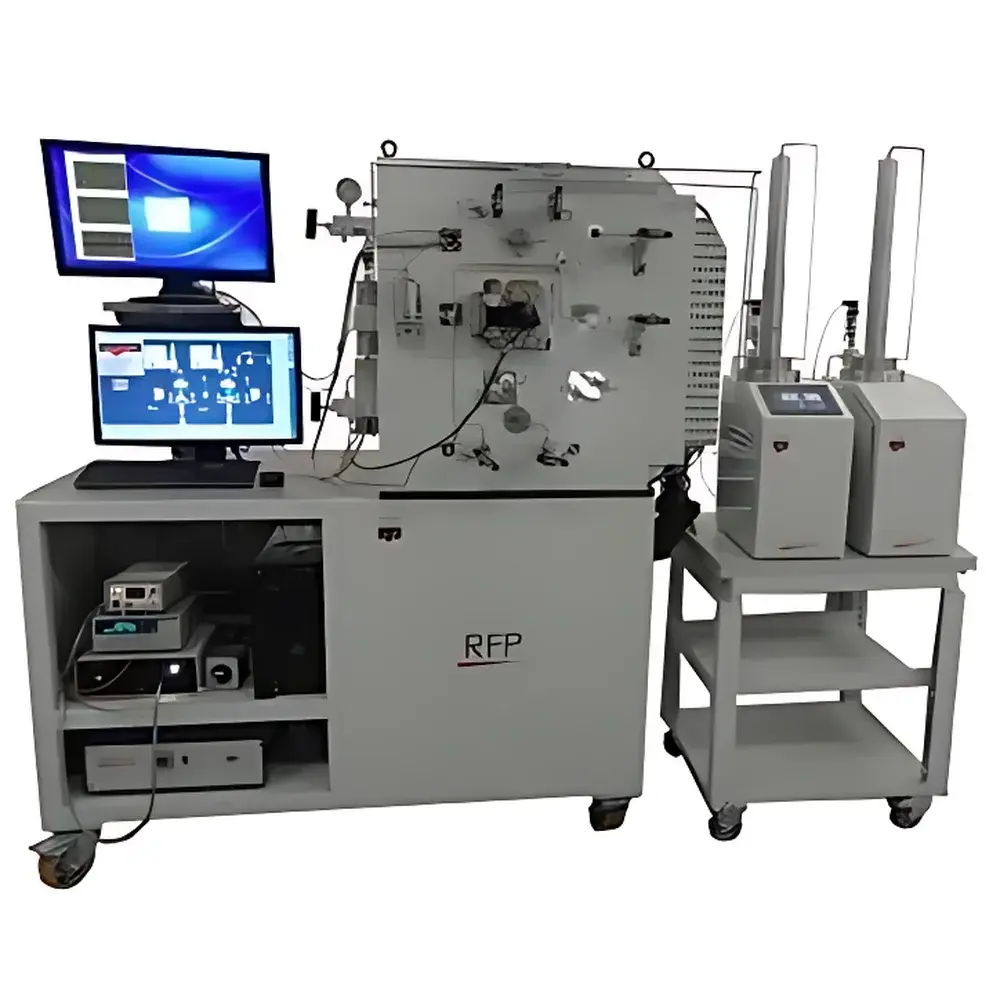
Reservoir Fluid Particle Analyzer RFP 1000 by VINCI (France)
| Brand | VINCI (France) |
|---|---|
| Origin | France |
| Model | RFP 1000 |
| Type | Reservoir Fluid Particle Precipitation Analyzer |
| Detection Principle | Near-Infrared Laser Scattering + Real-Time Visual Monitoring |
| Application Focus | Asphaltene and Wax Precipitation Onset Determination under Controlled Temperature & Pressure |
Overview
The VINCI RFP 1000 Reservoir Fluid Particle Analyzer is an engineered laboratory instrument designed for the quantitative determination of asphaltene and wax precipitation onset conditions in crude oils and reservoir fluids. It operates on a dual-detection principle: near-infrared (NIR) laser light scattering coupled with high-resolution, pressure-rated optical observation. Under precisely controlled temperature and pressure profiles—typically spanning −20 °C to 200 °C and up to 150 MPa—the system monitors dynamic changes in optical transmission and particle morphology during thermal or depressurization-induced phase separation. This enables reproducible identification of the first detectable particle formation event—defined as the precipitation onset point—critical for flow assurance modeling, reservoir management, and compositional simulation validation.
Key Features
- Integrated NIR laser scattering module (850 nm wavelength) with calibrated photodiode array for real-time turbidity quantification and onset threshold detection;
- High-pressure sapphire viewport cell (316L stainless steel body, 150 MPa rating) enabling simultaneous optical observation and laser interrogation;
- Precise P–T control via dual-loop PID regulation: ±0.1 °C temperature stability and ±0.05 MPa pressure stability over extended test durations;
- Automated ramp-and-hold protocols supporting both cooling-induced and depressurization-induced precipitation studies;
- Modular design compliant with standard laboratory gas handling interfaces (CGA-347, NPT 1/4″) and compatible with external chiller and hydraulic intensifier systems;
- CE-marked instrumentation architecture meeting IEC 61010-1 safety requirements for pressurized analytical equipment.
Sample Compatibility & Compliance
The RFP 1000 accommodates representative reservoir fluid samples including live crude oils, synthetic blends, and gas-condensate mixtures (minimum sample volume: 8 mL). Its cell geometry and optical path length are optimized for low-turbidity onset detection without dilution artifacts. The system supports ASTM D7143 (Standard Test Method for Determination of Asphaltene Precipitation Onset Using High-Pressure Optical Cell), ISO 13703 Annex C (Wax Appearance Temperature determination), and aligns with industry best practices outlined in API RP 14E and OGJ Flow Assurance Guidelines. All operational logs—including temperature, pressure, transmittance, timestamp, and user annotations—are recorded with audit-trail integrity, satisfying GLP documentation requirements for upstream R&D laboratories.
Software & Data Management
VINCI’s proprietary RFP Control Suite (v4.2+) provides full instrument orchestration via Windows-based GUI. It supports method-driven workflows, real-time scatter intensity plotting, derivative-based onset calculation (d(Transmittance)/dT), and automated report generation in PDF and CSV formats. Raw data files include embedded metadata (sample ID, operator, calibration stamp, environmental conditions) and are structured for direct import into reservoir simulators (e.g., CMG, Eclipse) or statistical analysis platforms (MATLAB, Python pandas). The software conforms to FDA 21 CFR Part 11 requirements through electronic signature support, role-based access control, and immutable audit logs—enabling use in regulated environments where data traceability is mandatory.
Applications
- Determination of Asphaltene Precipitation Onset Temperature (APOT) and Pressure (APOPT) for flow assurance risk assessment;
- Wax Appearance Temperature (WAT) mapping across varying gas-oil ratios and depletion scenarios;
- Evaluation of chemical inhibitor efficacy (e.g., dispersants, crystallization modifiers) under reservoir-relevant P–T conditions;
- Calibration and validation of thermodynamic models (e.g., PC-SAFT, CPA) used in compositional simulation;
- Supporting experimental design for core flooding studies involving particle plugging mechanisms;
- Quality control of produced fluid sampling integrity prior to PVT analysis.
FAQ
What sample volume is required for a single RFP 1000 test?
A minimum of 8 mL of representative, filtered reservoir fluid is required to ensure sufficient optical path interaction and pressure-volume equilibrium.
Can the RFP 1000 operate under live-fluid conditions (i.e., with dissolved gas)?
Yes—the system is rated for full saturation testing; users may charge the cell with CO₂, methane, or reservoir gas mixtures using standard HP gas manifolds prior to thermal ramping.
Is third-party calibration certification available?
VINCI provides NIST-traceable temperature and pressure calibration certificates upon request, aligned with ISO/IEC 17025-accredited service providers.
Does the system support automated multi-step precipitation protocols?
Yes—customizable sequences (e.g., isobaric cool → isothermal depressurize → hold) can be programmed and executed unattended for up to 72 hours.
How is particle size distribution estimated from NIR scattering data?
The RFP 1000 reports onset only; quantitative PSD requires coupling with complementary techniques such as dynamic light scattering (DLS) or field-flow fractionation (FFF), which are outside its scope per design intent.





