
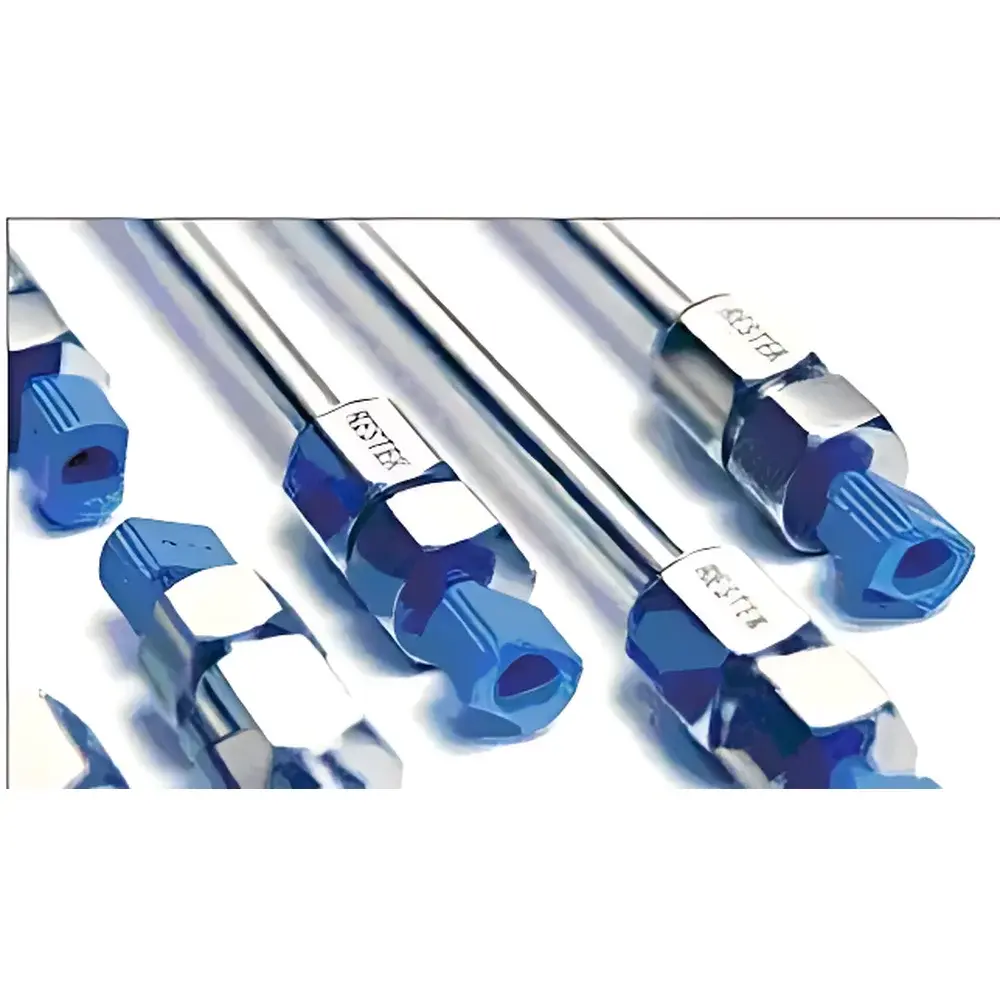
Restek Allure®, Ultra, Kromasil®, Viva, and Pinnacle™ HPLC Columns
| Brand | Restek |
|---|---|
| Origin | USA |
| Product Lines | Allure® C18, Allure® Basix, Allure® PFP Propyl, Allure® Biphenyl, Ultra C18, Ultra Aqueous C18, Ultra IBD, Kromasil® C18, Viva Wide Pore C18, Pinnacle™ II C18, Pinnacle™ DB C18 |
| Column Dimensions | 50 mm, 150 mm, 250 mm (length) |
| Particle Sizes | 3 µm & 5 µm |
| Catalog Numbers | e.g., 9214352-712, 9414565-712, 9178575-712, etc. |
Overview
Restek HPLC columns represent a comprehensive portfolio of high-performance liquid chromatography stationary phases engineered for method development flexibility, robustness under diverse mobile phase conditions, and long-term column lifetime. These columns operate on the principle of partition chromatography—where analyte separation is governed by differential distribution coefficients between the mobile phase (liquid solvent system) and the chemically bonded stationary phase immobilized on high-purity silica or hybrid particle substrates. Designed for use with standard and UHPLC-capable instrumentation, Restek’s column families—including Allure®, Ultra, Kromasil®, Viva, and Pinnacle™—address distinct selectivity requirements across pharmaceutical, environmental, food safety, and clinical research applications. Each column series undergoes rigorous quality control per ISO 9001-certified manufacturing protocols, with batch-specific test chromatograms and retention data provided to ensure inter-batch reproducibility and method transfer reliability.
Key Features
- Multiple bonded phase chemistries—including C18, phenyl-hexyl, biphenyl, pentafluorophenyl (PFP), basic deactivation (Basix), and aqueous-optimized (Ultra Aqueous)—to support orthogonal method development.
- High-purity, low-metal-content silica (e.g., Kromasil®’s Type B silica) and hybrid organic-inorganic particles (e.g., Ultra and Allure® platforms) delivering enhanced pH stability (pH 1–12 for select phases) and reduced silanol activity.
- Tightly controlled particle size distribution (3 µm and 5 µm options) and narrow pore size distribution (e.g., 100 Å, 120 Å, or wide-pore 300 Å for large biomolecules) ensuring consistent backpressure profiles and resolution performance.
- Endcapping and dual-layer bonding strategies applied across Allure® and Pinnacle™ series to minimize peak tailing for basic compounds and improve quantitative accuracy in regulated environments.
- Validated compatibility with gradient elution, high-organic mobile phases, and aqueous-rich conditions—critical for LC-MS coupling and polar compound analysis.
Sample Compatibility & Compliance
Restek HPLC columns are routinely employed in workflows aligned with pharmacopeial standards including USP L1 (C18), L7 (phenyl), L10 (biphenyl), and L43 (PFP), enabling direct method adoption in QC laboratories subject to FDA 21 CFR Part 11 and ICH Q2(R2) validation guidelines. The Ultra Aqueous C18 and Allure® Basix phases demonstrate exceptional stability in 100% aqueous mobile phases—eliminating “drying-out” risks during overnight runs or low-flow storage. All columns are manufactured in an ISO 13485-registered facility, with full traceability from raw material sourcing to final packaging. Certificates of Analysis (CoA) include batch-specific efficiency (N), asymmetry (As), and resolution (Rs) data against standardized test mixtures (e.g., USP System Suitability Mix A), supporting GLP/GMP audit readiness.
Software & Data Management
While Restek columns are hardware components without embedded firmware or native software, they integrate seamlessly with all major chromatography data systems (CDS), including Thermo Fisher Chromeleon™, Waters Empower™, Agilent OpenLab CDS, and Shimadzu LabSolutions™. Column metadata—including lot number, dimensions, particle size, and phase chemistry—is fully embeddable in CDS method files for automated audit trail generation. Restek’s Column Care Guide and Method Transfer Toolkit provide downloadable SOP templates, cleaning protocols, and lifetime estimation algorithms compatible with electronic lab notebook (ELN) platforms. For regulated users, column history logs—including equilibration cycles, solvent exposure records, and pressure trend data—can be exported in CSV format to satisfy ALCOA+ data integrity requirements.
Applications
- Pharmaceutical QC/QA: Assay and impurity profiling of small-molecule APIs using Pinnacle™ DB C18 (USP L1-compliant) or Allure® Biphenyl for orthogonality in forced degradation studies.
- Biopharmaceutical analysis: Separation of monoclonal antibody fragments and peptides via Viva Wide Pore C18 (300 Å) under denaturing or native conditions.
- Environmental testing: Multi-residue pesticide analysis in soil/water extracts using Ultra IBD (indole-bonded phase) for enhanced retention of polar heterocycles.
- Clinical toxicology: Quantification of drugs of abuse and metabolites in plasma/urine with Allure® PFP Propyl, leveraging π–π and dipole–dipole interactions for improved selectivity over C18.
- Food & beverage safety: Detection of mycotoxins, veterinary drug residues, and artificial sweeteners using Kromasil® C18 columns validated per AOAC and EU SANTE/11312/2021 guidelines.
FAQ
Are Restek HPLC columns compatible with UHPLC systems?
Yes—columns with 2.1 mm ID and 3 µm particles (e.g., Allure® C18, Pinnacle™ II) are rated for pressures up to 1000 bar and optimized for sub-2 µm equivalent efficiency at flow rates ≤0.5 mL/min.
What is the recommended maximum operating temperature for Kromasil® C18 columns?
Kromasil® C18 columns maintain stable performance up to 60 °C; extended operation above this temperature requires validation of retention time drift and peak shape per ICH Q5C.
Do Restek columns include system suitability test data?
Each column ships with a printed CoA containing resolution (Rs) values for USP Test Mixture A or B, plate count (N), and tailing factor (T) measured under defined conditions.
How should I store an Allure® Basix column after use?
Flush thoroughly with ≥10 column volumes of acetonitrile/water (50:50 v/v), then store in 100% acetonitrile or methanol at ambient temperature; avoid prolonged exposure to pure water or buffers.
Is method transfer supported between Ultra C18 and Kromasil® C18 columns?
Method transfer is feasible with minor re-optimization of gradient slope and temperature; both phases exhibit similar hydrophobicity (log kw ~7.2–7.5), but differ in silanol activity—baseline correction and peak symmetry assessment are advised.






