
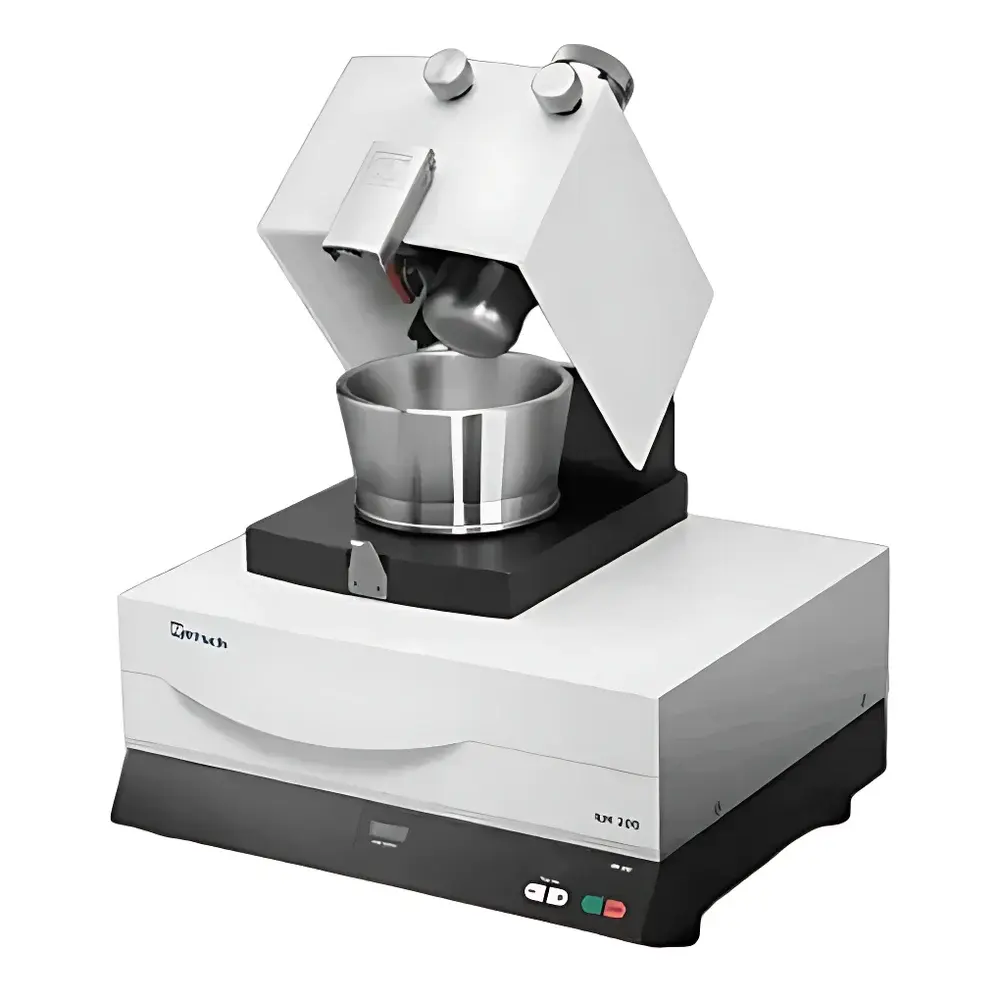
RETSCH RM 200 Mortar Grinder
| Brand | RETSCH |
|---|---|
| Origin | Germany |
| Model | RM 200 |
| Grinding Principle | Mechanical mortar grinding with adjustable impact force |
| Maximum Feed Size | < 8 mm |
| Final Particle Size | < 10 µm |
| Rotational Speed | 100 rpm |
| Grinding Modes | Dry, Wet, Cryogenic |
| Grinding Vessel Materials | Stainless steel, tungsten carbide, agate, ceramic |
| Pestle & Scraper Force Adjustment | Continuously variable |
| Scraper Materials | Polyurethane (PU), Beech wood, Polytetrafluoroethylene (PTFE) |
| Compliance | CE, ISO 9001, GLP-ready |
Overview
The RETSCH RM 200 Mortar Grinder is a precision-engineered laboratory instrument designed for reproducible, low-heat mechanical size reduction of small to medium sample quantities (typically 0.1–15 g). Operating on the principle of mortar grinding—where a rotating pestle applies controlled compressive and shearing forces against a stationary grinding bowl—the RM 200 delivers consistent particle size distribution without significant thermal degradation. Unlike rotor-based mills or ball mills, this system minimizes contamination through direct material confinement and eliminates media wear debris by avoiding grinding balls or discs. Its fixed rotational speed of 100 rpm ensures stable energy input, while continuously adjustable pestle pressure enables fine-tuning of comminution intensity across diverse material classes—from brittle pharmaceutical excipients to fibrous plant tissues and cohesive inorganic powders.
Key Features
- Tool-free, rapid exchange of grinding bowls and pestles—compatible with stainless steel, tungsten carbide, agate, and ceramic vessels for application-specific inertness and wear resistance.
- Three interchangeable scraper materials (polyurethane, beech wood, PTFE) allow optimization of adhesion control and surface compatibility—critical for sticky or electrostatically charged samples.
- Dust-tight sealed grinding chamber with integrated transparent polycarbonate viewport enables real-time process observation without compromising containment or operator safety.
- Continuously adjustable pestle contact force ensures precise control over mechanical stress applied to the sample—essential for preserving thermolabile compounds or achieving narrow PSDs.
- Integrated power monitoring system displays real-time motor load; automatic overload protection prevents mechanical strain and extends service life under variable sample densities or moisture contents.
- Supports dry grinding, wet grinding (with solvents or dispersants), and cryogenic grinding (when used with liquid nitrogen-cooled bowls)—enabling broad method flexibility per analytical or preparative requirements.
Sample Compatibility & Compliance
The RM 200 accommodates soft to medium-hard materials including pharmaceutical actives and excipients, botanical matrices (e.g., dried leaves, seeds, roots), foodstuffs (cocoa nibs, spices, salt), geological samples (soil, slag, coal, coke), ceramics (silicates, cement clinker), and biological cells (yeast, microbial pellets). It is routinely employed in pre-analytical sample preparation for XRD, SEM-EDS, ICP-MS, and dissolution testing. The instrument complies with CE marking requirements and adheres to ISO 9001 quality management standards. Its sealed architecture supports GLP-compliant workflows, and audit-ready documentation—including parameter logging and operator ID tracking—is achievable when paired with RETSCH’s optional software modules compliant with FDA 21 CFR Part 11 requirements.
Software & Data Management
While the RM 200 operates via intuitive front-panel controls, it integrates seamlessly with RETSCH’s RetschControl software suite for method storage, parameter recall, and electronic record generation. Users may define and save standardized grinding protocols—including pestle force, duration, cooling status, and vessel type—with timestamped execution logs. When connected to a networked lab information management system (LIMS), the grinder supports automated data transfer for traceability in regulated environments. All software modules are validated for use in GMP and GLP settings, offering full electronic signature support, change control history, and secure user role assignment.
Applications
- Pharmaceutical development: Homogenization of API blends prior to content uniformity analysis or tablet formulation studies.
- Food & agriculture: Preparation of representative sub-samples from heterogeneous commodities (e.g., oilseeds, nuts, spices) for proximate analysis or contaminant screening.
- Environmental testing: Reduction of soil, sediment, or fly ash to <10 µm for elemental leaching assays (e.g., TCLP, SPLP) or sequential extraction protocols.
- Materials science: Preparing ultrafine powders of cementitious phases or metallurgical slags for phase identification via X-ray diffraction.
- Life sciences: Gentle disruption of yeast cell walls or fungal mycelia for intracellular metabolite extraction without enzymatic or ultrasonic artifacts.
FAQ
What types of grinding vessels are available for the RM 200?
Stainless steel, tungsten carbide, agate, and ceramic bowls—each selected based on hardness, chemical resistance, and contamination sensitivity.
Can the RM 200 handle heat-sensitive samples?
Yes—cryogenic grinding mode, combined with low-speed operation and minimal frictional heating, preserves thermolabile compounds such as vitamins, enzymes, or volatile aroma constituents.
Is the RM 200 suitable for regulatory submissions?
When configured with validated software and operated under documented SOPs, it meets requirements for method reproducibility in USP , ASTM D346, and ISO 13320-compliant particle characterization workflows.
How is cross-contamination prevented between runs?
Tool-free vessel replacement, solvent-compatible surfaces, and optional ultrasonic cleaning protocols ensure effective decontamination—validated via swab testing per ISO 14644-1 Class 5 cleanroom practices.
Does the RM 200 require routine calibration?
No mechanical calibration is needed; however, periodic verification of pestle force linearity and final particle size output (e.g., using certified reference materials like NIST SRM 1979) is recommended for quality assurance.



