
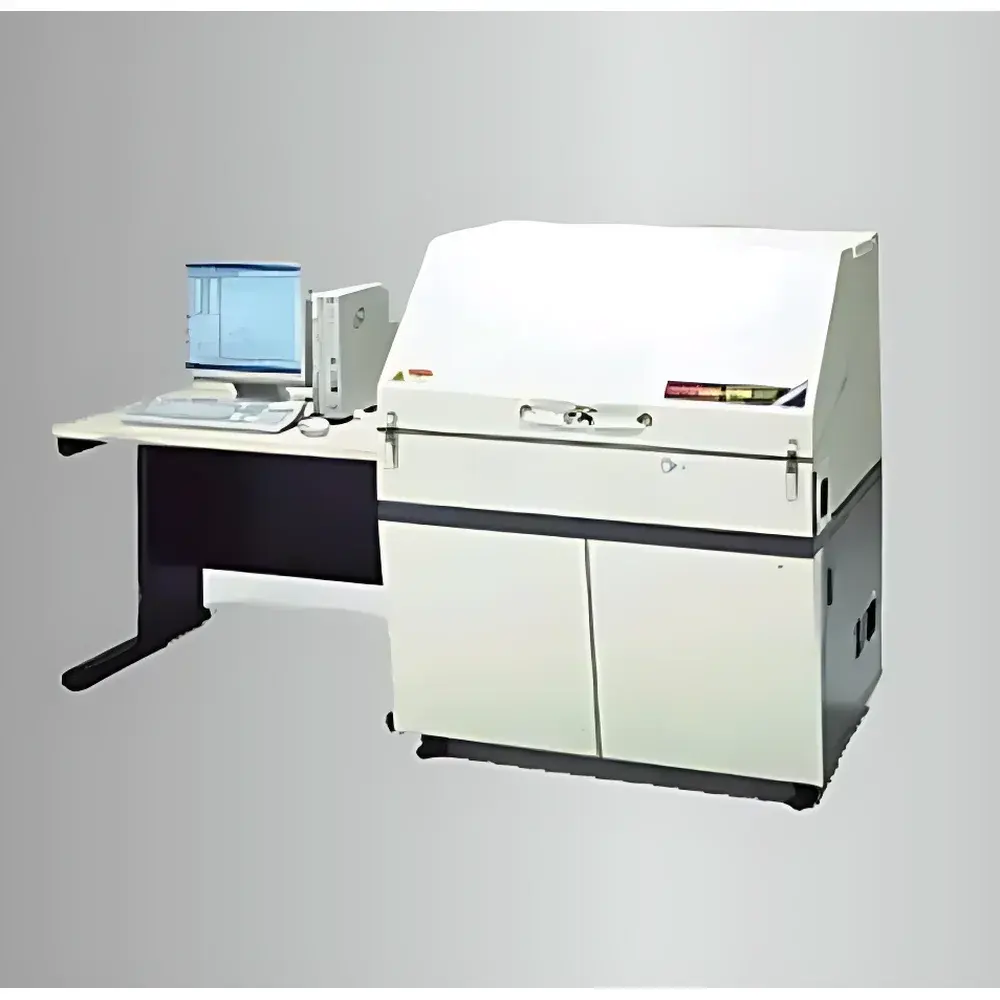
Shimadzu SolidSpec-3700 / SolidSpec-3700DUV High-Sensitivity UV-Vis-NIR Spectrophotometer
| Brand | Shimadzu |
|---|---|
| Origin | Japan |
| Model | SolidSpec-3700 / SolidSpec-3700DUV |
| Optical Design | Double-beam |
| Detector Configuration | PMT (UV-Vis), InGaAs & PbS (NIR) |
| Wavelength Range | 165–3300 nm |
| Wavelength Accuracy | ±0.2 nm |
| Spectral Bandwidth | Variable |
| Stray Light | <0.00005% |
| Sample Compartment Dimensions | 900 W × 700 D × 350 H mm |
| Detection Mode | Direct beam (DDU/DDU-DUV), integrating sphere (N₂-purged for DUV), specular reflection, transmission |
Overview
The Shimadzu SolidSpec-3700 and SolidSpec-3700DUV are high-performance double-beam UV-Vis-NIR spectrophotometers engineered for quantitative and qualitative spectral analysis across an exceptionally broad wavelength range—from deep ultraviolet (165 nm) to near-infrared (3300 nm). Unlike conventional instruments limited to the standard 190–1100 nm range, the SolidSpec series employs a triple-detector architecture: a high-gain photomultiplier tube (PMT) for UV-Vis detection (165–900 nm), an InGaAs detector for extended NIR (900–1700 nm), and a thermoelectrically cooled PbS detector for long-wavelength NIR (1700–3300 nm). This configuration ensures high signal-to-noise ratio (SNR) and photometric accuracy across all spectral regions—critical for demanding applications in optical thin-film metrology, semiconductor process control, flat panel display (FPD) material characterization, and photonics R&D. The SolidSpec-3700DUV variant incorporates a nitrogen-purged optical path and a dedicated Deep UV Direct Detection Unit (DDU-DUV), enabling stable, reproducible measurements down to 165 nm—a capability essential for evaluating wide-bandgap materials (e.g., AlN, Ga₂O₃), excimer laser optics, and high-transmittance DUV anti-reflective coatings.
Key Features
- Triple-detector system (PMT + InGaAs + PbS) optimized for seamless spectral coverage from 165 nm to 3300 nm with automatic detector switching and gain calibration
- N₂-purge-compatible optical bench and sample compartment—enabling reliable deep-UV operation below 190 nm without atmospheric oxygen absorption interference
- Large sample chamber (900 × 700 × 350 mm) with vertical optical path geometry, supporting direct measurement of oversized samples (e.g., 12-inch wafers, FPD substrates, large optical elements) while maintaining horizontal sample orientation
- Variable spectral bandwidth selection (0.1–5.0 nm) with slit-width control, allowing optimization of resolution versus throughput per application requirement
- Double-beam optical design with real-time reference compensation, minimizing drift and enhancing long-term photometric stability (±0.0004 Abs/h at 500 nm)
- High stray light suppression (<0.00005% at 220 nm), critical for accurate absorbance measurements of highly transparent or low-absorbing materials in DUV/NIR domains
Sample Compatibility & Compliance
The SolidSpec platform accommodates solid, liquid, and thin-film samples via interchangeable accessories—including DDU/DDU-DUV transmission units, motorized X-Y sample stages (optional), 60-mm and 150-mm integrating spheres (N₂-compatible), and angle-resolved specular reflectance attachments (5°, 12°, 30°, 45°). Its mechanical and optical architecture complies with ISO 9001-aligned manufacturing protocols and supports GLP/GMP workflows through audit-trail-enabled software operations. Data integrity meets FDA 21 CFR Part 11 requirements when configured with UVProbe’s electronic signature and user-access controls. All optical components—including gratings, mirrors, and detectors—are traceably calibrated against NIST-traceable standards, with optional factory certification available per ASTM E275, ISO 6245, and JIS K 0115.
Software & Data Management
Controlled exclusively by Shimadzu’s UVProbe software suite, the SolidSpec integrates spectral acquisition, quantitative analysis, kinetic profiling, and report generation within a single validated environment. UVProbe includes built-in compliance features: full electronic lab notebook (ELN) functionality, time-stamped audit trails, role-based user permissions, and irreversible data archiving. Batch processing supports multi-sample mapping across large-area substrates using the optional X-Y stage. Raw spectral data is stored in vendor-neutral ASCII and JCAMP-DX formats; export to LIMS or third-party analysis platforms (e.g., MATLAB, Python pandas) is fully supported. Software validation documentation (IQ/OQ/PQ templates) and 21 CFR Part 11 readiness packages are provided for regulated laboratories.
Applications
- Semiconductor Manufacturing: DUV transmittance/reflectance mapping of 300-mm wafers and lithography masks; bandgap determination of wide-bandgap semiconductors (SiC, GaN, AlGaN)
- Flat Panel Display (FPD) Development: NIR-sensitive thickness and uniformity analysis of ITO, metal oxide, and polymer layers on large glass substrates
- Optical Coating Metrology: High-precision evaluation of AR/HR coatings from 165 nm (excimer laser optics) to 3300 nm (thermal IR filters), including scatter-corrected transmittance
- Photonic Materials Research: Characterization of plasmonic nanostructures, quantum dot films, and perovskite absorbers across UV-Vis-NIR with sub-0.1 nm wavelength resolution
- Pharmaceutical Excipient Analysis: NIR identification and quantification of polymorphic forms and moisture content in solid dosage forms (per USP & EP monographs)
FAQ
What is the shortest measurable wavelength with the SolidSpec-3700DUV?
The SolidSpec-3700DUV achieves 165 nm using the DDU-DUV unit under continuous N₂ purge; operation below 190 nm requires purging to eliminate O₂ absorption bands.
Can the instrument measure both transmission and reflectance on the same sample without reconfiguration?
Yes—via automated accessory recognition and UVProbe’s method-driven workflow, users can switch between DDU transmission, integrating sphere diffuse reflectance, and angle-resolved specular reflectance within a single sequence.
Is the 900 × 700 × 350 mm sample chamber compatible with vacuum or controlled-atmosphere gloveboxes?
The chamber is designed for ambient and N₂-purged operation; integration with external inert-atmosphere enclosures requires custom flange adapters and is supported under Shimadzu’s Application Engineering services.
How does the triple-detector system ensure photometric continuity across 165–3300 nm?
UVProbe performs inter-detector intensity normalization using certified reference standards (e.g., NIST SRM 2036), applying wavelength-dependent correction factors derived from factory spectral responsivity maps.
Does UVProbe support automated GMP-compliant reporting for quality control labs?
Yes—predefined report templates include metadata stamping (operator ID, timestamp, instrument serial, calibration status), digital signatures, and PDF/A-1b archival export compliant with ISO 19005-1.




