
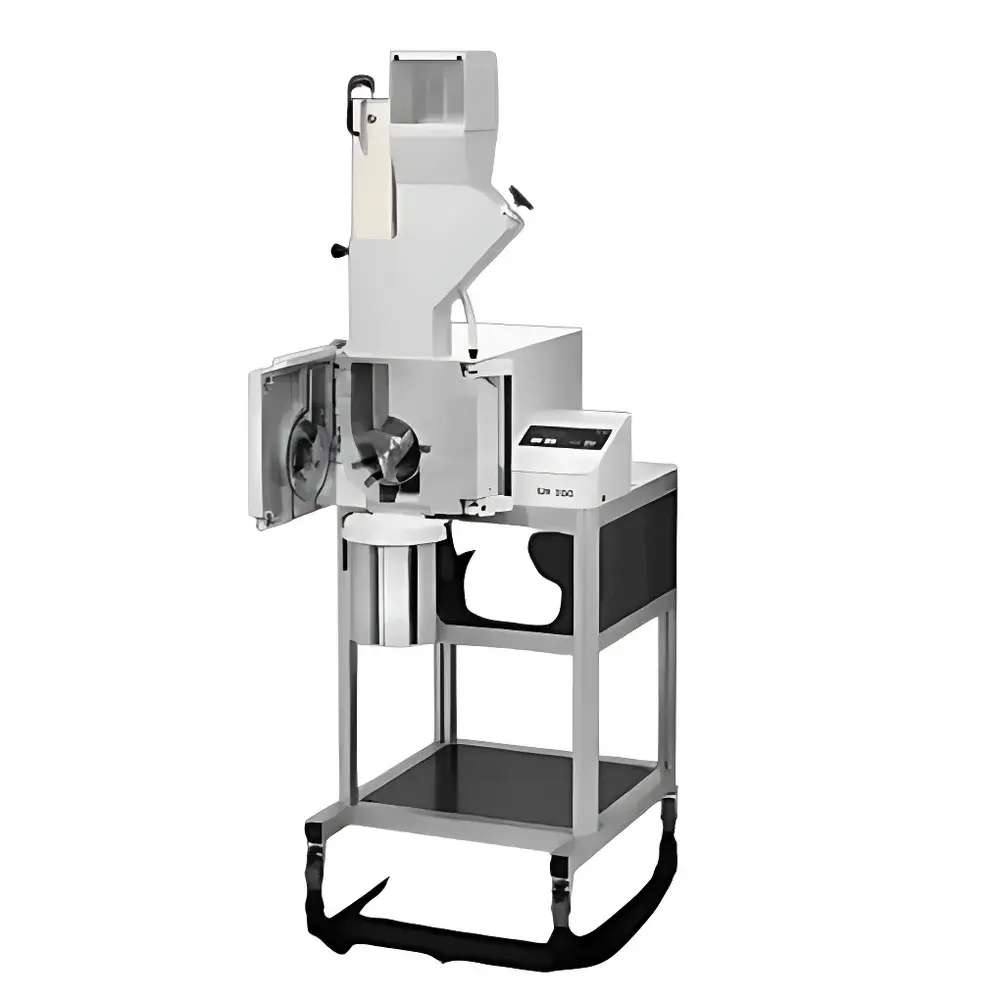
Retsch SM 300 Cutting Mill
| Brand | Retsch |
|---|---|
| Origin | Germany |
| Model | SM 300 |
| Instrument Type | Cutting Mill |
| Sample Applicability | Soft to Medium-Hard Materials |
| Max Feed Size | < 60 × 80 mm |
| Final Particle Size Range | 0.25–20 mm |
| Drive System | High-Torque Motor with RES Technology |
| Peak Power Output | Up to 20 kW |
| Minimum Operating Speed | 100 min⁻¹ |
| Construction Material (Standard) | Stainless Steel AISI 304 |
| Optional Food-Grade Version | AISI 316L |
| Sieve Options | Stainless Steel or Heavy-Metal-Free Perforated Plates (Trapezoidal or Square Apertures) |
| Optional Accessories | Cyclone Separator, 0.5–30 L Collection Vessels, Extended Hopper for Fibrous/Bulky Samples |
| Compliance | CE, ISO 9001, FDA-compliant materials available upon configuration |
Overview
The Retsch SM 300 Cutting Mill is a high-performance, laboratory-scale cutting grinder engineered for reproducible size reduction of soft, fibrous, elastic, and moderately hard materials. It operates on the principle of mechanical shearing and impact comminution, utilizing rotating cutting tools in conjunction with stationary counter-cutting elements to achieve controlled particle size distribution. Unlike rotor mills relying solely on centrifugal force or impact, the SM 300 employs Retsch’s proprietary RES (Rotational Energy Storage) technology — an integrated gravity-driven flywheel system that stores kinetic energy and delivers transient peak torque up to 20 kW. This enables consistent throughput even with heterogeneous or challenging feedstocks, while minimizing operational interruptions caused by jamming or thermal overload. Designed for analytical sample preparation and pilot-scale processing, the SM 300 meets the dimensional and material integrity requirements of regulated environments including food, pharmaceutical, and environmental testing laboratories.
Key Features
- RES Technology: Integrated flywheel delivers high instantaneous torque and dynamic power reserve, enhancing reliability during grinding of dense or adhesive samples.
- Three Rotating Knife Options: Parallel-blade rotor (18 cuts/revolution), 6-wing rotor, and V-shaped rotor — selectable based on sample elasticity, toughness, and desired fineness.
- Variable Speed Control: Adjustable rotational speed from 100 to 3,000 min⁻¹; low-speed operation (<500 min⁻¹) minimizes heat generation for thermolabile or light-sensitive materials.
- Modular Sieve System: Interchangeable bottom sieves with trapezoidal or square apertures (stainless steel AISI 304 or heavy-metal-free variants); aperture sizes determine final particle cut-off (0.25–20 mm).
- Food-Grade Configuration: Optional AISI 316L stainless steel construction for all wetted parts, compliant with EC 1935/2004 and FDA 21 CFR §178.3570 for food contact applications.
- Cyclone Integration: Compatible with stainless steel cyclone separators and collection vessels (0.5–30 L), enabling dust-free handling and near-complete sample recovery (>98%).
- Ergonomic Feed Design: Optional extended hopper facilitates feeding of long, bulky, or fibrous materials (e.g., hemp stalks, straw, cables) without pre-cutting.
Sample Compatibility & Compliance
The SM 300 accommodates a broad spectrum of organic and inorganic feed materials — including plant tissues, animal bone, polymers (PET, rubber, foams), composites, textiles, biomass fuels, pharmaceutical tablets, and electronic waste. Its robust architecture supports samples with high moisture content, elasticity, or fibrous structure — characteristics often problematic for jaw crushers or disc mills. All standard configurations comply with CE Machinery Directive 2006/42/EC and carry ISO 9001-certified manufacturing traceability. For GLP/GMP-aligned workflows, optional audit-trail-capable software interfaces (via Retsch’s RS 232/USB output) support 21 CFR Part 11 compliance when paired with validated LIMS platforms. Material certifications (e.g., EN 10204 3.1, FDA Letter of Guarantee) are available per order for regulated production use.
Software & Data Management
While the SM 300 operates via intuitive mechanical controls (speed dial, start/stop, emergency stop), it features analog and digital signal outputs for integration into automated lab infrastructures. Optional RS 232 or USB connectivity allows real-time logging of operational parameters — including speed, runtime, and motor load — into external data acquisition systems. When used with Retsch’s optional “RETSCH Control” software suite (v3.2+), users can configure method-based protocols, assign operator IDs, generate timestamped PDF reports, and enforce electronic signatures — fulfilling documentation requirements under ISO/IEC 17025 and ASTM D7429 for method validation. All firmware updates adhere to IEC 62443-2-4 cybersecurity guidelines.
Applications
The SM 300 serves as a primary size-reduction tool across quality control, R&D, and regulatory testing domains. Typical applications include homogenization of PET preforms prior to FTIR analysis; comminution of animal feed pellets for proximate analysis (AOAC 985.29); preparation of biomass samples (straw, wood chips, RDF) for calorific value determination (ISO 18125); fragmentation of electronic scrap for RoHS screening (EN 62321-5); and reduction of herbal matrices for HPLC-based phytochemical profiling. In food safety labs, it supports uniform grinding of spices, nuts, and composite snacks prior to mycotoxin extraction (AOAC 2005.08). Its ability to maintain sample integrity — without excessive heating or oxidation — makes it suitable for volatile compound preservation in fragrance and flavor analysis.
FAQ
What materials are incompatible with the SM 300?
Highly abrasive substances (e.g., quartz sand, alumina ceramics) and extremely hard metals (e.g., tungsten carbide, hardened steel) exceed the design limits of the cutting tools and may cause premature wear or mechanical failure.
Can the SM 300 be validated for GMP use?
Yes — with documented IQ/OQ protocols, calibrated tachometer verification, and traceable material certifications (AISI 316L, FDA-grade blades), the SM 300 supports qualification under EU Annex 15 and USP .
Is cryogenic grinding possible with this mill?
No — the SM 300 is not designed for liquid nitrogen cooling; however, its low-speed mode and optional air-cooled housing mitigate thermal degradation for most heat-sensitive organics.
How is particle size distribution verified post-grinding?
Final PSD is determined externally using standardized sieve analysis (ISO 3310-1) or laser diffraction (ISO 13320), as the SM 300 itself does not incorporate in-situ particle sizing.
What maintenance intervals are recommended?
Blade sharpening every 50–100 operating hours (depending on sample abrasiveness); full inspection and torque verification of rotor assembly every 500 hours; annual calibration of speed sensor and thermal cutoff circuitry.



