
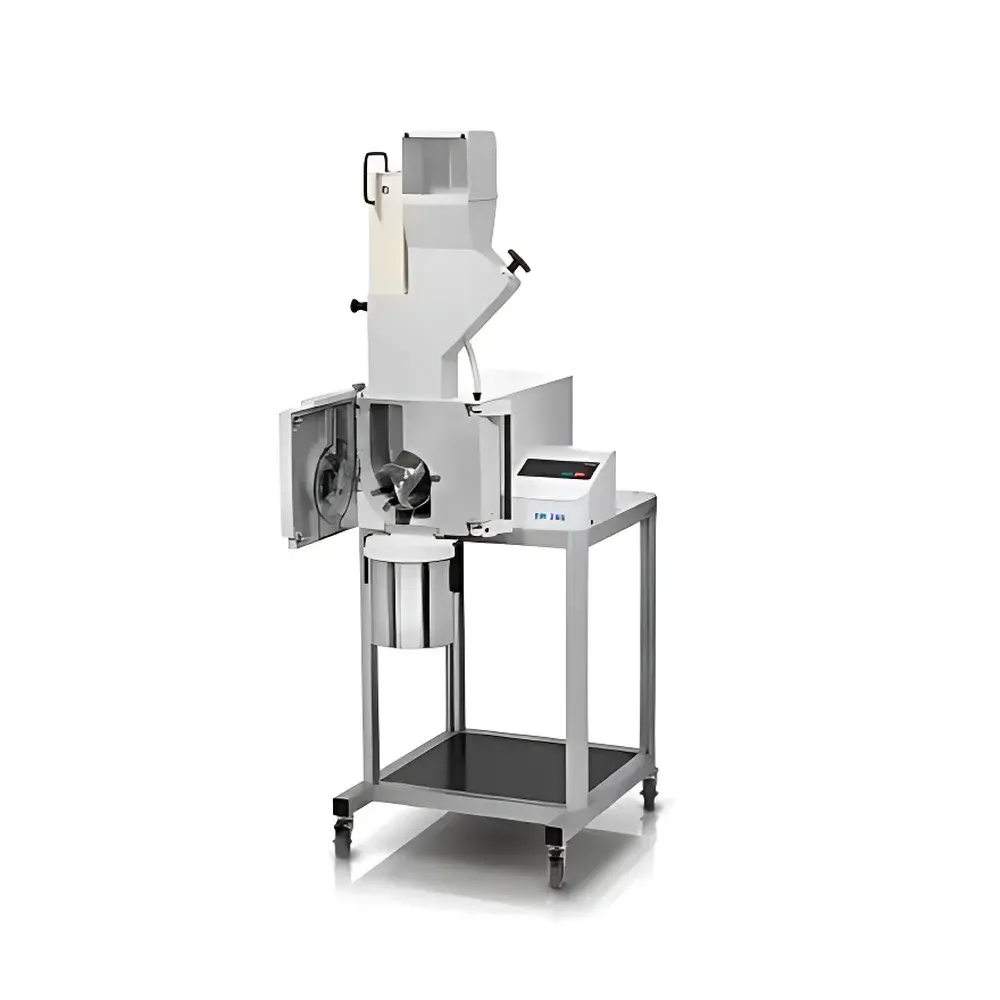
Retsch SM200 Cutting Mill
| Brand | Retsch |
|---|---|
| Origin | Germany |
| Model | SM200 |
| Drive Power | 2.2 kW |
| Max. Feed Size | < 60 × 80 mm |
| Output Particle Size | 0.25–20 mm |
| Rotor Speed | 1,500 rpm |
| Peripheral Rotor Tip Speed | 9.4–11.4 m/s |
| Rotor Diameter | 129.5 mm |
| Rotor Type | Parallel-cut, 6-blade assembly |
| Sieve Options | Trapezoidal apertures (0.25 / 0.50 / 0.75 / 1.00 / 1.50 mm) or square apertures (2.00 / 4.00 / 6.00 / 8.00 / 10.00 / 20.00 mm) |
| Collection Capacity | Standard 5 L hopper |
| Inlet Funnel Options | Standard and extended funnels |
| Construction Materials | Stainless steel, heavy-metal-free grinding steel, tungsten carbide blades |
| Protection Rating | IP54 |
| Dimensions (W × H × D) | 576 mm × 1675 mm × 760 mm (1090 mm H with hopper open) |
| Net Weight | ~90 kg (excl. hopper) |
| Compliance | CE-marked, conforms to EN 61000-6-2/-6-4, EN 61000-3-2/-3-3, EN 60204-1 |
Overview
The Retsch SM200 Cutting Mill is a high-performance, CE-compliant laboratory cutting mill engineered for reproducible size reduction of soft, medium-hard, elastic, fibrous, and synthetic materials. Operating on the principle of high-shear mechanical cutting—rather than impact or compression—the SM200 employs a precisely balanced, parallel-cut 6-blade rotor rotating at 1,500 rpm (50 Hz), delivering a peripheral tip speed of 9.4–11.4 m/s. This design ensures efficient comminution through controlled shearing action between the rotating blades and fixed counter-cutting edges, minimizing heat generation and sample degradation. Its 2.2 kW three-phase motor provides consistent torque across variable load conditions, making it suitable for both routine QC batch processing and demanding R&D applications in regulated environments. The instrument is designed and manufactured in Haan, Germany, in full compliance with ISO 9001 quality management systems and EU Machinery Directive 2006/42/EC.
Key Features
- Robust 2.2 kW three-phase drive with electromagnetic braking for rapid, safe rotor stoppage
- Parallel-cut 6-blade rotor (129.5 mm diameter) enabling 18 cutting events per revolution for uniform particle distribution
- Adjustable final particle size via interchangeable trapezoidal or square aperture sieves (0.25–20 mm range)
- Gravity-fed discharge or optional cyclone separation system (0.25–30 L capacity) for dust-sensitive or low-density samples
- Ergonomic, tool-free blade access via push-in rotor mechanism and splash-proof feed funnel design
- Smooth stainless-steel housing (IP54 ingress protection) with non-porous surfaces for GLP-compliant cleaning and residue minimization
- Integrated safety interlocks: rotor lock verification, emergency stop circuit, and motor overload monitoring per EN 60204-1
Sample Compatibility & Compliance
The SM200 accommodates feed sizes up to 60 × 80 mm and reliably processes heterogeneous matrices including animal feed, plant biomass, polymers, rubber, leather, paperboard, textiles, pharmaceutical excipients, electronic waste, and composite scrap. Its shear-based mechanism preserves structural integrity of thermolabile or viscoelastic samples better than impact mills. All wetted parts are constructed from stainless steel or optionally tungsten carbide—ensuring trace-metal-free operation required for food, feed, and pharmaceutical analysis (compliant with FDA 21 CFR Part 11 data integrity requirements when paired with Retsch’s TRIOS software). The unit meets IEC 61000 electromagnetic compatibility standards and carries full CE marking for use within EEA laboratories operating under ISO/IEC 17025, GLP, and GMP frameworks.
Software & Data Management
When integrated with Retsch’s TRIOS software (optional), the SM200 supports audit-trail-enabled operation logging—including timestamped start/stop events, sieve ID recognition, rotor runtime, and operator credentials. TRIOS complies with FDA 21 CFR Part 11 for electronic records and signatures, enabling full traceability for regulatory submissions. Method templates can be saved, version-controlled, and exported as PDF reports with metadata (e.g., ambient temperature, humidity, sieve specification). Instrument diagnostics—including motor current draw, thermal sensor readings, and safety circuit status—are logged automatically and exportable in CSV format for preventive maintenance scheduling.
Applications
- Agriculture & Feed Science: Homogenization of cereal grains, straw, silage, and compound feed prior to NIR or elemental analysis
- Pharmaceuticals: Size reduction of tablet binders, herbal extracts, and excipient blends under cGMP-aligned workflows
- Environmental Testing: Preparation of WEEE, e-waste, and municipal solid waste fractions for leaching tests (EN 12457, TCLP)
- Materials Research: Pre-conditioning of polymer composites, carbon fiber scraps, and bioplastics for rheological or thermal characterization
- Food Safety: Subsampling of heterogeneous food matrices (spices, dried fruits, meat products) for mycotoxin or pesticide residue analysis
- Recycling & Circular Economy: Sorting-preparatory milling of cable insulation, automotive shredder residue (ASR), and post-consumer plastics
FAQ
What types of materials are unsuitable for the SM200?
The SM200 is not recommended for highly abrasive materials (e.g., quartz, alumina ceramics) or extremely hard metals without tungsten carbide blade configuration. It is also unsuitable for sticky, paste-like, or high-moisture-content samples (>15% w/w) unless pre-dried.
Can the SM200 be validated for GMP environments?
Yes—when operated with documented SOPs, calibrated torque sensors (optional), and TRIOS software with 21 CFR Part 11 mode enabled, the SM200 supports IQ/OQ/PQ protocols aligned with Annex 15 and ASTM E2500.
How often must the rotor blades be replaced?
Blade service life depends on sample abrasivity and throughput; typical replacement intervals range from 200–1,000 operating hours. Wear is monitored via TRIOS vibration analytics or visual inspection of edge geometry.
Is explosion protection available?
ATEX-certified versions (II 2G Ex db IIB T4 Gb) are available upon request for processing flammable organic powders in classified zones.
Does the SM200 support automated feeding?
While gravity-fed operation is standard, vibratory or screw-type feeders (e.g., RETSCH VIBROFEEDER VF 100) can be integrated via custom mounting interface and PLC synchronization.



