
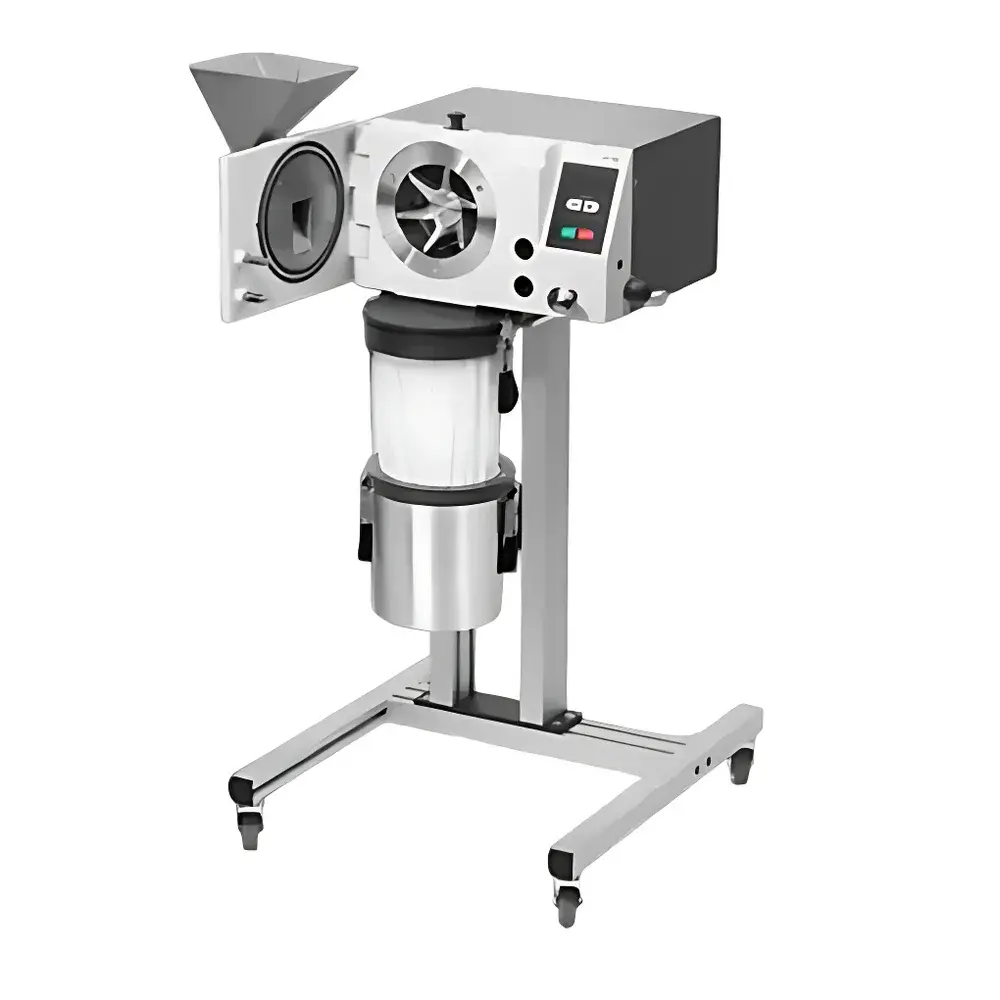
Retsch SR 300 Rotational Impact Mill
| Brand | Retsch |
|---|---|
| Origin | Germany |
| Model | SR 300 |
| Instrument Type | Impact Grinder |
| Sample Applicability | Hard, semi-hard, and brittle materials |
| Feed Size | < 25 mm |
| Final Particle Size | < 50 µm |
| Speed Range | 3,000 – 10,000 rpm |
| Construction | Fully stainless-steel grinding chamber, feed hopper, and inlet/outlet ports |
| Application Mode | Batch or continuous operation |
| Compliance | Designed for ISO/IEC 17025-compliant laboratories |
Overview
The Retsch SR 300 Rotational Impact Mill is an industrial-grade laboratory grinder engineered for high-energy size reduction of dry, brittle, and moderately hard materials. Operating on the principle of rotational impact comminution, the SR 300 accelerates sample particles against hardened steel impact elements mounted on a rapidly rotating rotor—generating controlled mechanical stress sufficient to fracture aggregates, crystalline structures, and composite matrices without significant thermal degradation. Unlike jaw or disc mills, the SR 300’s dynamic impact geometry enables efficient particle size reduction across a broad hardness spectrum—from quartz and ceramic oxides to pharmaceutical tablets and polymer granules—while maintaining batch-to-batch reproducibility essential for analytical sample homogenization and reference material preparation.
Key Features
- Adjustable rotational speed from 3,000 to 10,000 rpm, enabling precise control over impact energy and final particle size distribution
- Stainless-steel grinding chamber, feed hopper, and inlet/outlet channels—resistant to corrosion, wear, and cross-contamination
- Robust cast-aluminum housing with integrated vibration damping and thermal management system for extended operational stability
- Interlocked safety cover with automatic motor cutoff and emergency stop circuit compliant with EN 61000-6-2 and EN 61000-6-4 EMC standards
- Modular design supporting rapid tool-free disassembly for cleaning, maintenance, and residue-free changeover between sample types
- Optional accessories include cryo-cooling adapters (for temperature-sensitive organics), sieve inserts (for in-process size screening), and dust-tight collection vessels certified to ISO 14644-1 Class 8
Sample Compatibility & Compliance
The SR 300 accepts feed particles up to 25 mm in maximum dimension and consistently delivers sub-50 µm output—ideal for downstream techniques requiring fine, homogeneous powders, including X-ray fluorescence (XRF), X-ray diffraction (XRD), laser diffraction particle sizing, and elemental analysis by ICP-OES/MS. It accommodates organic (e.g., plant tissues, polymers), inorganic (e.g., minerals, catalysts, metal alloys), and composite samples—provided they exhibit sufficient brittleness for impact-induced fracture. The instrument meets mechanical safety requirements per EN 61000-1-2 and is routinely deployed in laboratories operating under ISO/IEC 17025, USP , and ASTM D5630–22 protocols for sample preparation. Its sealed architecture supports GLP-compliant documentation of grinding parameters (speed, duration, ambient temperature) when integrated with external data loggers.
Software & Data Management
While the SR 300 operates via a dedicated analog/digital control panel (no embedded firmware or touchscreen), it features RS-232 and 0–10 V analog outputs for integration into centralized laboratory automation systems. Users may record operational parameters—including run time, set speed, and motor current draw—via third-party SCADA or LIMS platforms. For audit-trail compliance in regulated environments (e.g., pharmaceutical QC labs), the device supports manual entry of grinding logs aligned with FDA 21 CFR Part 11 requirements when paired with electronic notebooks or validated Excel-based templates. Routine calibration verification is performed using certified tachometers and traceable particle size standards (e.g., NIST SRM 1980).
Applications
- Preparation of homogenized geological core samples for geochemical assay and petrographic analysis
- Reduction of ceramic green bodies and sintered oxides prior to BET surface area measurement
- Size conditioning of active pharmaceutical ingredients (APIs) and excipients for dissolution testing per USP
- Fragmentation of spent catalysts and metallurgical slags for leaching studies and heavy metal speciation
- Routine grinding of food-grade spices, grains, and botanicals for proximate analysis and contaminant screening
- Production-scale pilot grinding in process development labs, bridging benchtop feasibility to industrial milling parameter optimization
FAQ
What types of materials are unsuitable for processing in the SR 300?
Elastomeric, fibrous, or highly ductile materials (e.g., rubber, copper wire, aluminum foil) are not recommended due to insufficient brittleness for effective impact fracture and risk of rotor fouling.
Can the SR 300 be used under inert atmosphere conditions?
Yes—when equipped with optional gas-purged grinding chambers and sealed feed hoppers, the SR 300 supports nitrogen or argon purging for air-sensitive or pyrophoric samples.
Is routine maintenance required beyond cleaning?
Annual inspection of rotor balance, impact element wear, and bearing preload is advised per Retsch Technical Bulletin TB-SR300-Rev.4; no lubrication of the main drive shaft is required due to sealed bearing construction.
How does the SR 300 compare to planetary ball mills for sub-50 µm grinding?
The SR 300 achieves comparable fineness more rapidly for brittle materials but offers less control over narrow PSDs; planetary mills provide superior repeatability for ultra-fine, low-contamination applications where mechanical alloying or amorphization is desired.
Does Retsch provide method validation support for regulated industries?
Yes—Retsch Application Laboratories offer documented SOPs, grinding parameter matrices, and PQ reports aligned with ICH Q5A and ASTM E2921–20 for method transfer and equipment qualification.



