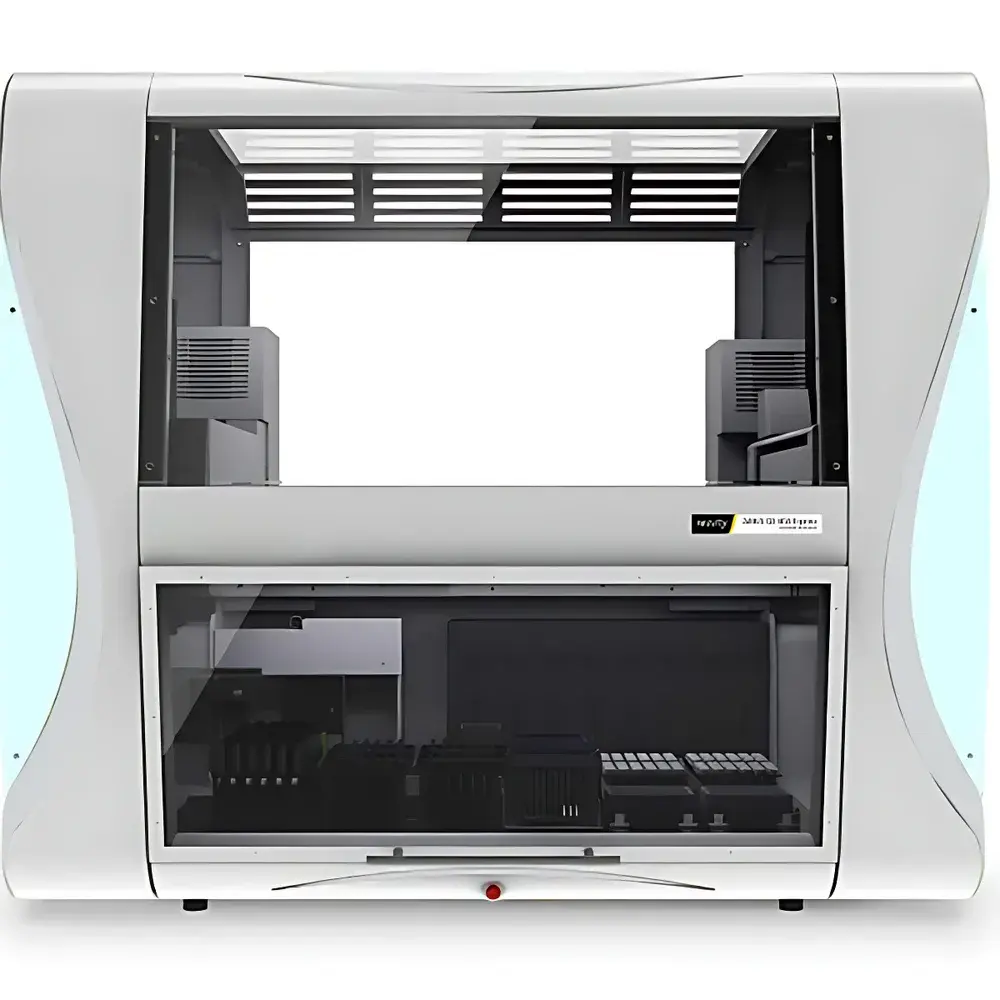
Revvity JANUS G3 Blood iQ Automated Blood Fractionation Workstation
| Brand | Revvity |
|---|---|
| Origin | USA |
| Manufacturer Type | Original Equipment Manufacturer (OEM) |
| Product Category | Imported Medical Instrument |
| Model | JANUS G3 Blood iQ |
| Pricing | Available Upon Request |
Overview
The Revvity JANUS G3 Blood iQ Automated Blood Fractionation Workstation is a purpose-built, benchtop automation platform engineered for precise, traceable, and high-integrity separation of plasma and buffy coat layers from centrifuged whole blood tubes. Unlike generic liquid handlers, the Blood iQ system integrates optical imaging, machine vision–driven layer detection, and adaptive aspiration logic specifically to address the biological variability inherent in clinical blood specimens. It operates on the principle of post-centrifugation stratification analysis—leveraging dual-angle optical imaging and deep learning–based segmentation algorithms to identify interfacial boundaries between plasma, buffy coat, and erythrocyte layers with sub-millimeter spatial resolution. This enables consistent, operator-independent fractionation critical for downstream molecular applications including cell-free DNA (cfDNA), cell-free RNA (cfRNA), and genomic DNA (gDNA) isolation. Designed for integration into biobanking, clinical diagnostics, and translational research laboratories, the system supports ISO 20387-compliant biobank operations and aligns with pre-analytical quality standards outlined in CLSI GP44-A4 and ISO 15189 Annex A.5 for specimen processing traceability.
Key Features
- Dual-angle optical imaging system for real-time, non-contact identification of plasma–buffy coat interface across diverse hematocrit ranges (20–55%)
- Deep learning–powered image analysis engine trained on >50,000 annotated centrifuged blood tube images, enabling robust layer recognition under variable lighting and tube geometry conditions
- High-throughput barcoded tube scanning: processes up to 96 sample tubes per batch using integrated 2D barcode reader compliant with GS1 DataMatrix standards
- Modular, reconfigurable deck layout featuring a recessed left-side tip rack station optimized for 5 mL wide-bore tips—enabling high-volume plasma transfer (up to 2.5 mL per tube) without carryover or splashing
- Multi-point aspiration technology: performs up to 10 independent X/Y/Z coordinate-based aspirations within a single tube well, ensuring maximal buffy coat recovery while minimizing red blood cell contamination
- Precision liquid handling with low-volume accuracy (CV ≤ 3% at 20 µL) and high-volume linearity (R² ≥ 0.999 across 100–2500 µL range)
- FDA 21 CFR Part 11–ready audit trail with immutable electronic records for all user actions, protocol executions, and instrument events
Sample Compatibility & Compliance
The JANUS G3 Blood iQ accepts standard clinical blood collection tubes—including EDTA-K2/K3, citrate, and serum separator tubes (SST)—in sizes ranging from 4.5 mL to 10 mL. Tube compatibility extends to common manufacturers (BD Vacutainer®, Greiner Bio-One, Sarstedt) with automatic diameter and height calibration. All workflows comply with ISO/IEC 17025:2017 requirements for testing laboratory competence and support GLP/GMP-aligned documentation packages. The system meets IEC 61010-1 safety standards for laboratory equipment and incorporates mechanical interlocks and optical sensors to prevent aspiration outside defined layer boundaries. Traceability is enforced via unique tube ID linkage to LIMS-compatible output files (CSV, XML), supporting CAP-accredited biobank workflows and EU IVDR Annex II conformity assessments.
Software & Data Management
Controlled by Revvity’s JANUS G3 Software Suite v4.2+, the Blood iQ workstation delivers intuitive, protocol-driven operation with pre-validated methods for plasma-only, buffy coat-only, or dual-fraction workflows. Software features include drag-and-drop method builder, real-time video overlay of aspiration paths, and synchronized timestamped image capture for every tube processed. Data export supports HL7 v2.5.1 messaging for EMR/LIS integration and includes embedded metadata fields for donor ID, collection time, centrifugation parameters, and fraction volume. Electronic signatures, role-based access control (RBAC), and encrypted local storage ensure compliance with HIPAA, GDPR, and 21 CFR Part 11 requirements. Audit logs are retained for ≥7 years and support automated backup to network-attached storage (NAS) or cloud-based object storage (AWS S3, Azure Blob).
Applications
- Pre-analytical processing for liquid biopsy workflows targeting cfDNA methylation profiling, tumor mutation burden (TMB) assessment, and minimal residual disease (MRD) monitoring
- Biobank-scale plasma and PBMC enrichment for longitudinal cohort studies in oncology, immunology, and metabolic disease research
- Standardized buffy coat harvesting for gDNA extraction in pharmacogenomic screening and HLA typing protocols
- Automated fractionation prior to NGS library prep—reducing hands-on time by >85% compared to manual pipetting while improving inter-operator reproducibility (CV < 5% across 20 replicates)
- Support for CAP/CLIA-certified clinical labs requiring documented SOP adherence and full chain-of-custody tracking from receipt to fractionation
FAQ
Does the JANUS G3 Blood iQ require manual calibration before each run?
No. The system performs automated optical self-calibration at startup and validates tip position accuracy using onboard fiducial markers prior to every protocol execution.
Can it process tubes with hemolyzed or lipemic samples?
Yes—the deep learning model was trained on heterogeneous clinical specimens, including moderate hemolysis (free Hb < 100 mg/dL) and lipemia (triglyceride ≤ 1000 mg/dL), with no impact on layer boundary detection fidelity.
Is third-party LIMS integration supported?
Yes. Native API endpoints (RESTful JSON over HTTPS) enable bidirectional communication with major LIMS platforms including LabVantage, STARLIMS, and Thermo Fisher SampleManager.
What maintenance is required for long-term operational reliability?
Scheduled preventive maintenance includes quarterly optical sensor cleaning, semiannual pipetting performance verification (per ISO 8655-6), and annual firmware updates delivered via secure Revvity Support Portal.
How does the system handle tube labeling inconsistencies or damaged barcodes?
Integrated fallback mode triggers manual ID entry with visual confirmation via touchscreen, while logging the event in the audit trail for QA review.