
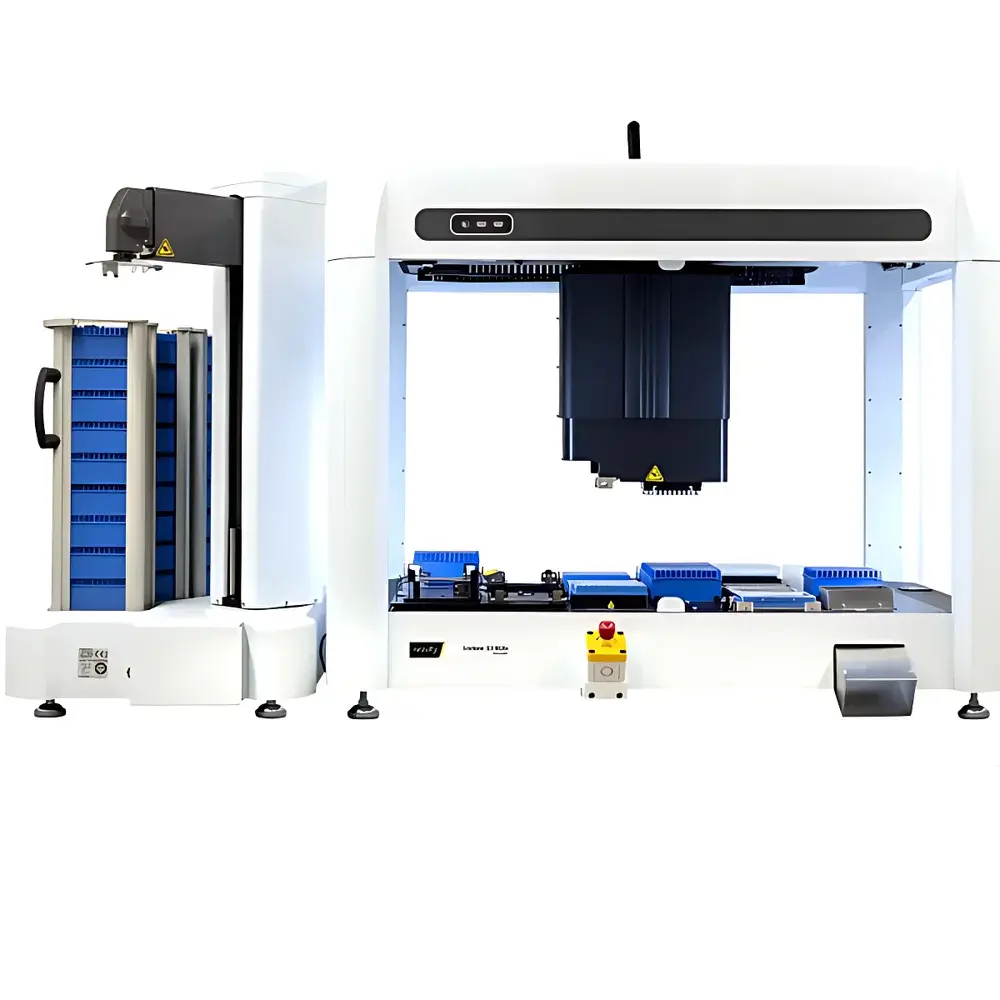
Revvity Sciclone® G3 NGSx iQ™ High-Throughput Automated NGS Library Preparation Workstation
| Brand | Revvity |
|---|---|
| Origin | USA |
| Manufacturer | Revvity, Inc. |
| Product Type | Imported Instrument |
| Model | Sciclone® G3 NGSx iQ™ |
| Plate Positions | 23 (fixed deck layout) |
Overview
The Revvity Sciclone® G3 NGSx iQ™ High-Throughput Automated NGS Library Preparation Workstation is an integrated, walk-away liquid handling platform engineered specifically to address the scalability, reproducibility, and compliance challenges inherent in next-generation sequencing (NGS) sample preparation. Unlike generic liquid handlers, this system implements a purpose-built architecture combining the precision of the Sciclone® G3 liquid handling engine with the extended reach and flexibility of the Twister III 5-axis robotic arm, enabling fully automated manipulation of microplates, tip boxes, and plate lids across a fixed 23-position deck. Its core function is the end-to-end automation of enzymatic fragmentation, end-repair, A-tailing, adapter ligation, size selection (via magnetic bead-based purification), and PCR amplification — all within a single, unattended workflow. The embedded desktop thermal cycler (ODTC) eliminates external instrument dependency and thermal transfer latency, while three independently controlled temperature zones (4–110 °C) support simultaneous incubations at distinct conditions required by multi-step library prep chemistries. Designed for laboratories operating under GLP, CLIA, or ISO 15189 frameworks, the system supports audit-ready operation through deterministic protocol execution and hardware-level process traceability.
Key Features
- Integrated Twister III 5-axis robotic arm with dual-gripper capability for simultaneous handling of plates, tip racks, and lids — eliminating manual intervention during long-run protocols.
- 23-position fixed deck with five positions dynamically accessible by the Twister arm; remaining positions host reagents, consumables, and waste modules.
- On-deck thermal cycler (ODTC) with rapid ramp rates and precise thermal uniformity across all wells — validated for Illumina, Thermo Fisher, and MGI-compatible library amplification steps.
- Three independent temperature-controlled zones: two at 4–110 °C (for enzymatic reactions and bead drying) and one shaking incubator at 4–70 °C (for hybridization and mixing).
- Automated waste segregation system with dedicated compartments for hazardous biological waste, used tips, and non-hazardous plastic — reducing disposal costs and improving lab safety compliance.
- Pre-validated, vendor-agnostic NGS library prep protocols covering >40 commercial kits from leading suppliers including Illumina TruSeq, NEBNext, KAPA HyperPrep, and QIAGEN QIAseq — each verified for yield, fragment size distribution, and duplication rate per ISO/IEC 17025-aligned test criteria.
Sample Compatibility & Compliance
The Sciclone® G3 NGSx iQ™ accommodates standard SBS-format microplates (96-well and 384-well), tube racks (1.5/2.0 mL), and magnetic bead separation plates. It supports input materials ranging from purified genomic DNA and FFPE-derived DNA to total RNA and cfDNA, with compatibility confirmed across QC metrics including DV200, RIN, and Qubit quantification. All preloaded protocols are developed and verified in accordance with ISO 20387 (biobanking), CLSI EP12-A2 (protocol verification), and FDA 21 CFR Part 11 requirements for electronic records and signatures. Audit trails capture timestamped event logs for every liquid transfer, temperature setpoint change, lid movement, and waste ejection — ensuring full traceability for regulatory inspections.
Software & Data Management
The workstation operates via Revvity’s intuitive, icon-driven VWorks™ Automation Control Software, featuring drag-and-drop protocol building, real-time deck visualization, and step-by-step execution monitoring. Protocol libraries are version-controlled and exportable in XML format for cross-lab deployment. Raw run logs and QC summary reports (including pipetting volume deviation, thermal profile fidelity, and cycle count accuracy) are stored in SQLite databases with optional integration into LIMS via HL7 or RESTful API. Software validation packages (IQ/OQ/PQ documentation) are available upon request to support GxP environments.
Applications
- High-volume clinical NGS workflows requiring consistent library quality across hundreds of samples per week.
- Multi-omics core facilities supporting WGS, WES, RNA-Seq, ChIP-Seq, and targeted panel sequencing with minimal hands-on time.
- Pharma R&D labs performing longitudinal biomarker discovery studies where inter-run reproducibility is critical for statistical power.
- Reference laboratories implementing CAP-accredited NGS testing programs with documented SOP adherence and error mitigation.
- Academic genomics centers scaling up population sequencing initiatives without proportional increases in FTE labor.
FAQ
Does the Sciclone® G3 NGSx iQ™ support custom protocol development?
Yes — VWorks™ allows advanced users to define custom liquid handling steps, thermal profiles, and robotic movements using a scriptable interface compliant with ANSI/AAMI SQ10 standards for method validation.
Can the system be integrated into existing laboratory informatics infrastructure?
It supports bidirectional communication with major LIMS platforms via standardized APIs and can export structured QC reports in CSV, PDF, and XML formats.
Is the embedded thermal cycler validated for clinical-grade amplification?
The ODTC undergoes quarterly performance verification per ASTM E2923-22 and includes built-in calibration traceability to NIST-traceable reference blocks.
What level of training and technical support does Revvity provide?
Installation qualification, operator certification, and annual preventive maintenance are included; 24/7 remote diagnostics and on-site engineering support are available under service contracts.
How is reagent carryover mitigated during high-throughput runs?
The system employs air-gap aspiration, post-aspiration tip wiping, and dynamic tip discard positioning — all optimized and verified per CLSI EP26-A guidelines for carryover assessment.



