
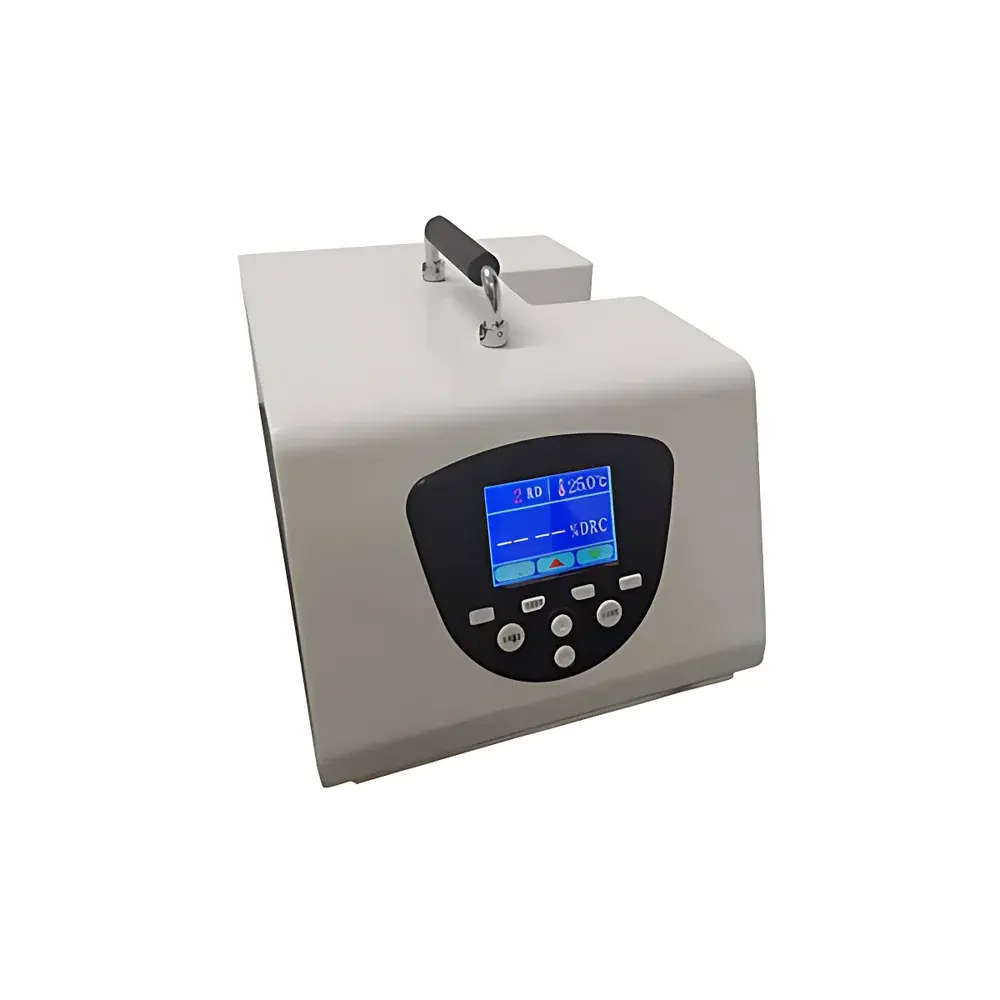
RH2010SF-I Microwave Moisture Analyzer for Organic Solvents
| Brand | Hexi |
|---|---|
| Origin | Hunan, China |
| Manufacturer Type | Authorized Distributor |
| Origin Category | Domestic (PRC) |
| Model | RH2010SF-I |
| Price Range | USD 4,200–7,000 |
| Moisture Measurement Range | 40%–97% (w/w) |
| Accuracy | ±2% of reading |
| Display | TFT-LCD digital interface |
| Single-Measurement Duration | 5–6 s |
| Net Weight | 7 kg |
| Dimensions | 340 × 240 × 200 mm |
| Portability | Integrated carrying handle |
| Compliance Standard | Q/AELE 003–2020 |
Overview
The RH2010SF-I Microwave Moisture Analyzer for Organic Solvents is a dedicated benchtop instrument engineered for rapid, non-destructive quantification of water content in low-polarity, volatile organic liquid matrices. Unlike conventional Karl Fischer titration or loss-on-drying methods, the RH2010SF-I employs microwave dielectric spectroscopy—leveraging the distinct dipole moment and rotational relaxation behavior of water molecules under controlled microwave excitation (typically within the ISM band at 2.45 GHz). In organic solvents such as ethanol, isopropanol, acetone, ethyl acetate, and aqueous-alcoholic formulations (e.g., disinfectants, flavor extracts, coating resins), water exhibits significantly higher dielectric loss tangent (tan δ) compared to most organic components. The analyzer exploits this contrast by emitting a precisely regulated, fixed-frequency microwave signal through a calibrated waveguide cavity; real-time detection of reflected and transmitted power enables calculation of complex permittivity, from which moisture concentration is derived via multivariate calibration models embedded in firmware.
Key Features
- Sub-6-second measurement cycle optimized for high-throughput QC laboratories handling ethanol-based sanitizers, pharmaceutical solvents, and beverage concentrates.
- Dedicated microwave cavity design with temperature-stabilized waveguide oscillator ensures signal consistency across ambient fluctuations (15–30 °C operating range).
- Onboard microprocessor performs real-time compensation for solvent-specific dielectric baseline drift using adaptive algorithmic correction—not reliant on user-entered density or refractive index inputs.
- TFT-LCD display provides direct readout in % w/w moisture, with configurable units (ppm, g/100g) and pass/fail status indication against preset specification limits.
- Integrated solvent recovery pathway directs post-measurement effluent to an external collection vessel, minimizing operator exposure and reducing consumable waste—critical for GMP-aligned environments handling Class 3 solvents.
- Compact footprint (340 × 240 × 200 mm) and ergonomic carrying handle support deployment in mobile labs, pilot plants, or multi-site quality control networks.
Sample Compatibility & Compliance
The RH2010SF-I is validated for use with polar and semi-polar organic solutions where water constitutes the dominant high-loss component—including but not limited to: pharmaceutical-grade ethanol (95%, 75%, USP), hand sanitizer formulations (60–80% ethanol/isopropanol), fruit juice concentrates, cosmetic emulsions, paint thinners, and industrial cleaning agents. It is not suitable for highly conductive aqueous electrolytes, suspensions, or viscous polymers (>500 cP) due to microwave penetration depth limitations. The instrument conforms to enterprise standard Q/AELE 003–2020, which defines performance criteria for microwave-based moisture analyzers in organic media—including repeatability (RSD ≤ 1.2% at 70% moisture level), linearity (r² ≥ 0.999 over 40–97% range), and thermal stability (±0.3% drift after 30-min warm-up). While not certified to ISO 12099 or ASTM D4006, its operational principles align with the physical basis outlined in ISO 15502:2002 (moisture analysis—general principles).
Software & Data Management
The RH2010SF-I operates via embedded firmware with no external PC dependency. All calibration coefficients, method parameters, and measurement logs are stored in non-volatile memory. Up to 100 user-defined test protocols can be saved—including solvent-specific calibration curves generated during factory validation or field requalification. Audit trail functionality records timestamp, operator ID (via optional USB keyboard input), measurement result, and system diagnostics for each analysis—supporting GLP documentation requirements. Data export is supported via USB 2.0 port (CSV format), enabling integration into LIMS platforms compliant with FDA 21 CFR Part 11 when paired with validated third-party data management software. Firmware updates are delivered via encrypted HEX file loaded from FAT32-formatted USB drive.
Applications
- Pharmaceutical manufacturing: In-process verification of ethanol/water ratios in API crystallization solvents and final rinse validation for vial washing systems.
- Food & beverage QA: Rapid screening of alcohol content in fortified wines and spirit blends—correlating moisture loss to ethanol concentration per AOAC 982.07 principles.
- Disinfectant production: Batch release testing of WHO-recommended ethanol- and isopropanol-based formulations per EN 14476 Annex A.
- Coatings & adhesives R&D: Monitoring water ingress in solvent-borne acrylics and polyurethane prepolymers during storage stability studies.
- Contract manufacturing: On-site moisture verification for toll-manufactured cosmetic actives dissolved in propylene glycol or glycerin.
FAQ
Does the RH2010SF-I require chemical reagents or consumables?
No—operation is entirely reagent-free; only routine cavity cleaning with anhydrous ethanol is recommended between sample types.
Can it measure samples with suspended solids or particulates?
Not reliably; suspended matter causes scattering and standing-wave distortion, leading to non-representative permittivity readings. Homogeneous, filtered liquids only.
Is temperature compensation automatic?
Yes—the internal thermistor continuously monitors cavity temperature and applies empirically derived correction factors to the dielectric model in real time.
What is the minimum sample volume required?
3.0 mL is the validated fill volume; deviations below ±0.2 mL introduce measurable error due to field inhomogeneity at the cavity boundary.
How often must the instrument be recalibrated?
Factory calibration remains valid for 12 months under normal use; annual verification using traceable moisture standards (e.g., NIST SRM 2890) is recommended for regulated environments.




