
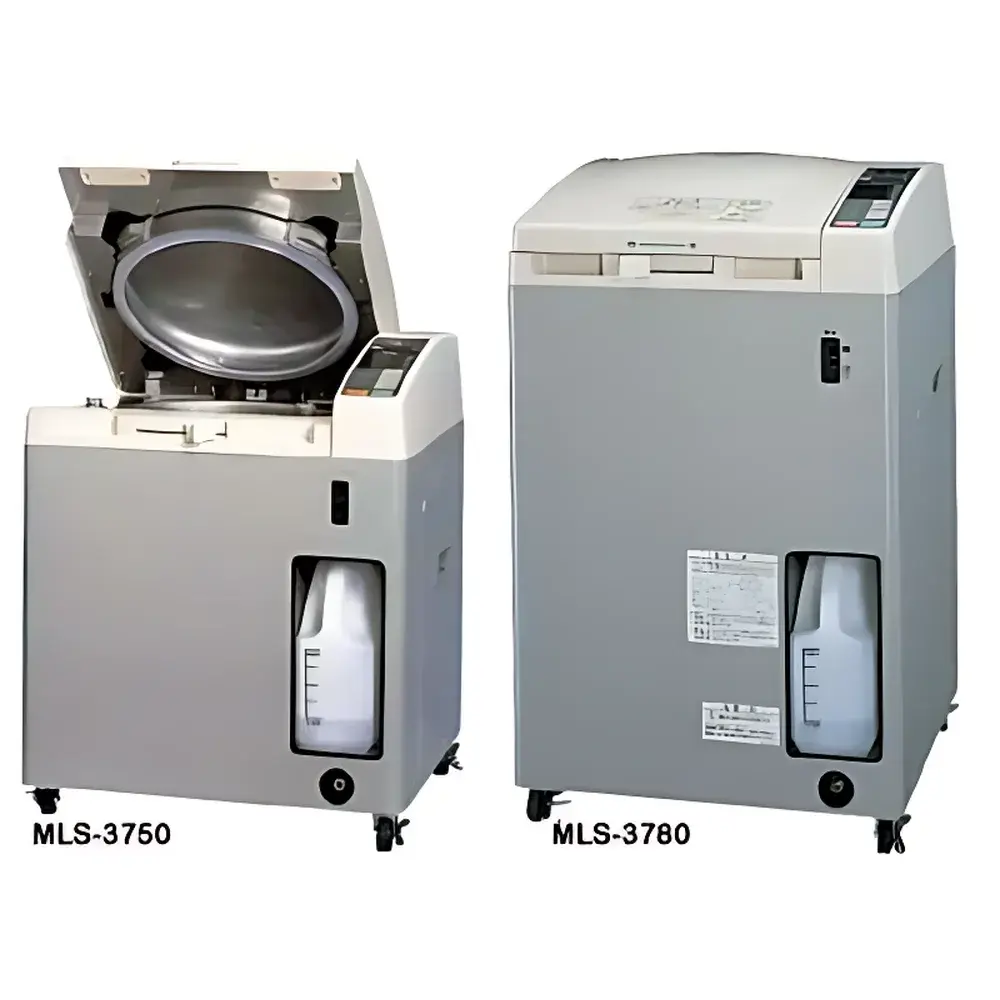
SANYO MLS-3750 High-Pressure Steam Sterilizer
| Brand | SANYO |
|---|---|
| Origin | Japan |
| Model | MLS-3750 |
| Maximum Pressure | 0.235 MPa (2.4 kgf/cm²) |
| Sterilization Temperature Range | 105–135 °C |
| Media Melting Temperature Range | 60–100 °C |
| Holding Temperature Range | 45–60 °C |
| Sterilization Time | 1–250 min (up to 72 h for instrument/utensil cycle) |
| Melting Time | 0–250 min (up to 72 h) |
| Holding Duration | Up to 72 h with auto-shutdown |
| Delayed Start | 1–99 h programmable |
| Chamber Capacity | 50 L |
| Inner Chamber Dimensions (Ø × H) | 370 × 410 mm |
| External Dimensions (W × D × H) | 600 × 560 × 754 mm |
| Safety Features | Dual pressure relief valves, overtemperature limiter, dry-run protection, dual interlocked door mechanism, overpressure cutoff |
| Accessories | 2 × stainless steel baskets (standard), optional 3-basket configuration |
Overview
The SANYO MLS-3750 is a fully programmable, high-pressure steam sterilizer engineered for precision, safety, and operational reliability in regulated laboratory environments. Operating on the principle of saturated steam under elevated pressure—compliant with ISO 17665-1 and EN 285 standards—the unit achieves microbial inactivation through thermal denaturation of proteins and nucleic acids. Its microprocessor-controlled system maintains tight temperature uniformity (±2 °C across the chamber during sterilization at 105–135 °C), ensuring reproducible lethality (F0) values essential for validation in GLP, GMP, and clinical research settings. Designed and manufactured in Japan, the MLS-3750 features a robust stainless-steel pressure chamber rated to 0.235 MPa (2.4 kgf/cm²), enabling rapid attainment of 135 °C—critical for reducing cycle times while preserving heat-labile media integrity.
Key Features
- Human-centered ergonomics: Low-profile chassis and upward-opening, self-balancing lid eliminate lateral clearance requirements—ideal for space-constrained labs.
- Dual-interlock door system: Mechanically and thermally interlocked; door release is physically inhibited until chamber pressure drops to ≤0.05 MPa and internal temperature falls below 80 °C—fully compliant with ASME PVHO-1 and PED 2014/68/EU safety directives.
- Programmable steam exhaust control: Exhaust valve activation temperature adjustable between 100–125 °C, minimizing condensation risk during cooling and preventing thermal shock to liquid loads.
- Multi-cycle flexibility: Preconfigured protocols include Liquid Sterilization, Instrument Sterilization (up to 72 h), Media Melting + Hold, and Sterilize-Hold—each independently configurable for time, temperature, exhaust mode, and delay start (1–99 h).
- Chamber geometry optimized for volumetric efficiency: 370 mm Ø × 410 mm H cavity accommodates four 1000 mL Erlenmeyer flasks per shelf or two 50-tube racks—validated load patterns support routine IQ/OQ documentation.
Sample Compatibility & Compliance
The MLS-3750 accommodates standard laboratory glassware (flasks, bottles, Petri dishes), stainless-steel instruments, pipette tips, and wrapped surgical packs. It supports both gravity-displacement and pre-vacuum compatible cycles (via optional vacuum pump integration). All sterilization cycles adhere to internationally recognized biological indicator performance criteria using Geobacillus stearothermophilus spores (ATCC 7953), meeting ISO 11138-3 and USP requirements for aseptic processing environments. The unit’s construction materials—including AISI 304 stainless steel chamber and silicone-free gasketing—ensure compatibility with autoclave-grade packaging and prevent extractables contamination per USP .
Software & Data Management
While the MLS-3750 utilizes an embedded microcontroller (no external PC interface), its event-driven logging system records critical parameters—including actual chamber temperature, pressure, elapsed time, and phase transitions—for each run. Cycle logs are retained onboard for ≥1,000 cycles and can be manually reviewed via the front-panel LCD. For full auditability in FDA-regulated workflows, optional RS-232 output enables connection to external data loggers compliant with 21 CFR Part 11 requirements (electronic signatures, audit trails, and record retention). All firmware updates follow IEC 62304 medical device software lifecycle standards.
Applications
- Routine sterilization of culture media, buffers, and reagents in microbiology and cell culture laboratories.
- Decontamination of reusable labware—including glass, metal, and autoclavable plastics—in academic, pharmaceutical, and diagnostic facilities.
- Preparation of molten agar and selective media requiring precise melting and extended holding without solidification.
- Validation-supporting operations where F0-based cycle development and repeatability are required per ISO 13408-2 and AAMI ST46.
- Compliance-critical workflows including environmental monitoring sample preparation and QC testing in ISO/IEC 17025-accredited laboratories.
FAQ
What safety certifications does the MLS-3750 hold?
The unit complies with JIS B 8401 (Japanese Industrial Standard for sterilizers), carries PSE mark for electrical safety in Japan, and meets CE marking requirements under the Pressure Equipment Directive (PED 2014/68/EU) and EMC Directive 2014/30/EU.
Can the MLS-3750 be validated for GMP use?
Yes—its consistent temperature uniformity, traceable pressure/temperature logging, and mechanical interlocks support IQ/OQ/PQ execution per Annex 15 of the EU GMP Guidelines and FDA Process Validation Guidance.
Is vacuum capability available?
The base MLS-3750 operates via gravity displacement; however, vacuum-assisted air removal (for porous load sterilization) is supported via optional external vacuum pump integration—requiring factory-installed port and controller firmware upgrade.
How is maintenance access designed?
Front-access service panels allow tool-free removal of the water reservoir, drain filter, and exhaust line components—minimizing downtime during preventive maintenance per manufacturer-recommended intervals (every 6 months or 500 cycles).
Does it support automated documentation for regulatory audits?
With RS-232 output and compatible third-party data acquisition software, the unit supports electronic record generation with time-stamped cycle metadata, satisfying ALCOA+ principles for data integrity in GLP/GMP environments.



