
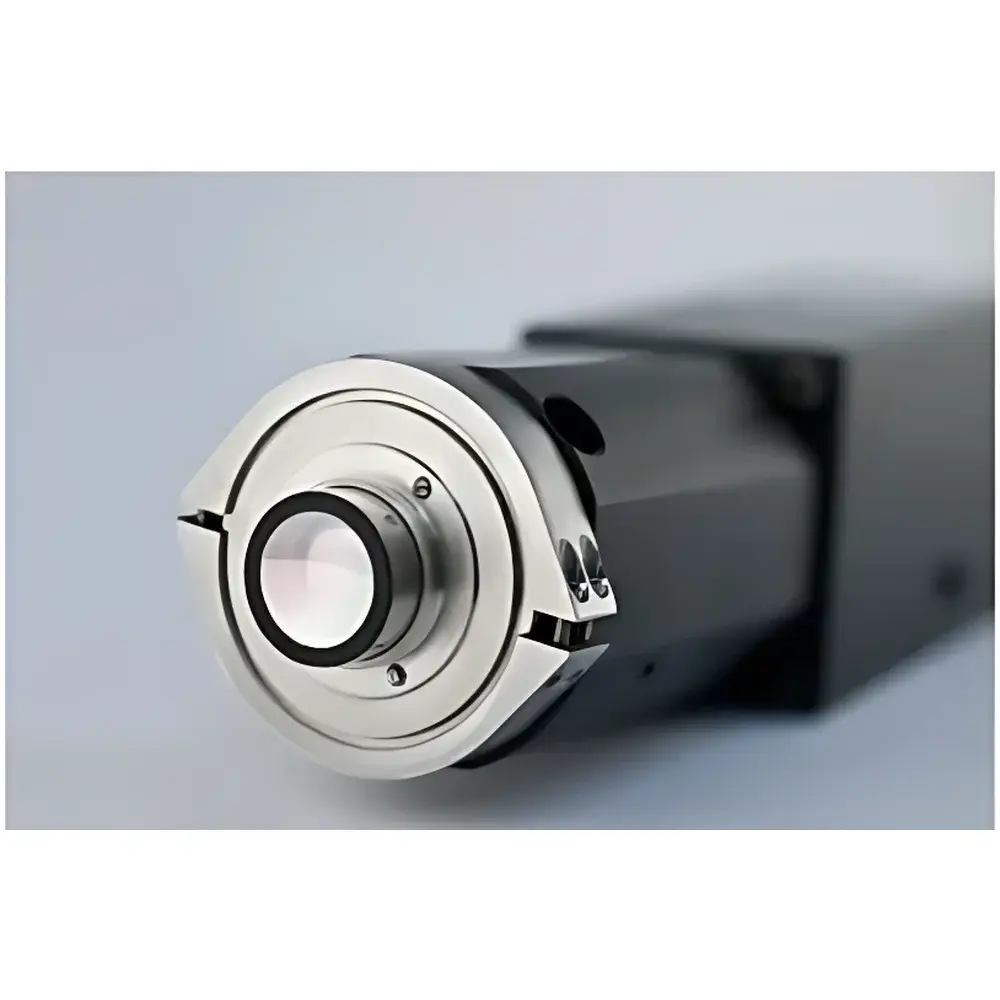
Specim ImSpector Series Hyperspectral Imaging Spectrometer
| Brand | Specim |
|---|---|
| Origin | Finland |
| Model | ImSpector |
| Operating Principle | Push-broom |
| Imaging Method | Dispersive |
| Platform Compatibility | Ground-based & Airborne |
| Spectral Range | 380–1700 nm |
| Spectral Resolution | 6 nm |
| Spatial Resolution (IFOV) | 30 µm |
| Field of View (TFOV) | 8°–56° |
| Frame Rate | 100 Hz |
| Imaging Format | 6.6 mm (spectral) × 8.8 mm (spatial) |
Overview
The Specim ImSpector Series is a family of high-performance, compact push-broom hyperspectral imaging spectrometers engineered for precision spectral-spatial data acquisition across the visible (VIS), visible-near-infrared (VNIR), and near-infrared (NIR) spectral domains. Based on dispersive optical architecture—utilizing transmission gratings and optimized fore-optics—the ImSpector captures full spectral profiles line-by-line as the instrument or sample moves relative to the sensor. This principle enables high-fidelity, distortion-free spectral mapping with minimal keystone and smile aberrations, critical for quantitative reflectance analysis, spectral unmixing, and pixel-wise classification in industrial and scientific applications. Designed for integration into OEM machine vision platforms, laboratory setups, UAV-mounted payloads, and ground-based scanning systems, the ImSpector series delivers consistent radiometric stability and optical throughput (>50%, polarization-insensitive) without requiring active thermal stabilization under standard operating conditions (5–40 °C).
Key Features
- Modular design supporting multiple spectral bands: VIS (380–800 nm), VNIR (400–1000 nm), and NIR (900–1700 nm), with dedicated models (e.g., V10E, N17E) optimized for detector-specific performance.
- Low-aberration optical path: Keystone < 1–5 µm and smile < 1.5–45 µm across models, ensuring spatial-spectral fidelity essential for pixel-accurate chemometric modeling.
- Flexible slit configuration: Standard slit widths (30–150 µm) selectable per application; narrow slits (e.g., 30 µm) enhance spectral resolution at the expense of light throughput, while wider slits improve SNR for low-light scenarios.
- Native C-mount interface with adjustable back focal length (±1 mm), enabling seamless coupling to scientific-grade monochrome CCD/CMOS (e.g., EMCCD) or InGaAs detectors.
- Robust mechanical construction: Anodized aluminum housing (IP50-rated), operational weight range 300–1500 g, and compact form factor (e.g., Ø35 × 139 mm for V8) suitable for space-constrained integrations.
- High frame rate capability: Up to 100 Hz line scan rate, compatible with real-time conveyor-based inspection and synchronized motion control systems.
Sample Compatibility & Compliance
The ImSpector supports non-contact, non-destructive analysis of solid, granular, and semi-solid samples—including agricultural commodities (e.g., peanuts, grape seeds), pharmaceutical tablets, food products, minerals, and painted surfaces—without sample preparation. Its spectral response is calibrated traceable to NIST-traceable standards, and system-level validation adheres to ISO/IEC 17025 principles when deployed in accredited laboratories. While not inherently compliant with FDA 21 CFR Part 11, the ImSpector integrates seamlessly with validated software platforms that support audit trails, electronic signatures, and data integrity controls required for GLP/GMP environments. Optional accessories—including OBF 570 band-rejection filters, FODIS fiber-coupled irradiance sensors, and mechanical shutters—extend functionality for standardized illumination monitoring and stray-light suppression per ASTM E275 and ISO 13406-2 guidelines.
Software & Data Management
ImSpector systems operate with Specim’s proprietary SpectralCube™ software suite, providing real-time preview, spectral calibration, dark/current reference correction, and export in ENVI-compatible BIL/BIP formats. Raw data are stored in 16-bit unsigned integer format with embedded metadata (wavelength grid, slit width, exposure time, lens ID). Integration with third-party analysis environments—including MATLAB, Python (via spectral-python, scikit-learn), and commercial packages such as Unscrambler® and ENVI—is fully supported. All spectral datasets retain native spatial-spectral dimensionality (M × N × λ), enabling advanced preprocessing (e.g., Savitzky-Golay smoothing, SNV, wavelet denoising) and multivariate modeling (PLS-DA, SVM-RBF, LDA) directly on pixel-level spectra. Time-stamped acquisition logs and detector temperature telemetry (where applicable) are recorded for full experimental reproducibility.
Applications
- Agricultural quality control: Discrimination of aflatoxin B1-contaminated peanuts via integrated spectral-texture feature extraction and SVM-RBF classification (94% validation accuracy).
- Seed varietal identification: Non-destructive NIR-HSI (874–1734 nm) of single grape seeds with PCA-guided effective wavelength selection and 88.7% predictive classification accuracy.
- Pharmaceutical tablet coating uniformity assessment using spectral slope analysis across 600–900 nm.
- Mineralogical mapping in core scanning workflows, leveraging diagnostic absorption features in the 1000–1700 nm region.
- Recyclable material sorting in automated waste streams via spectral library matching against PET, HDPE, and PVC reference spectra.
- Art conservation: Pigment identification and degradation state mapping through subtle shifts in reflectance minima and inflection points.
FAQ
What detector types are compatible with the ImSpector?
Standard configurations support 2/3″-format monochrome CCD/CMOS sensors for VIS-VNIR models and InGaAs line-scan arrays for NIR models (e.g., Xeva-992). Custom adapter rings accommodate larger-format detectors upon request.
Is radiometric calibration included?
Yes—each unit ships with factory-measured relative spectral response (RSR) and optional NIST-traceable irradiance calibration kits are available for absolute reflectance quantification.
Can the ImSpector be mounted on drones?
Yes—lightweight variants (e.g., V8, V10E) have been successfully integrated onto multirotor and fixed-wing UAVs with GNSS-IMU synchronization for georeferenced hyperspectral mosaicking.
How is stray light managed in high-dynamic-range scenes?
Optical design incorporates internal baffling and <0.5% stray light rejection (measured with halogen source + long-pass/Notch filters); optional OBF 570 band-rejection filters further suppress out-of-band contributions.
What is the typical integration time range?
Exposure times are detector-dependent but typically span 10 µs to 1 s, programmable via camera SDK or SpectralCube™ GUI, with hardware-triggered synchronization supported.





