
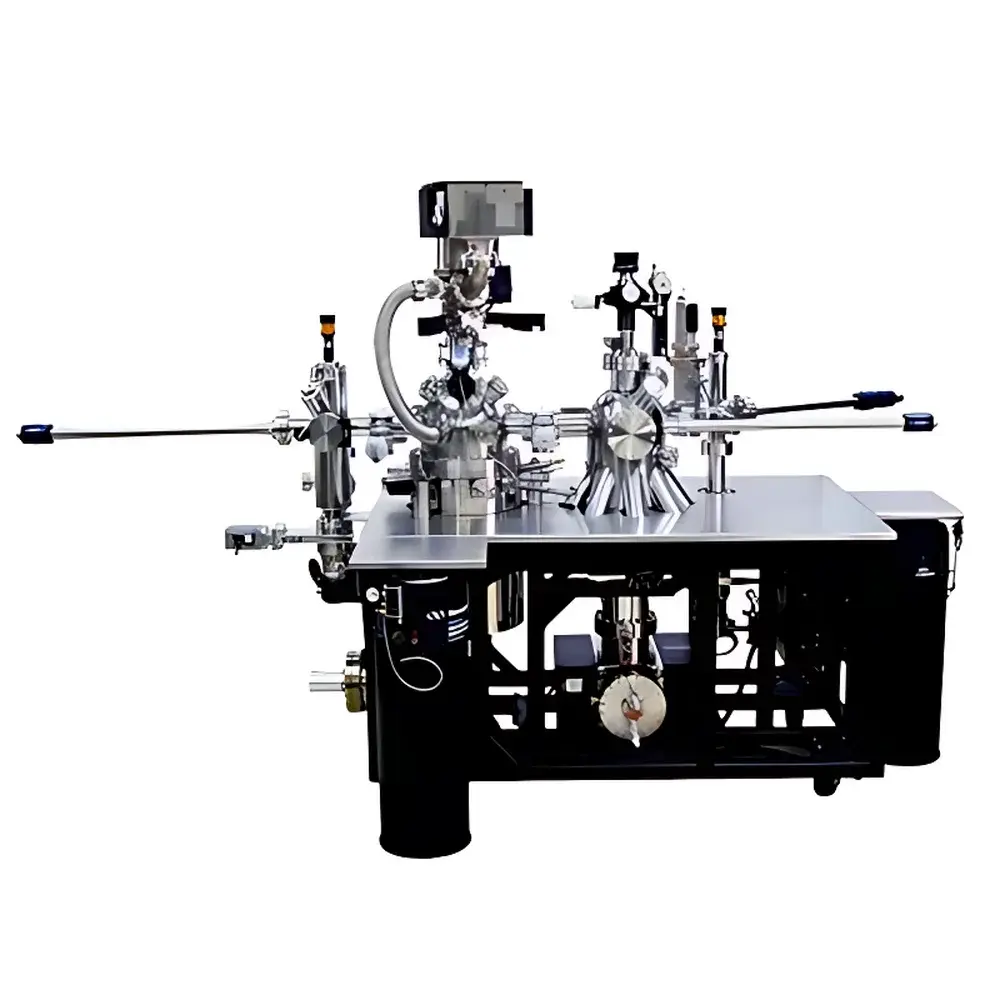
RHK QuadraProbe Ultra-High Vacuum Low-Temperature Four-Probe Scanning Probe Microscope
| Brand | RHK |
|---|---|
| Origin | USA |
| Manufacturer Type | Authorized Distributor |
| Origin Category | Imported |
| Model | QuadraProbe |
| Instrument Type | Scanning Tunneling Microscope (STM) |
| Sample Stage Travel Range | 1.5 µm (300 K) |
| Sample Temperature | 10 K (LHe), 80 K (LN₂) |
| Coarse Approach Range (X/Y/Z) | ±1.5 mm per step |
| Sample Positioning Accuracy | ±1.5 mm |
| STM Resolution | Atomic resolution on HOPG achievable with all four probes |
| SEM Resolution | <20 nm |
| Probe Material | Tungsten wire, optionally coated with Pt, Au, or other conductive metals |
Overview
The RHK QuadraProbe is an ultra-high vacuum (UHV), cryogenic four-probe scanning probe microscope engineered for atomic-scale electrical and topographic characterization under extreme thermal and environmental conditions. Built upon a modular multi-chamber UHV platform, the system integrates scanning tunneling microscopy (STM), scanning electron microscopy (SEM), and optional scanning Auger microscopy (SAM) within a single coordinated infrastructure. Its core measurement principle relies on quantum mechanical tunneling current detection between atomically sharp metallic tips and conductive or semiconductive surfaces—enabling simultaneous multi-terminal transport measurements, local density of states (LDOS) mapping, and in situ spectroscopic analysis at temperatures as low as 10 K. The system’s bath cryostat architecture minimizes liquid helium consumption while maintaining thermal stability essential for high signal-to-noise spectroscopy and long-term drift-free imaging. Designed for fundamental condensed matter physics, mesoscopic transport, superconductivity, and 2D materials research, the QuadraProbe supports true in situ tip and sample exchange without breaking vacuum—ensuring contamination-free operation critical for surface-sensitive experiments.
Key Features
- Four independently controlled, UHV-compatible probes—each capable of atomic-resolution STM imaging on highly oriented pyrolytic graphite (HOPG) and other crystalline substrates
- Cryogenic operation at 10 K (liquid helium) and 80 K (liquid nitrogen), with integrated thermal shielding and vibration-damping stages to ensure sub-angstrom stability
- Modular chamber configuration including main analysis chamber, sample preparation chamber, and fast-load lock chamber—enabling sequential tip conditioning, sample annealing, and transfer without vacuum interruption
- Coarse approach mechanism with ±1.5 mm step motion in X, Y, and Z axes for precise probe positioning prior to piezo-controlled fine scanning
- Optional integration of a superconducting magnet (up to 9 T) mounted directly on the sample stage for magneto-transport studies
- Fiber-coupled optical access to the sample region, supporting in situ photoexcitation, pump-probe spectroscopy, and optoelectronic correlation experiments
- Open, user-programmable control environment based on real-time Linux and LabVIEW-compatible APIs—facilitating custom experiment sequencing, feedback loop design, and third-party instrumentation interfacing
Sample Compatibility & Compliance
The QuadraProbe accommodates standard 10–15 mm diameter planar samples and supports epitaxial thin films, exfoliated 2D crystals, molecular monolayers, and nanostructured electrodes. All vacuum chambers meet ISO Class 5 (Class 100) cleanroom-equivalent pumping specifications, achieving base pressures below 1×10⁻¹⁰ mbar after bakeout. The system complies with UHV material standards (ASTM E1574, ISO 14644-1), and its electrical grounding, EMI shielding, and RF filtering conform to IEC 61326-1 for laboratory measurement equipment. For regulated environments, audit-ready data logging—including timestamped parameter sets, instrument state metadata, and raw current/voltage traces—can be configured to satisfy GLP and FDA 21 CFR Part 11 requirements when paired with validated software modules.
Software & Data Management
Control and acquisition are managed via RHK’s proprietary QControl software suite, which provides synchronized multi-channel lock-in detection, real-time FFT spectral analysis, and automated tip optimization routines. All acquired datasets—including topography, dI/dV maps, conductance spectra, and time-resolved current transients—are stored in HDF5 format with embedded experimental metadata (temperature, bias, setpoint, probe ID, calibration coefficients). The software supports batch processing pipelines compatible with Python-based scientific stacks (NumPy, SciPy, Matplotlib) and includes export filters for Igor Pro, MATLAB, and OriginLab. Remote monitoring and script-based automation are enabled through TCP/IP and RESTful API endpoints, allowing integration into centralized lab data management systems.
Applications
- Multi-terminal conductance quantization and ballistic transport in nanowires and graphene nanoribbons
- In situ spectroscopic imaging of vortex lattices and quasiparticle interference in high-Tc superconductors
- Correlative STM/SEM structural-electronic mapping of heterointerfaces and defect states
- Low-temperature charge ordering, Mott transitions, and Kondo physics in correlated oxides
- Tip-enhanced Raman spectroscopy (TERS) via fiber-coupled excitation combined with spatially resolved tunneling
- Development and validation of first-principles DFT models using experimentally constrained LDOS datasets
FAQ
What vacuum level does the QuadraProbe achieve, and how is it maintained?
The system reaches a base pressure of ≤1×10⁻¹⁰ mbar using a combination of turbomolecular pumps, ion pumps, and non-evaporable getter (NEG) strips; all chambers are bakeable to 150°C for outgassing.
Can the system operate in non-contact AFM mode?
Yes—the platform supports upgrade to frequency-modulated non-contact AFM (FM-AFM) via optional qPlus sensor integration and dedicated low-noise deflection detection electronics.
Is remote operation supported for multi-user facilities?
Yes—QControl includes role-based access control, session logging, and secure VNC-over-SSH remote desktop functionality compliant with institutional IT security policies.
How is tip alignment and calibration performed?
Each probe is individually calibrated using on-axis SEM imaging, piezo sensitivity mapping via capacitive sensors, and in situ tunneling I–V curve referencing against known surface states on Au(111) or Si(111)-7×7.
What documentation and validation support is provided for regulated research?
RHK delivers full IQ/OQ documentation packages, traceable calibration certificates for all motion and current channels, and software validation reports aligned with GAMP5 guidelines upon request.



