
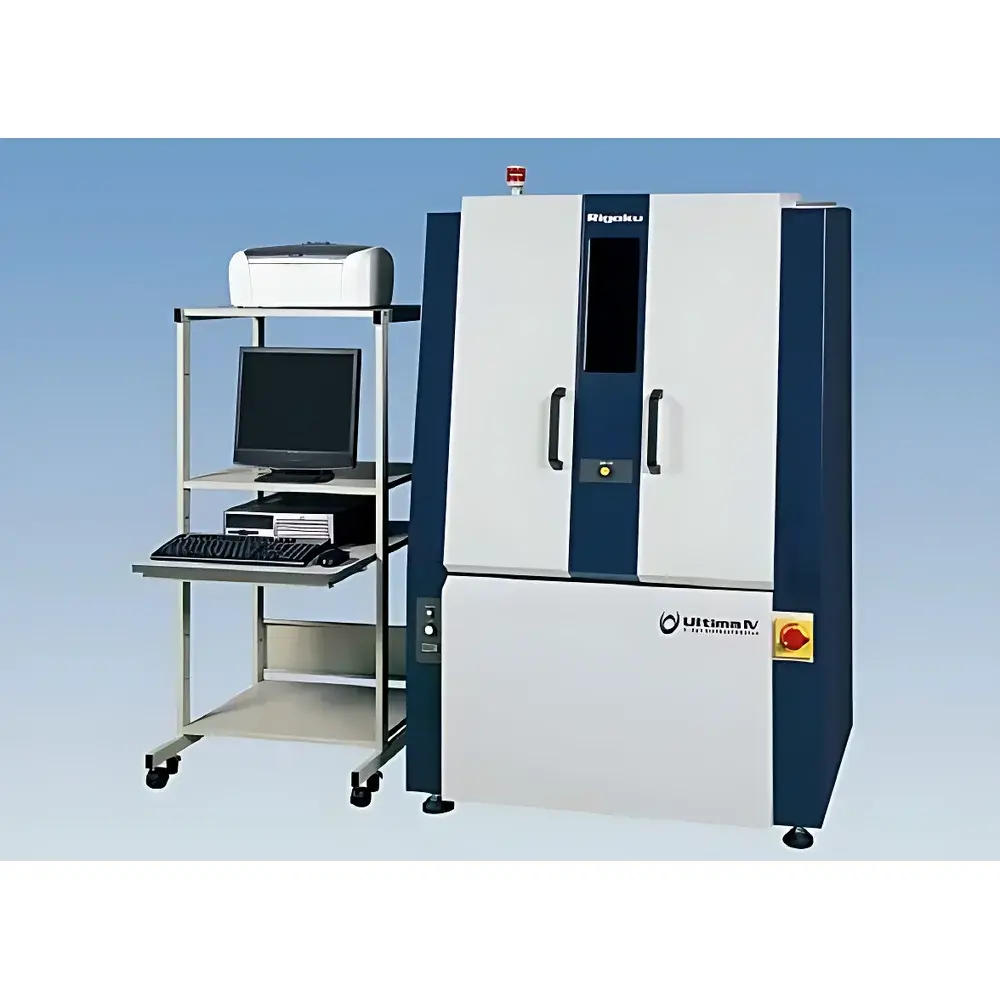
Rigaku MiniFlex / Ultima IV / SmartLab Series X-Ray Diffractometers
| Brand | Rigaku |
|---|---|
| Origin | Japan |
| Model | MiniFlex / Ultima IV / SmartLab |
| Configuration | Benchtop & Floor-Standing |
| Application Type | General-Purpose |
| Elemental Analysis Range | Not applicable (XRD is phase-structural, not elemental) |
| Detection Principle | Bragg diffraction of monochromatic Cu Kα X-rays (λ = 1.5418 Å) |
| Angular Range | 2θ = −5° to 160° (SmartLab), −2° to 140° (Ultima IV), 5° to 80° (MiniFlex) |
| Minimum Step Size | 0.0001° (SmartLab), 0.001° (Ultima IV), 0.01° (MiniFlex) |
| Detector Options | D/teX Ultra (energy-resolving, <20% FWHM at Mn Kα), PILATUS 100K/R (2D photon-counting), scintillation counter |
| Optical Systems | CBO Cross-Beam Optics (patented), fixed or variable divergence/slits, monochromator (graphite or multilayer), in-plane arm, SAXS/Ultra-SAXS module, thin-film optics, micro-diffraction optics |
| Compliance | IEC 61000-6-3, IEC 61000-6-4, JIS Z 3103, FDA 21 CFR Part 1020.40, ISO 17025 (when operated under accredited lab conditions) |
Overview
The Rigaku MiniFlex, Ultima IV, and SmartLab series represent a tiered portfolio of laboratory-scale X-ray diffractometers engineered for precision crystallographic analysis across academic, pharmaceutical, materials science, and industrial quality control environments. These instruments operate on the fundamental principle of Bragg diffraction: when a collimated beam of monochromatic X-rays (typically Cu Kα, λ = 1.5418 Å) impinges upon a crystalline sample, constructive interference occurs at specific angles (2θ) governed by the lattice spacing (d) and Miller indices (hkl), as described by nλ = 2d sinθ. Each system integrates Rigaku’s proprietary optical architectures—MiniFlex emphasizes compactness and safety-certified benchtop operation; Ultima IV delivers rapid reconfiguration between powder, thin-film, and small-angle scattering modes via its patented Continuous Beam Optimization (CBO) optics; SmartLab serves as a fully modular, high-resolution platform with automated component recognition, closed-loop θ/θ goniometry, and support for advanced techniques including in-plane diffraction, grazing-incidence XRD (GIXRD), and ultra-small-angle X-ray scattering (USAXS).
Key Features
- Patented CBO Cross-Beam Optics: Enables seamless switching between parallel-beam (high-intensity) and focused-beam (high-resolution) configurations without manual realignment—critical for reproducible multi-technique workflows.
- Real-Time Angle Calibration: Integrated laser interferometric feedback and dual optical encoders ensure angular accuracy better than ±0.0005° over full 2θ range, eliminating drift during long-duration scans.
- Modular Detector Ecosystem: Supports energy-dispersive detection (D/teX Ultra, <20% energy resolution at Mn Kα) for fluorescence suppression, as well as 2D photon-counting detectors (PILATUS 100K/R) for texture analysis, reciprocal space mapping, and time-resolved studies.
- Automated Component Recognition: SmartLab’s RFID-tagged optics, sample stages, and attachments are auto-identified upon installation—ensuring correct parameter loading and eliminating setup errors.
- Comprehensive Safety Architecture: Interlocked sample chamber with fail-safe shutter closure, redundant beam-stop monitoring, and hardware-enforced dose limits compliant with IEC 61000-6-4 and JIS Z 3103.
- Multi-Mode Sample Handling: Optional 6-position autosampler, rotating stage, hermetic chamber (for air/moisture-sensitive samples), and micro-diffraction optics (spot size down to 100 µm) extend applicability from bulk powders to nanoscale thin films.
Sample Compatibility & Compliance
Rigaku XRD systems accommodate solid-state samples in diverse physical forms: free-flowing powders, pressed pellets, polished metal blocks, spin-coated thin films (<1 nm–1 µm), liquid suspensions (capillary or sandwich cell), and micro-regions (via motorized XYZ stage and CBO-F optics). All models meet international radiation safety standards (IEC 61000-6-3/4, JIS Z 3103) and are designed for integration into GLP/GMP-compliant laboratories. When paired with SmartLab Guidance software and audit-trail-enabled instrument control, systems support full traceability per FDA 21 CFR Part 11 requirements—including electronic signatures, version-controlled method files, and immutable raw data archiving. Routine calibration verification follows ASTM E975 (standard practice for XRD residual stress measurement) and ISO 17873 (XRD phase analysis of cementitious materials), while Rietveld refinement workflows align with ICDD guidelines.
Software & Data Management
SmartLab Guidance—a context-aware, wizard-driven software suite—guides users from experimental design through publication-ready reporting. It auto-selects optimal scan parameters based on sample type (e.g., “pharmaceutical API”, “Si wafer”, “LiCoO₂ cathode”), recommends reference patterns from the ICDD PDF-4+ database, and initiates quantitative phase analysis (QPA), crystallite size/strain modeling (Scherrer–Williamson), and full-pattern Rietveld refinement. Raw data is stored in vendor-neutral .raw/.uxd formats, with metadata embedded per NeXus/HDF5 conventions. Batch processing, spectral overlay, and PDF-4+ library searching are accessible via both GUI and Python API (Rigaku PyXRD). Data export supports CIF, CSV, XYE, and Crystallographic Information Framework (CIF) outputs compatible with TOPAS, GSAS-II, and FullProf.
Applications
- Quantitative phase analysis (QPA) of polymorphic drug substances per USP <1058> and ICH Q5A guidelines
- Determination of crystallinity index and amorphous content in biopolymers and battery electrode materials
- Grazing-incidence XRD (GIXRD) for depth-profiling of epitaxial oxide thin films (e.g., YBCO, STO)
- In-plane/out-of-plane reciprocal space mapping of strained semiconductor heterostructures
- SAXS/USAXS characterization of nanoparticle size distribution (1–100 nm) and pore structure in MOFs and mesoporous silica
- Residual stress evaluation in aerospace alloys using sin²ψ methodology (ASTM E975)
- Automated identification of asbestos species (chrysotile, crocidolite) in building materials per EPA Method IO-3.2
- Free lime (CaO) quantification in cement clinker for process optimization (ASTM C114)
FAQ
What distinguishes MiniFlex from Ultima IV and SmartLab?
MiniFlex is a cost-optimized, 600 W benchtop system ideal for teaching labs and routine QC; Ultima IV adds CBO optics and full automation for multi-technique flexibility; SmartLab integrates 9 kW rotating anode capability, sub-arcsecond goniometry, and full modularity for research-grade structural characterization.
Is GMP/GLP compliance supported out-of-the-box?
Yes—SmartLab Guidance includes 21 CFR Part 11-compliant audit trails, electronic signatures, and role-based access control when deployed on validated Windows OS platforms.
Can these systems perform in-situ or operando measurements?
With optional environmental stages (heating/cooling, humidity, gas flow, electrochemical cells), all three platforms support time-resolved XRD under controlled atmospheres up to 1200 °C or −180 °C.
What detector options are available for low-background SAXS measurements?
The Ultra-SAXS module pairs with a vacuum-compatible PILATUS 100K/R detector and long-collimation path (up to 4 m source-to-detector distance), achieving q-min ≈ 0.001 Å⁻¹.
How is calibration maintained across different optical configurations?
CBO optics retain permanent alignment; automatic calibration routines verify zero-angle offset, 2θ linearity, and intensity stability using NIST-traceable Si standard prior to each session.
Related Products





