
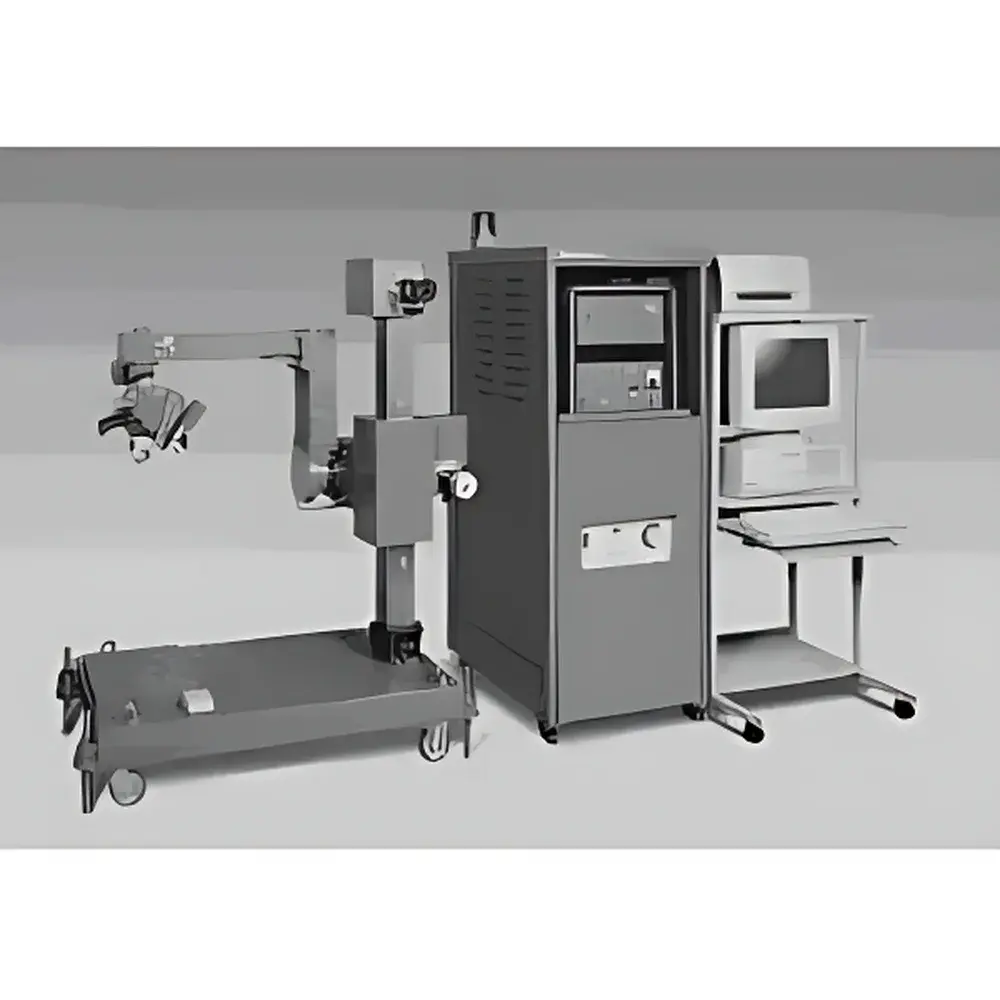
Rigaku MSF-3M / PSF-3M X-Ray Residual Stress Analyzer
| Brand | Rigaku |
|---|---|
| Origin | Japan |
| Model | MSF-3M / PSF-3M |
| Configuration | Benchtop & Portable Versions |
| X-ray Source | Cr-target tube, 30 kV / 10 mA (300 W max) |
| 2θ Angular Range | 140°–170° (standard), 120°–150° (austenite measurement accessory) |
| Operating System | Windows XP |
| Compliance | IEC 61000-6-3, IEC 61000-6-4, JIS Z 3060, ASTM E915-22, ISO 21943:2020 |
| Safety | Interlocked beam shutter, emergency stop, real-time radiation monitoring, sample chamber door interlock |
Overview
The Rigaku MSF-3M and PSF-3M X-Ray Residual Stress Analyzers are precision-engineered instruments designed for non-destructive evaluation of residual stress in crystalline metallic materials using the sin²ψ X-ray diffraction (XRD) method. Based on Bragg’s law and lattice strain measurement, these analyzers determine microstructural deformation by quantifying angular shifts in diffraction peaks as a function of sample tilt angle (ψ). The MSF-3M is configured as a benchtop laboratory system optimized for high reproducibility and multi-directional mapping, while the PSF-3M is a field-deployable variant engineered for on-site stress assessment in manufacturing environments, maintenance facilities, or welding inspection sites. Both models employ a sealed Cr-target X-ray tube operating at up to 30 kV and 10 mA (300 W maximum power), delivering stable, high-intensity Kα radiation ideal for ferrous and non-ferrous alloys. The goniometric system supports precise 2θ scanning from 140° to 170°, with an optional austenite measurement kit extending the range to 120°–150° for phase-specific analysis in stainless steels and duplex alloys.
Key Features
- Non-destructive residual stress quantification via sin²ψ XRD methodology — no surface removal or sectioning required
- Dual configuration platform: MSF-3M (benchtop, lab-grade stability) and PSF-3M (portable, vibration-damped chassis for field use)
- Cr-anode X-ray tube with integrated cooling and long-life design, compliant with IEC 61000 electromagnetic compatibility standards
- Motorized ψ-tilt stage with ±45° angular range and <0.02° positional repeatability, supporting both single-tilt (ψ₀) and double-tilt (ψ) correction protocols
- Automated collimator exchange mechanism for rapid switching between standard (1.0 mm) and micro-beam (0.5 mm) apertures
- Interlocked radiation safety architecture: beam shutter activation synchronized with chamber door status, real-time dose rate monitoring, and hardware-enforced exposure limits per JIS Z 3060
- Integrated XYZ sample positioning stage (±25 mm travel) with manual and motorized options for spatial stress profiling
Sample Compatibility & Compliance
The MSF-3M/PSF-3M accommodates a broad range of industrial specimens — including machined components, weld joints, castings, forged parts, and additive-manufactured metal structures — without geometric constraints. Its compact X-ray optics and adjustable incident angle allow stress measurement on curved surfaces, narrow grooves, and irregular contours. The system complies with ASTM E915-22 (“Standard Test Method for Verifying the Alignment of X-Ray Diffraction Instrumentation for Residual Stress Measurement”) and ISO 21943:2020 (“Non-destructive testing — X-ray diffraction methods for residual stress analysis”). All measurement routines support traceable calibration against NIST SRM 1978 (stainless steel stress standard), and data acquisition adheres to GLP documentation requirements for regulated industries. Radiation shielding meets Japanese Ministry of Health, Labour and Welfare Ordinance No. 33 and EU Directive 2013/59/Euratom.
Software & Data Management
Control and analysis are performed using Rigaku’s proprietary STRESSCALC™ software suite, running natively on Windows XP (with backward-compatible drivers for Windows 7/10 virtual environments). The interface provides real-time diffraction pattern visualization, automated peak search and profile fitting (Pseudo-Voigt function), and iterative sin²ψ linear regression with outlier rejection. Raw intensity vs. 2θ datasets are stored in ASCII and .raw formats; processed stress values export to CSV or Excel with full metadata (sample ID, ψ angle, hkl reflection, FWHM, error estimation). Audit trails record operator login, parameter changes, calibration events, and report generation — satisfying FDA 21 CFR Part 11 requirements when deployed under validated SOPs. Software modules include residual austenite quantification (per ASTM E975), macro-strain separation, and depth-profiling via incremental electrolytic layer removal integration.
Applications
- Quality assurance of heat-treated gears, shafts, and bearing races in automotive and aerospace supply chains
- Weld integrity verification: mapping tensile/compressive gradients across HAZ (heat-affected zones) and fusion lines
- Process validation for shot peening, laser shock peening, and roller burnishing operations
- Failure analysis of cracked or fatigued components where stress concentration precedes fracture
- Residual stress benchmarking in powder metallurgy and directed energy deposition (DED) additively manufactured parts
- Research-grade lattice strain studies in Ni-based superalloys, Ti-6Al-4V, and martensitic steels under thermal-mechanical loading
FAQ
What X-ray diffraction method does the MSF-3M/PSF-3M use for stress calculation?
It implements the sin²ψ technique based on Bragg’s law, measuring lattice strain-induced 2θ peak shifts across multiple sample tilt angles.
Can the system measure residual stress in non-ferrous metals such as aluminum or titanium alloys?
Yes — Cr-Kα radiation is suitable for (311) Al, (111) Ti, and (200) Cu reflections; optional Co or Fe tubes can be integrated for enhanced sensitivity in specific alloys.
Is regulatory documentation available for GMP or ISO 17025 laboratory accreditation?
Yes — Rigaku provides Factory Acceptance Test (FAT) reports, IQ/OQ documentation templates, and metrology certificates traceable to NMIJ (National Metrology Institute of Japan).
How is radiation safety ensured during operation?
Hardware interlocks prevent X-ray emission unless the sample chamber is fully closed and the emergency stop circuit is intact; dose rates are continuously monitored and logged.
Does the system support automated stress mapping across large-area components?
The MSF-3M supports programmable XY raster scanning with user-defined grid spacing; third-party motion controllers can be interfaced via RS-232 or Ethernet for custom macro-motion integration.
Related Products






