
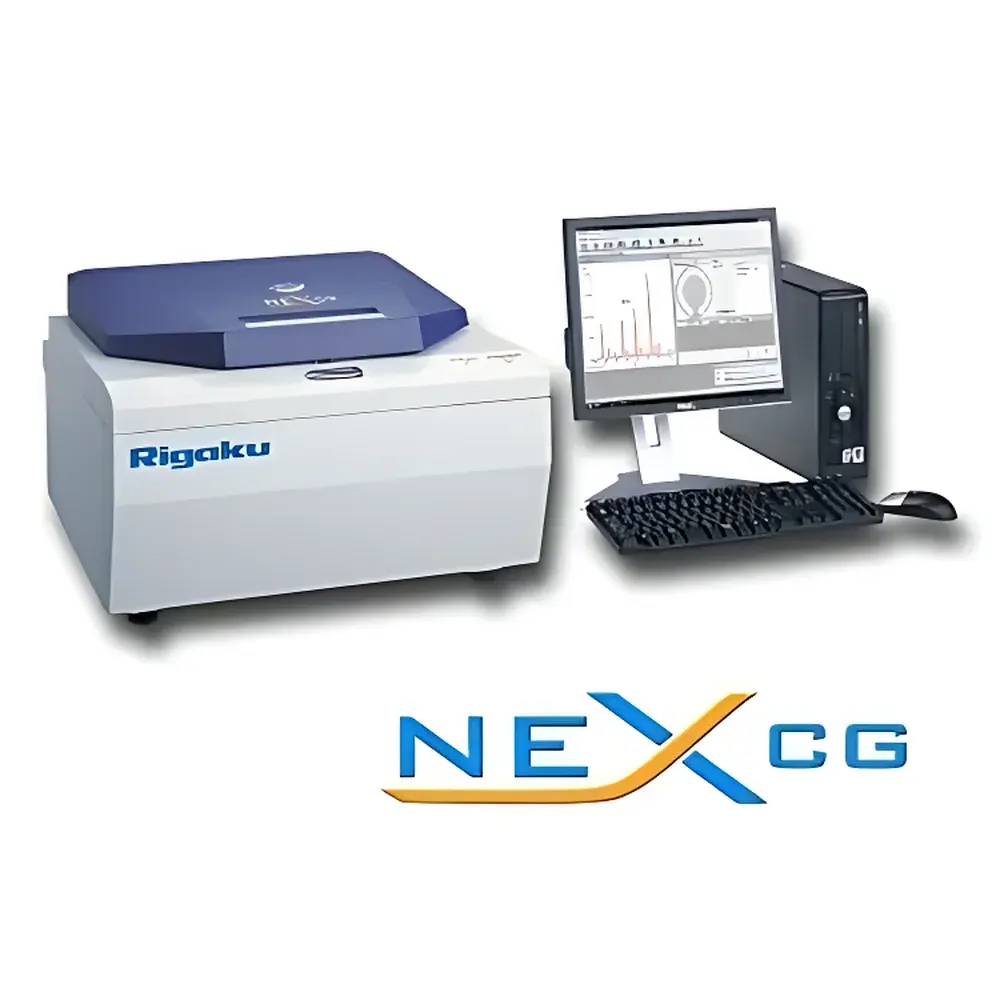
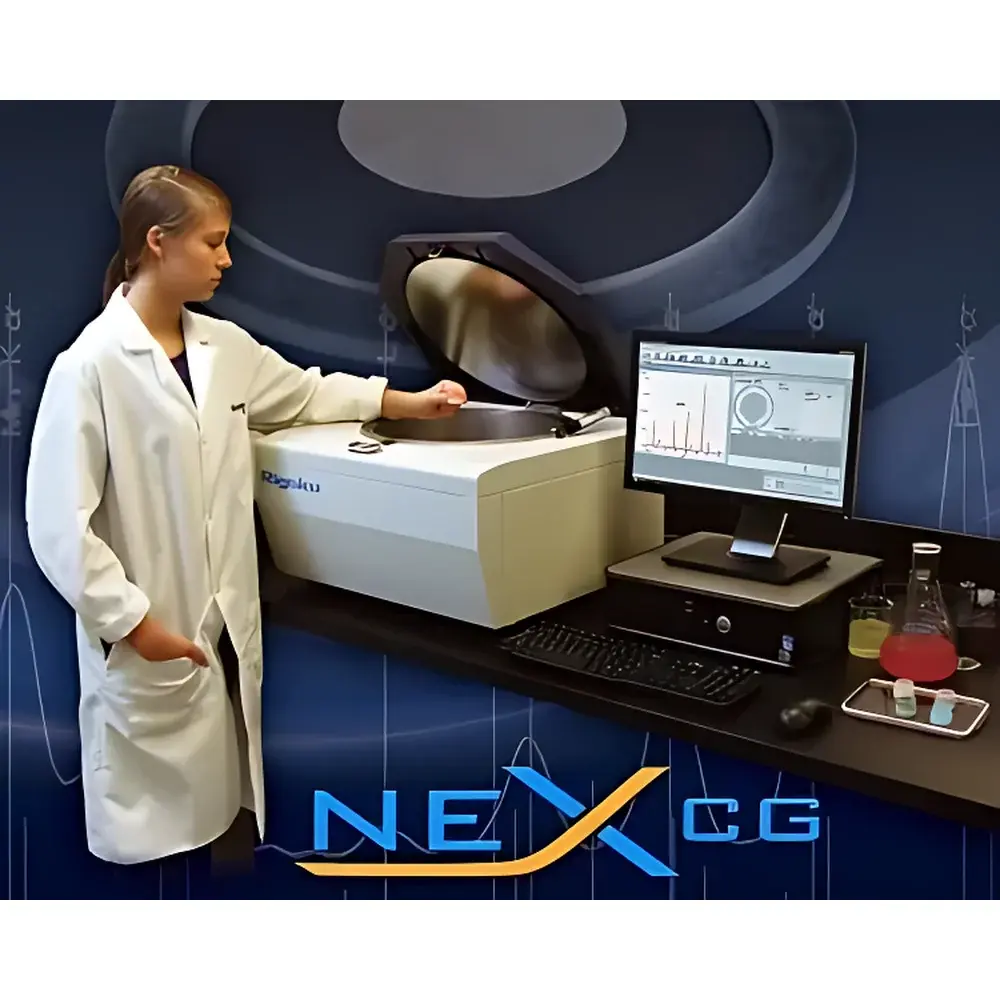
Rigaku NEX CG Energy Dispersive X-Ray Fluorescence Spectrometer
| Origin | USA |
|---|---|
| Manufacturer Type | Authorized Distributor |
| Origin Category | Imported |
| Model | RIGAKU NEX CG |
| Price Range | USD 42,000 – 70,000 (FOB) |
| Form Factor | Benchtop (not handheld — corrected per technical specification) |
| Elemental Range | Na (11) to U (92) |
| Quantification Range | 0.1 ppm to 100 wt% |
| Energy Resolution | ≤140 eV at Mn Kα |
| Repeatability | ≤0.1% RSD for major elements under controlled conditions |
Overview
The Rigaku NEX CG is a benchtop energy dispersive X-ray fluorescence (EDXRF) spectrometer engineered for high-precision elemental analysis across diverse sample matrices. Unlike conventional EDXRF systems relying on direct tube excitation, the NEX CG employs a proprietary tight-coupling confocal geometry (CG) optical configuration. This design positions the X-ray source, sample, and detector in a precisely aligned coaxial arrangement—enabling selective excitation of target elements while minimizing scattered radiation and background continuum. By utilizing secondary target excitation (e.g., Ti, Al, or Cu targets activated by the primary X-ray tube), the system delivers enhanced peak-to-background ratios—particularly critical for trace-level detection of light elements (Na–F) and overlapping transitions in complex spectra. The instrument operates under vacuum or helium purge for optimal light-element sensitivity and conforms to ISO 21043 (XRF performance verification) and ASTM E1621 (standard test method for elemental analysis by EDXRF).
Key Features
- Confocal Geometry Core: Patented optical path reduces geometric scatter and improves signal specificity—yielding up to 5× higher peak intensity and lower detection limits compared to standard EDXRF configurations.
- Secondary Target Excitation: Selectable anode materials (Ti, Al, Cu, Mo) enable optimized excitation energies for specific element groups—enhancing sensitivity for low-Z elements without compromising high-Z linearity.
- UltraCarry™ Liquid Handling Module: Integrated flow-cell accessory enables automated, reproducible analysis of aqueous samples down to sub-ppb (ng/L) levels for regulated environmental and industrial hygiene applications.
- RPF-SQX Software Suite: Incorporates Rigaku Profile Fitting (RPF) algorithm for deconvolution of overlapping peaks (e.g., S Kα/Pb Mα, As Kα/Pb Lα), significantly reducing inter-element interference errors in multi-component matrices.
- Non-Destructive & Multi-Matrix Compatibility: Supports solids (metals, ceramics, polymers), pressed powders, fused beads, thin films (<1 µm), and liquids—without sample digestion or coating requirements.
- Regulatory-Ready Operation: Software supports audit trails, electronic signatures, and 21 CFR Part 11 compliance modules for GLP/GMP environments; calibration records are automatically timestamped and user-locked.
Sample Compatibility & Compliance
The NEX CG accommodates heterogeneous samples ranging from geological core fragments to pharmaceutical excipients and electroplated coatings. Its open-sample chamber (up to 100 mm × 100 mm × 50 mm) accepts irregular geometries without vacuum chamber constraints. For regulatory workflows, the system meets ISO/IEC 17025:2017 requirements for analytical competence when operated with certified reference materials (CRMs) such as NIST SRM 2782 (Al alloy), SRM 2711a (soil), and BAM BCR-723 (steel). Method validation documentation—including limit of detection (LOD), limit of quantification (LOQ), and recovery studies—is fully exportable in PDF and CSV formats for QA/QC reporting.
Software & Data Management
RPF-SQX provides both semi-quantitative screening (with matrix correction via fundamental parameters) and rigorous quantitative analysis using empirical calibrations. The software includes built-in libraries for >120 CRMs and allows custom calibration curve generation with internal standardization (e.g., Co for steel, Rh for catalysts). All spectral acquisitions are stored with full metadata (tube voltage/current, filter selection, acquisition time, purge gas status). Data exports comply with ASTM E1358 (XRF data exchange format) and support LIMS integration via ODBC drivers. Automated report generation includes uncertainty estimation per ISO/IEC Guide 98-3 (GUM) and customizable templates for ISO 17025 accreditation submissions.
Applications
- Materials Science: Alloy grade identification (stainless steels, superalloys), coating thickness & composition (Zn/Ni/Cr on automotive substrates), and inclusion analysis in silicon wafers.
- Environmental Monitoring: Soil heavy metal screening (Pb, As, Cd, Hg), fly ash characterization, and wastewater sludge compliance testing per EPA Method 6200.
- Geology & Mining: Ore grade control (Cu, Fe, Ni, REEs), exploration geochemistry (multi-element pathfinder analysis), and lithological discrimination.
- Consumer Goods Safety: RoHS/ELV-compliant screening of Pb, Cd, Hg, Cr(VI), and Br in plastics, PCBs, and packaging materials.
- Pharmaceuticals: Catalyst residue analysis (Pd, Pt, Rh) in active pharmaceutical ingredients (APIs) per ICH Q2(R2) guidelines.
FAQ
Is the NEX CG a handheld instrument?
No—the NEX CG is a benchtop EDXRF spectrometer with fixed-source/detector geometry requiring stable lab mounting. Handheld variants (e.g., Rigaku KT-100S) are separate product lines with different optical and regulatory specifications.
What vacuum or purge options are available for light-element analysis?
The system supports high-vacuum mode (≤10⁻² Pa) for Na–Mg analysis and helium purge (≥99.999% purity) for extended light-element coverage down to boron (B) under optimized conditions.
Can RPF-SQX perform quantification without certified standards?
Yes—semi-quantitative analysis uses fundamental parameter (FP) algorithms with default mass absorption coefficients; however, trace-level accuracy (<10 ppm) requires at least one matrix-matched CRM for calibration refinement.
Does the UltraCarry module require external pumps or consumables?
The UltraCarry integrates a peristaltic pump, PTFE flow cell, and waste reservoir—all housed within the instrument footprint; only deionized water and optional chelating agents (e.g., EDTA) are required as consumables.
How is measurement repeatability validated?
Repeatability (≤0.1% RSD) is verified per ISO 8258 using 10 consecutive measurements of homogeneous CRMs under identical operating conditions; results are logged in the instrument’s QC dashboard with statistical process control (SPC) charts.






