
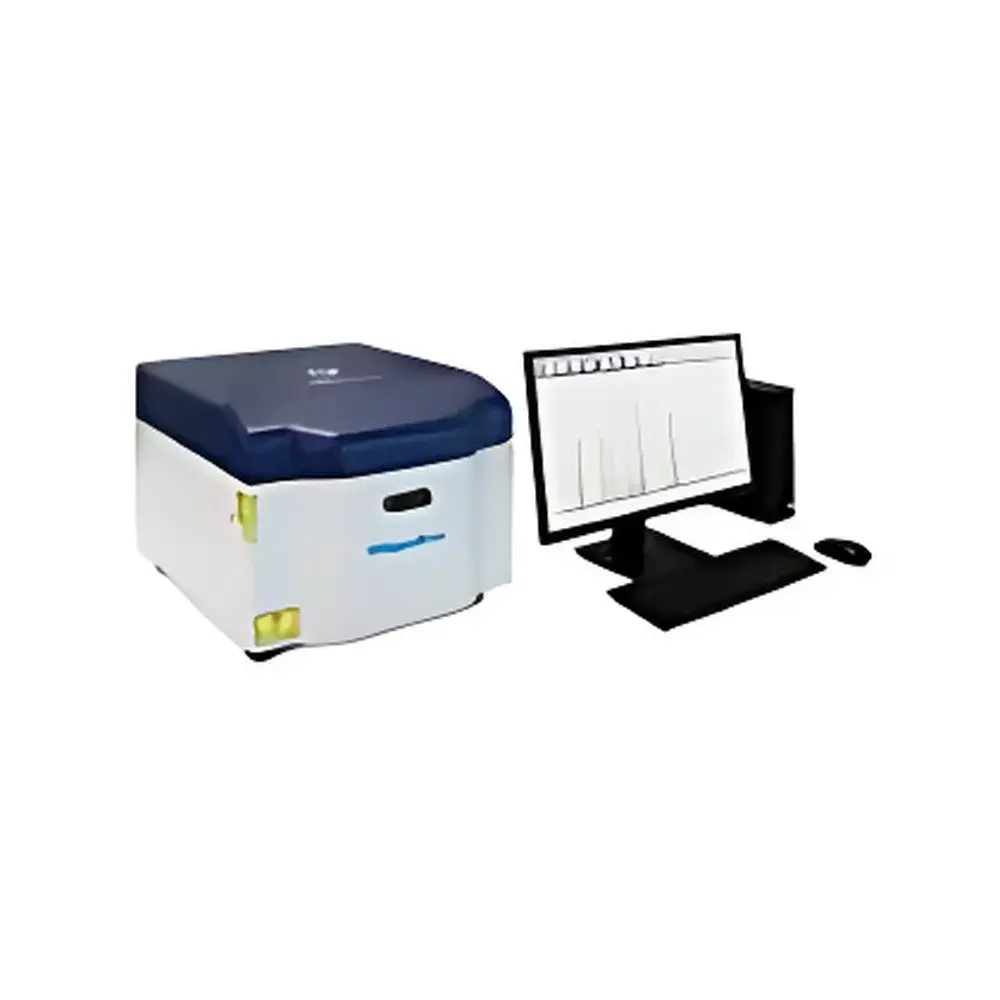
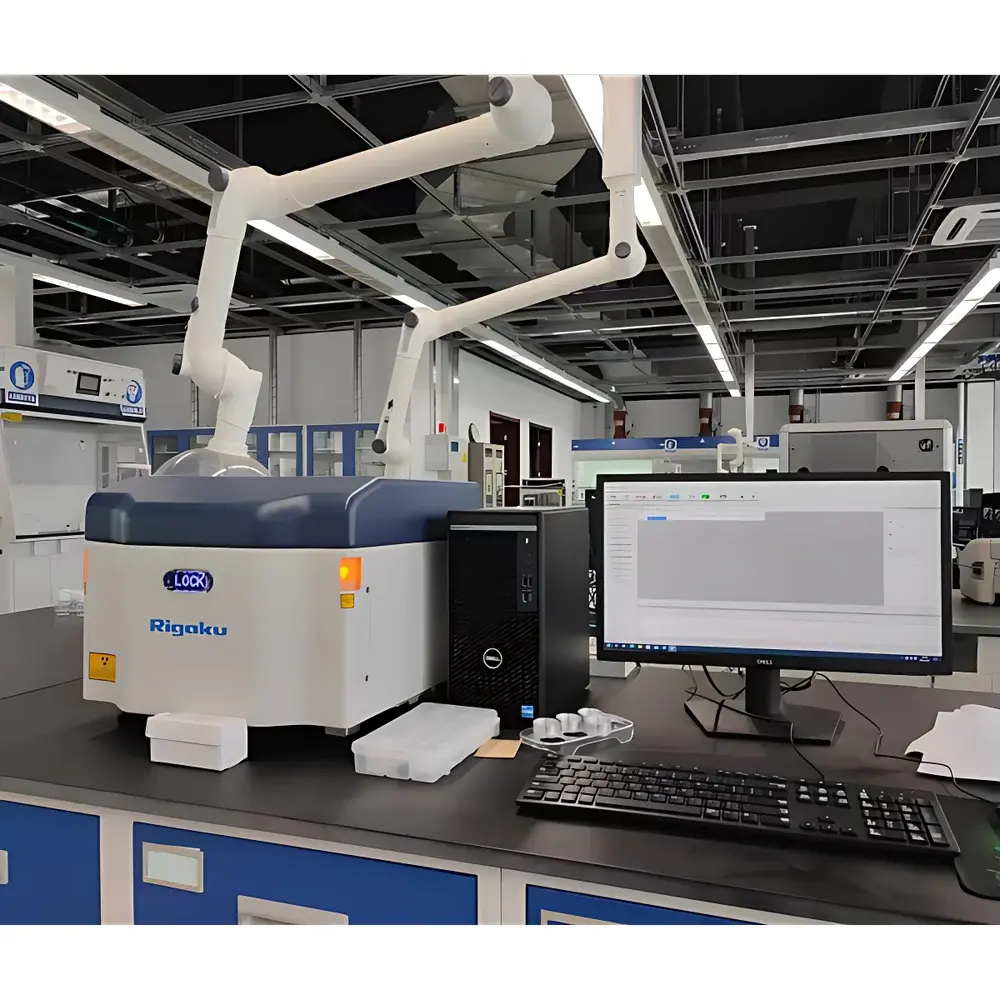
Rigaku NEX CG II 3D Polarized Energy Dispersive X-Ray Fluorescence Spectrometer
| Brand | Rigaku |
|---|---|
| Origin | USA |
| Model | NEX CG II |
| Element Range | Na (11) to U (92) |
| Detection Limits (typical for petroleum) | Si 1.1 ppm, P 0.8 ppm, S 0.5 ppm, Cl 0.4 ppm, Mn 0.9 ppm, Fe 0.7 ppm, Pb 0.7 ppm |
| Concentration Range | 0.11 ppm – 10% |
| Energy Resolution | <140 eV (Mn Kα) |
| Repeatability | 0.05% RSD |
| Detector | Silicon Drift Detector (SDD) with Peltier cooling |
| Excitation Source | Pd anode X-ray tube, max 50 kV / 50 W |
| Polarization Optics | 5-position polarized secondary target assembly |
| Geometry | Cartesian 3D configuration (X-ray tube → polarizer → sample → detector) |
| Sample Volume | 5 mL |
| Autosampler | 15-position carousel |
| Calibration Method | Compton scattering C/H ratio correction |
| Data Output | USB 2.0 and Ethernet (RJ-45), CSV/PDF export |
| Dimensions | 463 × 492 × 382 mm (W×D×H) |
| Power | AC 200–240 V, 50/60 Hz, 1.6 A |
| Operating Environment | 18–28 °C, RH <75% non-condensing, vibration-free, non-corrosive atmosphere |
Overview
The Rigaku NEX CG II is a benchtop energy dispersive X-ray fluorescence (ED-XRF) spectrometer engineered for high-precision elemental quantification in liquid and solid petrochemical matrices. It implements a proprietary 3D polarized excitation architecture—comprising a Pd-target X-ray tube, a five-position polarized secondary target module, and a Cartesian spatial arrangement—to minimize spectral background and enhance peak-to-background ratios. This geometry enables selective excitation of target elements while suppressing bremsstrahlung and scattered radiation, thereby improving detection sensitivity—particularly critical for trace metal analysis in fuels per NB/SH/T 6043, ASTM D7220, ASTM D4294, and GB/T 17040. The instrument operates on fundamental parameter (FP) quantification principles augmented by Compton-scattering-based C/H ratio correction, allowing robust calibration across diverse hydrocarbon matrices without matrix-matched standards.
Key Features
- 3D Cartesian optical path design: Optimized spatial alignment of X-ray source, polarized secondary target, sample position, and SDD detector minimizes geometric attenuation and scatter-induced noise.
- Five-position polarized secondary target system: Enables application-specific excitation tuning—e.g., optimized sensitivity for S, Cl, or transition metals in distillates, lubricants, or crude fractions.
- Silicon drift detector (SDD) with Peltier thermoelectric cooling: Delivers <140 eV energy resolution at Mn Kα (5.9 keV), supporting accurate deconvolution of overlapping L- and K-lines in multi-element spectra.
- Compton-scattering C/H ratio normalization: Compensates for variations in oil density, viscosity, and hydrocarbon composition—eliminating systematic bias in sulfur, chlorine, and metal quantification across gasoline, diesel, jet fuel, and residual oils.
- 15-position automated sample carousel: Supports unattended batch analysis with programmable dwell times, repeat measurements, and QC flagging.
- Integrated protective polymer film between sample cup and detector: Mechanically isolates the SDD from accidental spills or volatile hydrocarbon exposure—reducing maintenance frequency and extending detector lifetime.
- Modular service architecture: Critical subassemblies—including X-ray tube, high-voltage generator, and detector electronics—are field-replaceable in China under local technical support, minimizing instrument downtime.
Sample Compatibility & Compliance
The NEX CG II accepts standard 5 mL polyethylene or quartz sample cups with disposable polymer films—enabling rapid turnaround for routine refinery QC. It complies with regulatory measurement requirements for fuel quality control, including NB/SH/T 6043 (China), ASTM D7220 (standard test method for sulfur in gasoline by ED-XRF), ASTM D4294 (sulfur in petroleum products), and GB/T 17040 (sulfur in petroleum products). Its analytical performance meets GLP data integrity expectations: audit trails for method changes, user logins, calibration history, and result exports are retained locally and exportable via Ethernet or USB. While not FDA 21 CFR Part 11 certified out-of-the-box, the firmware supports timestamped electronic signatures and configurable access controls—facilitating validation for regulated laboratories operating under ISO/IEC 17025 or internal GMP frameworks.
Software & Data Management
Operation is managed through Rigaku’s proprietary Quant’X software suite, featuring intuitive workflow-driven acquisition, FP-based quantification with optional empirical calibration, and real-time spectral visualization. All raw spectra and processed results are stored in a relational database with version-controlled method files. Data export supports CSV (for LIMS integration), PDF (for QA reports), and XML (for enterprise analytics platforms). Ethernet connectivity enables remote monitoring, scheduled diagnostics, and centralized fleet management across multi-site refineries or third-party testing labs. Software updates are delivered via secure HTTPS channels and validated against SHA-256 checksums to ensure integrity.
Applications
Primary use cases include sulfur, chlorine, silicon, phosphorus, manganese, iron, and lead quantification in gasoline, diesel, biodiesel blends, aviation turbine fuel, and lubricating oils. The instrument supports ASTM D7220-compliant sulfur screening at ≤0.5 ppm detection capability, enabling compliance verification against Euro 5/6, Tier 3, and China VI specifications. It is also deployed for catalyst residue monitoring (e.g., Ni, V in vacuum resid), additive element profiling (Ca, Zn, Mg in detergents), and corrosion-related contaminant tracking (Na, Cl in feedstocks). Its compact footprint and low power demand allow deployment in mobile labs, offshore platforms, and field service vans—without requiring dedicated shielding rooms or chilled water systems.
FAQ
Does the NEX CG II require external cooling or shielding?
No. The SDD uses solid-state Peltier cooling; no liquid nitrogen or chiller is needed. Its lead-lined housing and interlocked shutter meet Class I radiation safety requirements per IEC 61010-1 and do not necessitate additional room shielding.
Can it analyze solid samples such as catalyst powders or filter residues?
Yes—using optional pressed pellet holders or fused bead accessories. Quantitative accuracy depends on homogeneity, particle size (<50 µm recommended), and proper FP matrix correction.
Is method transfer possible between different NEX CG II units?
Yes. Quant’X supports method file portability across instruments of the same model. Cross-unit reproducibility is maintained within ±0.05% RSD for repeated measurements under identical conditions.
What calibration standards are required for daily operation?
A single certified reference material (CRM) for Compton normalization is sufficient for routine QC. Rigaku provides traceable oil-based CRMs for S, Cl, and metals aligned with NB/SH/T 6043 Annex B.
How is data security handled during network transmission?
All Ethernet communications use TLS 1.2 encryption. User authentication follows role-based access control (RBAC), and exported files contain embedded digital signatures verifiable via public key infrastructure (PKI).



