
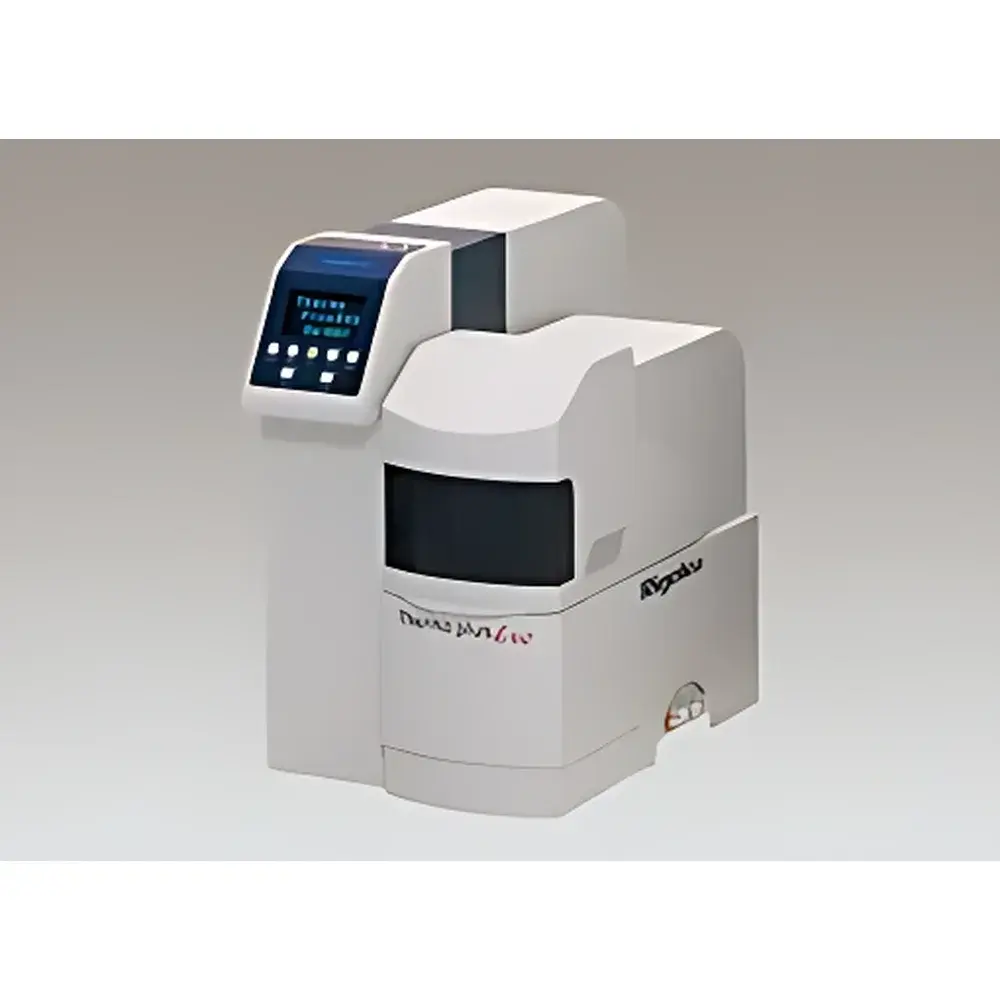
Rigaku Thermo Plus EVO DSC8230 Differential Scanning Calorimeter
| Brand | Rigaku |
|---|---|
| Origin | Japan |
| Model | DSC8230 |
| Heating Rate | up to 150 °C/min |
| Cooling Rate | 400 °C → 50 °C in ≤4 min |
| Multi-unit Control | up to 8 units via single PC |
| Temperature Control | Pre-compensated PID with hold-mode overshoot correction |
| Calibration | Built-in temperature calibration function |
| Power Mode | ECO standby mode (30% energy reduction) |
| Software | Integrated thermal analysis suite with auto-diagnosis, dual-data backup, remote firmware update, and configurable end-of-run actions |
| Sample Automation | Optional ASC (Automatic Sample Changer), field-installable |
| Hybrid Capability | Compatible with simultaneous XRD-DSC coupling |
Overview
The Rigaku Thermo Plus EVO DSC8230 is a high-performance differential scanning calorimeter engineered for precision thermal characterization of materials across research, quality control, and regulatory environments. Based on the heat-flux DSC principle, it measures the difference in heat flow between a sample and an inert reference as both are subjected to identical, programmable temperature profiles. This enables quantitative determination of thermal transitions—including glass transitions (Tg), melting points (Tm), crystallization onset (Tc), enthalpy changes (ΔH), oxidative induction time (OIT), and cure kinetics—under controlled inert or reactive atmospheres. Designed and manufactured in Japan by Rigaku Corporation, the DSC8230 integrates advanced thermal management architecture, including a compact high-efficiency furnace and active forced-air cooling, delivering rapid thermal response without compromising baseline stability or signal reproducibility.
Key Features
- Ultra-fast thermal programming: Achieves heating rates up to 150 °C/min and cools from 400 °C to 50 °C in ≤4 minutes using integrated forced-air cooling—enabling high-throughput screening and kinetic studies.
- Pre-compensated temperature control: Implements predictive thermal compensation during isothermal holds, eliminating overshoot artifacts without requiring pre-scan stabilization—improving measurement fidelity for low-ΔH events and subtle transitions.
- Onboard temperature calibration: Embedded calibration routines support traceable verification against certified reference materials (e.g., indium, zinc, tin), ensuring long-term accuracy aligned with ISO 11357 and ASTM E794 standards.
- ECO power management: Reduces standby power consumption by 30% via intelligent subsystem deactivation; selectable either through the front-panel interface or software—supporting sustainability goals without interrupting operational readiness.
- Modular hardware design: Features a rotatable control panel for flexible benchtop integration in space-constrained labs; optional ASC (Automatic Sample Changer) mounts directly to the instrument base and is user-installable without service intervention.
- Multi-instrument network control: A single Windows-based workstation can coordinate up to eight DSC8230 units simultaneously—ideal for centralized QC laboratories operating parallel thermal analysis workflows.
Sample Compatibility & Compliance
The DSC8230 accommodates standard hermetic and vented aluminum crucibles (e.g., 40 µL, 70 µL), platinum, and gold pans for corrosive or high-temperature applications (up to 600 °C). It supports purge gas control (N2, Ar, O2, synthetic air) with mass flow regulation, enabling oxidation stability testing per ASTM D3895 and polymer degradation analysis per ISO 11357-6. The system meets electromagnetic compatibility (EMC) requirements per IEC 61326-1 and safety standards per IEC 61010-1. Its software architecture supports audit trails, electronic signatures, and configurable user roles—facilitating compliance with FDA 21 CFR Part 11, EU Annex 11, and GLP/GMP documentation requirements when deployed in regulated pharmaceutical or medical device manufacturing settings.
Software & Data Management
Thermo Plus EVO software provides a unified platform for method development, real-time monitoring, post-run analysis, and reporting. Users define multi-step temperature programs with conditional triggers (e.g., end on ΔT ≥ 0.1 °C/min), set safety limits (max temp, rate violation), and specify automated post-measurement actions—including power-down, ECO activation, or forced cooling initiation. The software includes built-in algorithms for baseline subtraction, peak integration, Tg inflection detection (ASTM E1356), and kinetic modeling (e.g., Ozawa-Flynn-Wall). All raw and processed data are stored in vendor-neutral formats (e.g., .csv, .txt) alongside proprietary .dsc files. Dual-data backup ensures redundancy: primary storage resides on the local PC, while mirrored archives synchronize to a designated network drive or NAS—enabling seamless data recovery and cross-lab collaboration.
Applications
The DSC8230 serves diverse technical domains: polymer science (crystallinity quantification, copolymer composition analysis, aging studies); pharmaceutical development (polymorph screening, excipient compatibility, lyophilized product stability); battery materials (SEI formation, cathode thermal runaway onset); metals and alloys (phase transformation mapping, solidus/liquidus determination); and food science (fat crystallization behavior, starch gelatinization enthalpy). Its compatibility with simultaneous XRD-DSC coupling allows correlative structural–thermal analysis—for instance, tracking in situ phase evolution during heating cycles in catalysts or MOFs.
FAQ
Does the DSC8230 support GLP-compliant data handling?
Yes—software features include user access controls, full audit trail logging, electronic signature capability, and immutable data archiving—designed to meet GLP and GMP documentation integrity requirements.
Can the ASC be added after initial installation?
Yes—the Automatic Sample Changer is a field-upgradable module; mechanical mounting and electrical connection require no tools or service engineer.
Is the ECO mode compatible with scheduled measurements?
Yes—ECO mode suspends non-essential subsystems during idle periods but maintains thermal readiness; scheduled runs initiate automatically without manual wake-up.
What reference materials are recommended for routine calibration?
Indium (Tm = 156.60 °C, ΔHf = 28.45 J/g), zinc (Tm = 419.53 °C), and tin (Tm = 231.93 °C) are traceable standards used for temperature and enthalpy calibration per ISO 11357-1.
How does the pre-compensation algorithm improve isothermal stability?
It dynamically adjusts heater output based on real-time thermal inertia modeling—reducing overshoot during hold segments by up to 80% compared to conventional PID control, enhancing resolution of weak transitions near baseline drift thresholds.



