
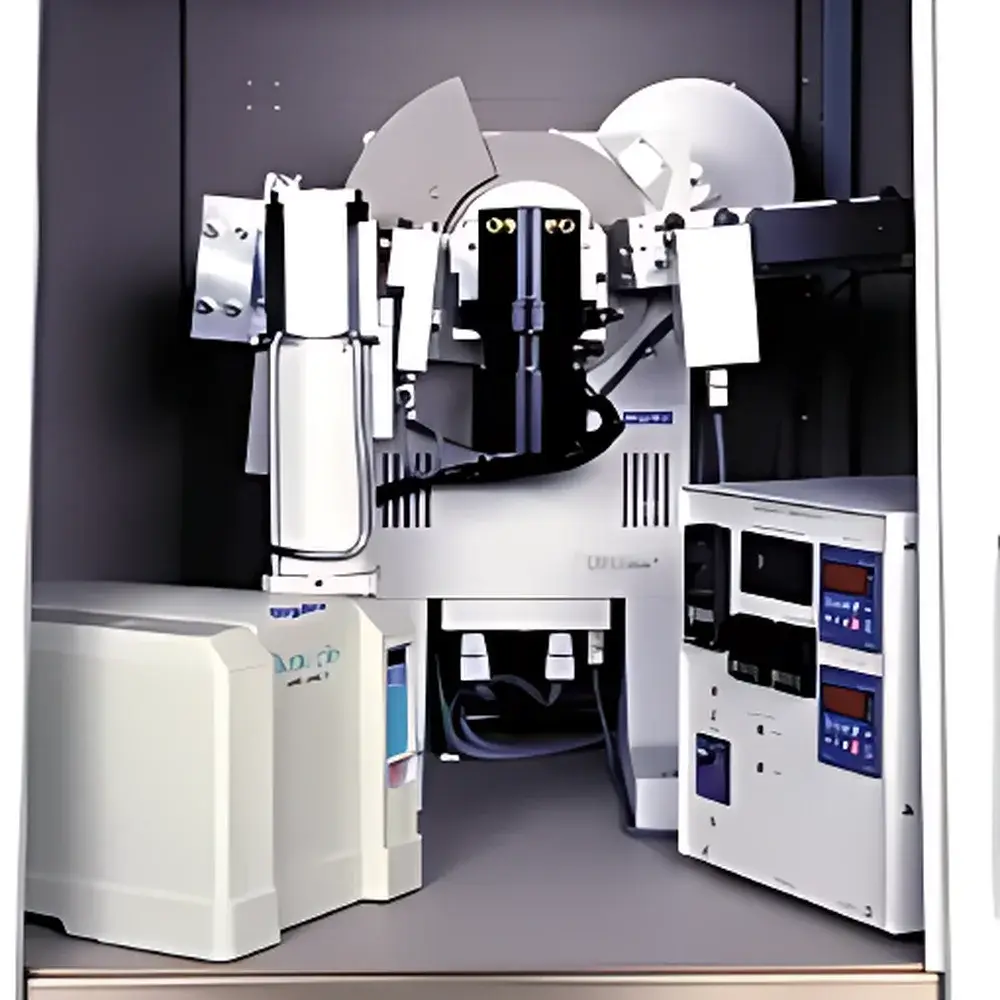
Rigaku XRD-DSC Simultaneous X-ray Diffraction and Differential Scanning Calorimetry System
| Brand | Rigaku |
|---|---|
| Origin | Japan |
| Model | XRD-DSC |
| Heating Rate | 0.01–100 °C/min |
| Temperature Range | Ambient to 1500 °C |
| Temperature Stability | ±0.01 °C |
| Atmosphere Options | Inert, Oxidizing, Reducing (via optional gas modules) |
| Compliance | ASTM E1269, ISO 11357, USP <1158>, FDA 21 CFR Part 11 (software-enabled) |
Overview
The Rigaku XRD-DSC is a purpose-engineered simultaneous thermal analysis and in situ X-ray diffraction platform designed for correlative structural and thermodynamic characterization of solid-state materials under controlled thermal conditions. Unlike conventional sequential or loosely coupled instrumentation, this integrated system enables true time- and temperature-synchronized acquisition of high-resolution X-ray diffraction (XRD) patterns and differential scanning calorimetry (DSC) thermograms within a single furnace environment. The core measurement principle relies on Cu Kα radiation (λ = 1.5418 Å) generated by a sealed-tube X-ray source, coupled with a high-sensitivity DSC sensor embedded directly beneath the sample stage. This architecture ensures sub-second temporal alignment between lattice parameter evolution (via Bragg peak position/width/intensity shifts) and enthalpic events (endothermic/exothermic transitions), enabling unambiguous assignment of phase transformations—such as polymorphic transitions, solid-state reactions, crystallization onset, or decomposition pathways—to their precise thermal signatures.
Key Features
- Integrated dual-detection architecture: Co-aligned XRD detector (scintillation counter or silicon strip detector) and high-precision DSC sensor share identical sample positioning and thermal history.
- Wide operational temperature range from ambient to 1500 °C, supported by a high-stability Pt/Rh thermocouple and active PID-controlled furnace with ±0.01 °C isothermal stability over 30-minute intervals.
- Programmable heating/cooling rates from 0.01 to 100 °C/min, compatible with both linear ramp and multi-step isothermal protocols.
- Modular atmosphere control: Standard configuration supports static vacuum or inert purge; optional accessories include cryogenic cooling stage (–180 °C), steam generator module (for hydration/dehydration studies), and mass flow-controlled gas mixing unit (N₂, Ar, O₂, CO₂, H₂).
- Rigaku’s proprietary parallel-beam optics and Johansson monochromator ensure high angular resolution (<0.02° 2θ FWHM) and minimal background, critical for detecting subtle lattice distortions during transient thermal events.
Sample Compatibility & Compliance
The XRD-DSC accommodates standard powder, thin-film, and bulk solid samples (max. 20 mm diameter, 2 mm thickness) mounted on low-background alumina or platinum sample holders. It meets essential regulatory requirements for materials qualification in pharmaceutical, ceramic, and metallurgical R&D environments. Data acquisition and processing comply with GLP/GMP principles through audit-trail-enabled software, supporting full traceability per FDA 21 CFR Part 11. Thermal calibration follows ASTM E1269 (heat capacity determination) and ISO 11357-2 (DSC calibration), while XRD calibration adheres to NIST SRM 660c (LaB₆) and ISO 17873. All firmware and control logic are validated under IEC 61508 functional safety guidelines.
Software & Data Management
Operation is managed via Rigaku’s SmartLab Studio II platform, which provides synchronized instrument control, real-time overlay of XRD patterns and DSC curves, and automated peak-tracking algorithms (e.g., Rietveld refinement integration, lattice parameter mapping vs. temperature). Raw data are stored in vendor-neutral HDF5 format with embedded metadata (time stamp, temperature, gas flow, voltage, detector gain). Batch processing supports quantitative phase analysis (QPA), crystallinity index calculation, and reaction kinetics modeling (Kissinger, Ozawa-Flynn-Wall methods). Export options include CSV, CIF, and XML for third-party integration with LIMS or ELN systems.
Applications
- Pharmaceutical solid-form screening: Correlating amorphous-to-crystalline transitions observed in DSC with emerging Bragg peaks and preferred orientation effects in XRD.
- Ceramic sintering mechanism studies: Tracking intermediate phase formation (e.g., spinel, perovskite) alongside exothermic crystallization enthalpies and grain growth kinetics.
- Battery cathode material degradation: Identifying oxygen loss events (via lattice expansion in XRD) concurrent with irreversible heat flow in charged/discharged cycling protocols.
- Hydration/dehydration thermodynamics: Quantifying stoichiometric water loss steps using TGA-DSC-XRD triad data, especially for zeolites and metal–organic frameworks.
- Polymorph stability mapping: Constructing temperature–composition phase diagrams using in situ variable-temperature XRD combined with melting enthalpy quantification.
FAQ
Can the XRD-DSC perform measurements under reactive atmospheres such as hydrogen or air?
Yes—when equipped with the optional gas mixing module and quartz or alumina furnace tubes, the system supports oxidizing, reducing, and corrosive atmospheres up to 1000 °C. High-temperature air exposure requires specialized sample holders to prevent oxidation artifacts.
Is Rietveld refinement supported in real time during data collection?
SmartLab Studio II enables live Rietveld fitting during acquisition for selected phases; however, full quantitative refinement is typically performed post-run due to computational load. Predefined phase libraries accelerate on-the-fly identification.
What is the minimum detectable enthalpy change for a solid-state reaction?
Under optimal conditions (10 mg sample, 10 °C/min heating rate), the DSC sensor achieves a noise level of <0.5 µW, corresponding to ~0.1 J/g detection limit for sharp transitions.
How is beam damage mitigated during long-duration in situ experiments?
The system employs automatic beam attenuation, pulsed X-ray exposure modes, and real-time dose monitoring to minimize radiation-induced amorphization—particularly critical for organic and hydrated samples.
Does the instrument support coupling with mass spectrometry (TGA-MS-XRD)?
While the base XRD-DSC does not include MS interfacing, Rigaku offers a dedicated TGA-MS-XRD tri-hybrid configuration (XRD-TGA-MS) as a separate platform with shared furnace and synchronized data acquisition.



