
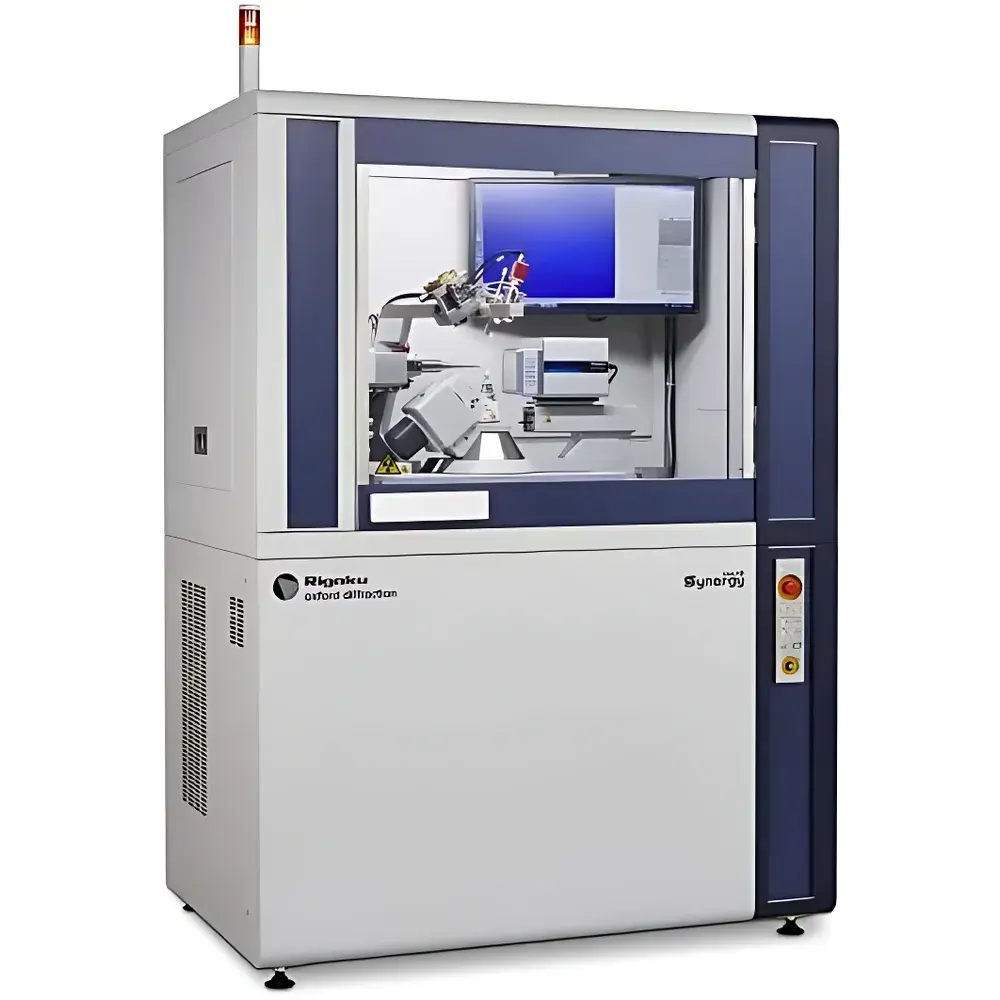
Rigaku XtaLAB Synergy Single-Crystal X-ray Diffractometer
| Brand | Rigaku |
|---|---|
| Origin | Japan |
| Model | XtaLAB Synergy |
| Instrument Type | Single-Crystal X-ray Diffractometer |
| Configuration | Floor-Standing |
| Power Stability | < 0.0001 (unitless, indicating angular reproducibility or beam stability per manufacturer specification) |
| Detector | HyPix-6000HE Photon-Counting Pixel Array Detector |
| Detector Active Area | 77.5 mm × 80.0 mm |
| Pixel Size | 100 µm × 100 µm |
| Cooling Method | Air-Cooled |
| Dynamic Range | Up to 31-bit equivalent |
| Readout Mode | Shutterless, 0-ms dead time |
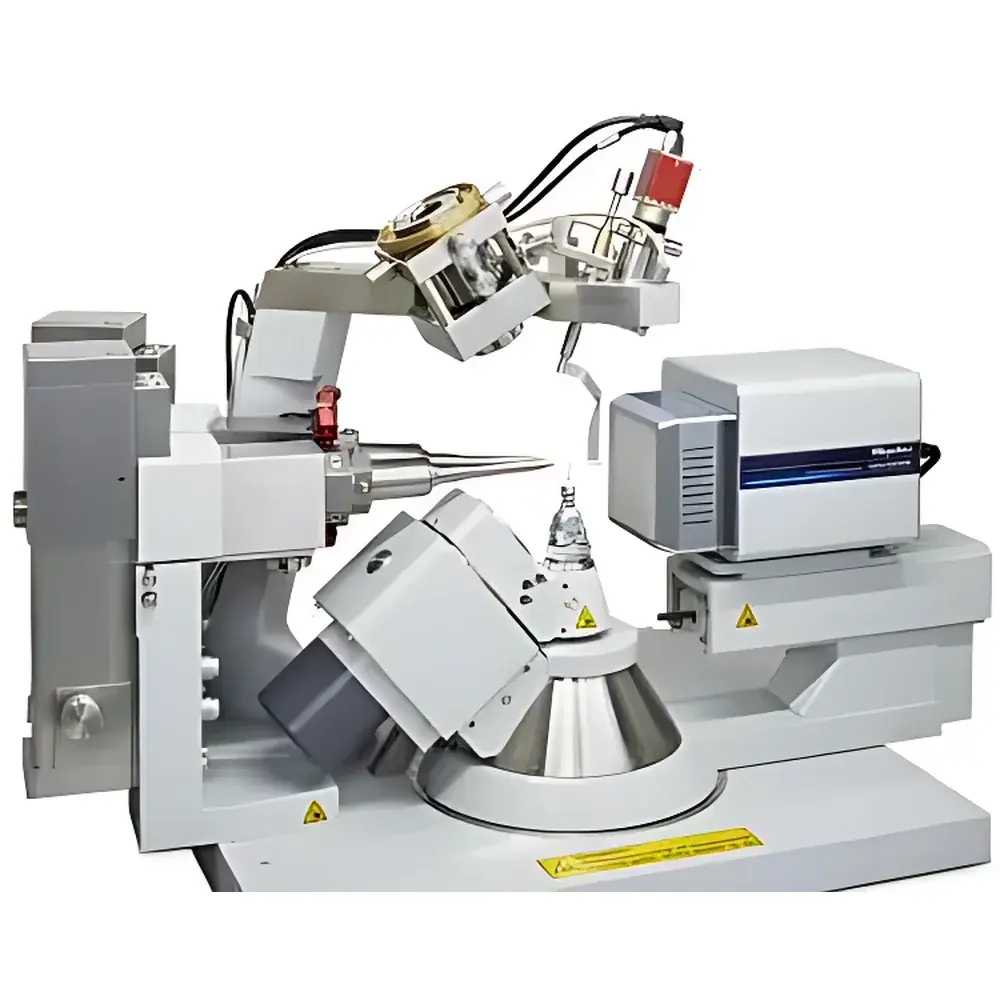
| Goniometer | AFC-Kappa Four-Axis |
| X-ray Source Options | Microfocus Sealed-Tube (Cu/Mo), MM007HF Rotating Anode, FR-X High-Brilliance Rotating Anode |
| Anode Materials | Cu, Mo, or Dual Cu/Mo |
| Cryogenic Capability | Integrated Low-Temperature System (e.g., Oxford Instruments Cryostream-compatible) |
| Software Suite | CrysAlisPro (data collection & processing), AutoChem (automated structure solution and refinement) |
Overview
The Rigaku XtaLAB Synergy is a high-performance, floor-standing single-crystal X-ray diffractometer engineered for precision structural determination of small-molecule crystalline materials. It operates on the fundamental principle of Bragg diffraction, where monochromatic X-rays interact with the periodic lattice of a single crystal, producing a three-dimensional diffraction pattern that encodes atomic-level structural information. Designed for rigorous academic, pharmaceutical, and industrial crystallography laboratories, the system integrates advanced hardware—such as the HyPix-6000HE photon-counting detector and AFC-Kappa four-circle goniometer—with rigorously validated software workflows to deliver high-fidelity intensity data, low systematic error, and exceptional measurement reproducibility. Its architecture supports both routine characterization and demanding projects requiring high-resolution, low-noise data collection under cryogenic conditions.
Key Features
- HyPix-6000HE detector: A next-generation, air-cooled, direct-read pixel array detector with 100 µm × 100 µm pixels and an active area of 77.5 mm × 80.0 mm, enabling shutterless data acquisition with zero dead time and a dynamic range exceeding 31-bit equivalent resolution.
- AFC-Kappa four-axis goniometer: Provides precise, motorized control of crystal orientation (ω, κ, φ, and 2θ axes), optimized for accurate centering, multi-axis data collection strategies, and compatibility with standard cryocooling devices.
- Flexible X-ray source configuration: Supports multiple excitation options including microfocus sealed-tube sources (Cu or Mo), the high-flux MM007HF rotating anode, and the ultra-brilliant FR-X rotating anode—each selectable based on resolution requirements, throughput demands, and sample sensitivity.
- Integrated low-temperature capability: Compatible with industry-standard cryogenic systems (e.g., Oxford Instruments Cryostream), enabling data collection at temperatures as low as 80 K to minimize thermal motion and improve structural accuracy—critical for weakly diffracting or radiation-sensitive crystals.
- Modular optical path design: Accommodates interchangeable monochromators and collimators to optimize beam divergence and spectral purity, ensuring compliance with IUCr-recommended data quality metrics (e.g., I/σ(I) > 10 in outer shell, completeness > 99%).
Sample Compatibility & Compliance
The XtaLAB Synergy accommodates a broad range of small-molecule crystalline samples—including organometallic complexes, pharmaceutical intermediates, chiral compounds, and coordination polymers—typically mounted on glass fibers or loops and stabilized under inert atmosphere or cryogenic nitrogen stream. Sample handling conforms to widely adopted laboratory safety and data integrity standards. The instrument’s hardware and software architecture support audit-ready operation in regulated environments: CrysAlisPro includes electronic logbook functionality compliant with GLP documentation requirements, while raw data files adhere to the Crystallographic Information File (CIF) standard (version 1.1, IUCr). All detector and goniometer calibration procedures are traceable to NIST-certified reference standards, and system performance verification aligns with ISO 15195:2018 (laboratory accreditation for testing and calibration) and ASTM E3074–17 (standard guide for single-crystal X-ray diffraction analysis).
Software & Data Management
Data collection, reduction, and initial structure solution are fully integrated within the CrysAlisPro software environment—a platform developed jointly by Rigaku and former Agilent Technologies (Oxford Diffraction) crystallography teams. CrysAlisPro implements real-time data monitoring, automatic crystal centering, absorption correction (using empirical or numerical methods), and space-group determination via statistical symmetry analysis. AutoChem, embedded within the same workflow, provides automated structure solution using dual-space algorithms (e.g., SHELXT), refinement (SHELXL), and comprehensive validation (checkCIF-compliant reporting). All processed data and metadata are stored in vendor-neutral formats (e.g., .hkl, .cif, .res), supporting long-term archival and interoperability with third-party tools such as Olex2, JANA2020, or PLATON. Audit trails, user authentication, and version-controlled processing scripts satisfy FDA 21 CFR Part 11 requirements for electronic records and signatures when deployed in GMP-regulated settings.
Applications
The XtaLAB Synergy serves core functions across chemical R&D, materials science, and pharmaceutical development. Typical use cases include absolute stereochemistry assignment of chiral drug candidates, confirmation of synthetic product identity and purity (e.g., distinguishing polymorphs or solvates), structural validation of catalysts and ligand-metal coordination geometries, and quantitative analysis of disorder and thermal displacement parameters (ADPs). In academic research, it supports mechanistic studies involving transient intermediates isolated in situ, while industrial users rely on its robustness for high-throughput screening of crystalline forms during solid-state characterization campaigns. Its low-background, high-dynamic-range detection also enables successful data collection from microcrystals (< 10 µm) and weakly scattering species (e.g., light-atom-only structures containing only C, H, N, O).
FAQ
What crystal size is required for reliable data collection on the XtaLAB Synergy?
Crystals between 50–300 µm in their largest dimension typically yield optimal signal-to-noise ratios; however, successful structure solutions have been reported for crystals as small as 10 µm when using the FR-X source and optimized collimation.
Does the system support remote operation and unattended data collection?
Yes—CrysAlisPro enables secure remote access via SSH or VNC, and batch queueing allows overnight or weekend data collection with automated crystal screening and prioritization logic.
Is dual-source (Cu/Mo) switching automated within the software?
Yes—motorized anode selection and corresponding monochromator alignment are fully scripted in CrysAlisPro, minimizing manual intervention and ensuring consistent wavelength-specific calibration.
How is detector calibration maintained over time?
HyPix-6000HE employs on-chip gain stabilization and regular dark-frame acquisition; full geometric and intensity calibration is performed quarterly using certified reference crystals (e.g., NaCl or silicon) and logged in the system audit trail.
Can the instrument be integrated into a laboratory LIMS or ELN infrastructure?
Raw and processed data files (including CIFs and .hkl) can be exported programmatically via API or file-watch directories, enabling bidirectional synchronization with major ELN platforms (e.g., LabArchives, Benchling) and LIMS systems supporting HL7 or RESTful interfaces.




