
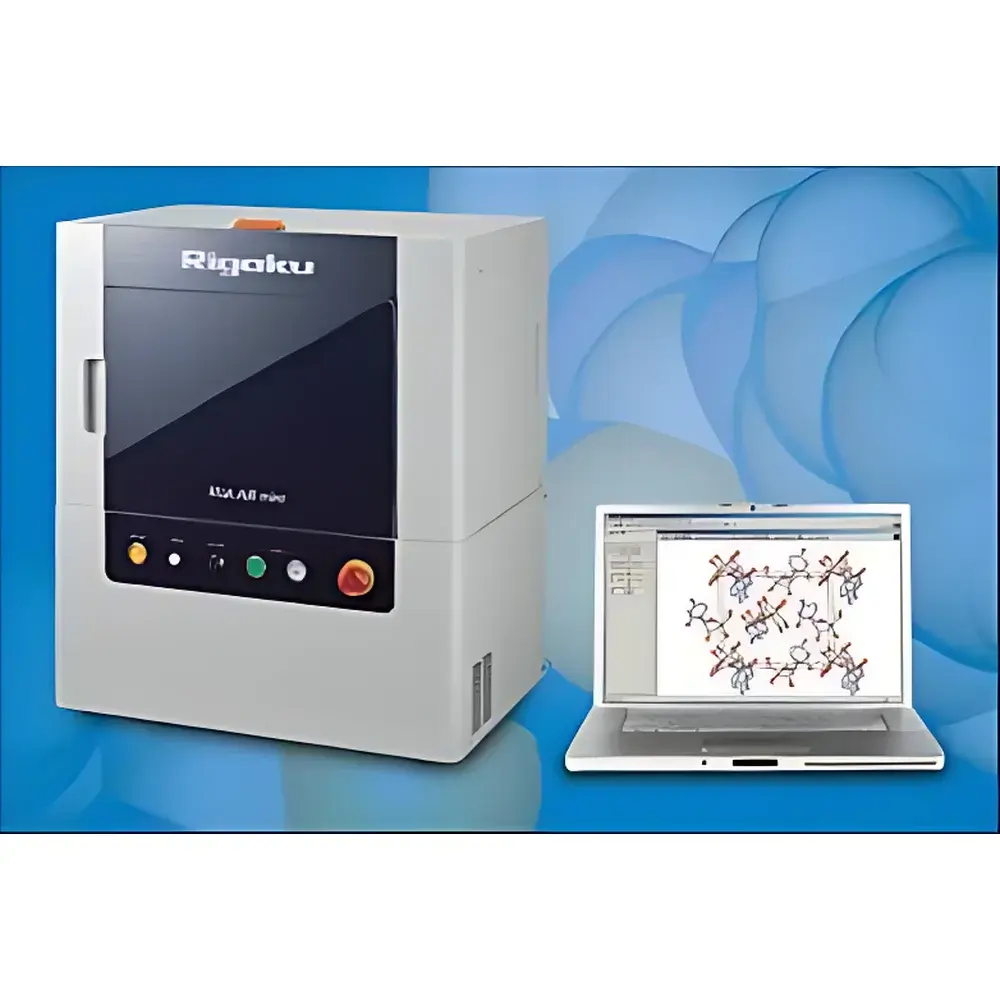
Rigaku XtaLABmini Benchtop Single-Crystal X-ray Diffractometer
| Brand | Rigaku |
|---|---|
| Origin | Japan |
| Model | XtaLABmini |
| Instrument Type | Single-Crystal X-ray Diffractometer |
| Configuration | Benchtop |
| X-ray Source | Mo Kα, 600 W high-frequency generator |
| Goniometer Axes | χ fixed at 54°, Φ rotation: −360° to +360° about sample center axis, ω range: 2θ ± 90° (−60° to +120°), 2θ fixed at 30° |
| Sample Viewing | 70× CCD microscope with 50 mm camera-to-sample distance |
| Detector | CCD, active area Φ75 mm, pixel sizes 73.2 µm / 146.4 µm, resolution modes 1024 × 1024 / 512 × 512, readout times 2.24 s / 0.56 s, dark current 0.1 e⁻/pixel/s |
| Optional | Cryogenic sample stage (e.g., Oxford Instruments Cryostream-compatible) |
Overview
The Rigaku XtaLABmini is a compact, benchtop single-crystal X-ray diffractometer engineered for high-precision structural determination of small-molecule organic, organometallic, and coordination compounds. Based on Bragg’s law and monochromatic Mo Kα radiation (λ = 0.71073 Å), the system employs a robust goniometric architecture optimized for accurate three-dimensional diffraction data collection. Its design integrates Rigaku’s SHINE optical system — a high-efficiency collimation and focusing assembly — to maximize photon flux at the sample while minimizing background scatter. Unlike floor-standing systems requiring dedicated shielding rooms, the XtaLABmini meets international radiation safety standards (IEC 61010-1, JIS Z 4901) in a footprint under 0.8 m², enabling deployment in shared teaching labs, synthetic chemistry suites, or core facilities without structural modification.
Key Features
- Benchtop form factor: World’s smallest commercially available single-crystal diffractometer, eliminating need for vaults or lead-lined rooms
- Mo-target high-frequency X-ray generator (600 W): Delivers stable, low-noise output with rapid warm-up and minimal thermal drift
- Automated data acquisition workflow: Integrated software controls crystal centering, orientation, exposure optimization, and frame integration without user intervention
- High-sensitivity CCD detector: 75 mm diameter active area, dual-binning capability (73.2 µm and 146.4 µm pixels), enabling flexible trade-offs between resolution and dynamic range
- Real-time sample visualization: 70× magnification CCD microscope with 50 mm working distance supports precise crystal mounting and alignment
- Comprehensive goniometry: Independent Φ rotation (±360°), ω scanning (−60° to +120°), and fixed χ (54°) and 2θ (30°) angles ensure full reciprocal space coverage for triclinic to cubic systems
- Cryogenic readiness: Designed for seamless integration with standard cryostream cooling systems (80–300 K), supporting low-temperature data collection per IUCr recommendations
Sample Compatibility & Compliance
The XtaLABmini accommodates standard capillary- or loop-mounted crystals (0.05–0.5 mm typical dimensions) and supports routine analysis of air-sensitive samples via inert-gas glovebox-compatible sample changers (optional). Data reduction and structure solution conform to IUCr CIF standards (version 1.1), and final structure factors meet Acta Crystallographica Section C submission requirements. The instrument complies with ISO 17025:2017 for testing laboratories, supports audit trails and electronic signatures in accordance with FDA 21 CFR Part 11 when paired with Rigaku’s CrysAlisPro software in validated configurations, and operates within GLP/GMP-aligned workflows for pharmaceutical crystallization studies.
Software & Data Management
Rigaku CrysAlisPro serves as the unified control, processing, and analysis platform. It provides automated crystal screening, integration (using profile-fitting algorithms), scaling, absorption correction (multi-scan or empirical), and structure solution (SHELXT) and refinement (SHELXL) pipelines. All processing steps are logged with timestamps, operator ID, and parameter sets, ensuring full traceability. Export formats include CIF, SHELX .res/.hkl files, PDB, and publication-ready figures (CIF2IMG, Mercury-compatible). Data archives are stored in vendor-neutral HDF5 containers, compatible with institutional LIMS and FAIR data management policies.
Applications
- Determination of absolute stereochemistry in chiral drug candidates and natural products
- Polymorph and solvate identification during solid-form screening
- Validation of synthetic outcomes in methodology development (e.g., asymmetric catalysis, macrocyclization)
- Teaching crystallography fundamentals: From Laue symmetry assessment to least-squares refinement diagnostics
- Quality-by-Design (QbD) support for API crystallization process development
- Coordination geometry analysis in metal–organic frameworks (MOFs) and supramolecular assemblies
FAQ
Is the XtaLABmini suitable for teaching laboratories?
Yes — its intuitive interface, automated workflows, and integrated tutorial modules enable undergraduate students to collect publishable-quality datasets within one lab session.
Does it support low-temperature data collection?
Yes — the goniometer and sample stage are fully compatible with standard nitrogen cryostream systems; optional vacuum dewar accessories extend stability to 100 K.
What software licenses are included?
CrysAlisPro base license (acquisition + integration) is bundled; SHELX suite (SHELXT/SHELXL) and Olex2 are provided at no additional cost for academic users.
How is radiation safety ensured in a benchtop configuration?
The unit incorporates interlocked lead–acrylic shielding, real-time dose monitoring, and automatic beam shuttering — certified to IEC 62495 and compliant with national regulatory limits for uncontrolled areas.
Can it handle twinned or weakly diffracting crystals?
Yes — advanced profile modeling, multi-frame exposure strategies, and dynamic background subtraction improve signal-to-noise for challenging samples, though resolution remains dependent on crystal quality and size.





