
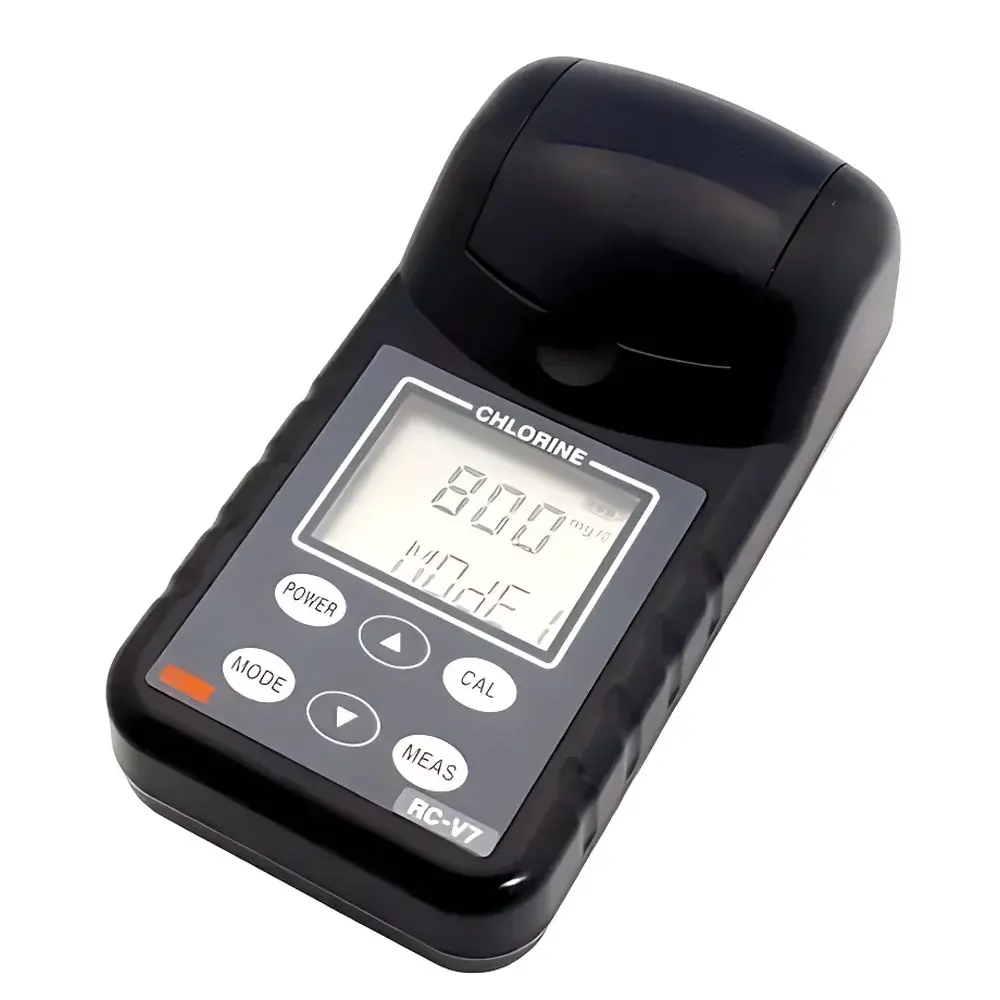
Rikari RC-V7 UV-LED Based Reagent-Free Residual Chlorine Analyzer
| Brand | Rikari |
|---|---|
| Origin | Japan |
| Model | RC-V7 |
| Instrument Type | Portable |
| Measurement Principle | UV-LED Absorption Photometry (Deep UV, 254 nm) |
| Measured Parameter | Residual Chlorine (as Cl₂), Chlorine Dioxide (ClO₂) |
| Range Mode 1 | 0–1000 mg/L |
| Range Mode 2 | 0–500 mg/L |
| Accuracy | ±1% of reading |
| Repeatability | ±2% (under controlled conditions) |
| Resolution | 1 mg/L |
| LOD | 1 mg/L |
| Operating Temperature | 1–35 °C |
| Power Supply | 4 × AA alkaline batteries (DC 6 V) |
| Weight | ~310 g |
Overview
The Rikari RC-V7 is a portable, reagent-free residual chlorine and chlorine dioxide analyzer engineered for rapid, on-site quantification of oxidizing disinfectant concentrations in aqueous solutions. Unlike conventional colorimetric or amperometric methods requiring chemical reagents, the RC-V7 employs deep ultraviolet absorption photometry at 254 nm—leveraging the characteristic absorbance peak of hypochlorous acid (HOCl), hypochlorite ion (OCl⁻), and chlorine dioxide (ClO₂) in the UV-C spectral region. This principle enables direct, interference-minimized measurement without sample derivatization, acidification, or catalyst addition. The instrument is calibrated for total residual chlorine (expressed as Cl₂) and cross-validated for ClO₂ detection within the same optical path, supporting dual-parameter verification where regulatory protocols require distinction between oxidant species. Designed for field-deployable operation in variable ambient conditions, it meets the functional requirements of ISO 7888 (water quality — determination of residual chlorine), ASTM D1253 (standard test method for residual chlorine in water), and aligns with WHO Guidelines for Drinking-water Quality (4th ed.) regarding point-of-use disinfectant monitoring.
Key Features
- Reagent-free operation: Eliminates consumables, calibration drift from reagent degradation, and operator exposure to hazardous chemicals.
- Dual-range optical detection: Switchable measurement spans (0–500 mg/L and 0–1000 mg/L) optimized for low-concentration process control or high-dose disinfection validation.
- UV-LED light source: Stable 254 nm emission with >10,000-hour lifetime; no warm-up time required and immune to mercury-vapor lamp aging effects.
- Temperature-compensated photometric cell: Integrated thermistor corrects for refractive index and absorbance temperature dependence across 1–35 °C.
- Robust mechanical architecture: IP65-rated housing with chemical-resistant PBT polymer body; drop-tested to MIL-STD-810G for field durability.
- Low-power design: Operates continuously for ≥12 hours on four standard AA alkaline cells; no external charger or USB dependency.
Sample Compatibility & Compliance
The RC-V7 is validated for use with acidic electrolyzed water (AEW), neutral electrolyzed water (NEW), sodium hypochlorite solutions (bleach), hypochlorous acid (HOCl) formulations, and chlorine dioxide solutions. It accommodates turbidities up to 5 NTU without filtration and tolerates dissolved solids ≤500 mg/L TDS. Samples must be free of suspended particulates that could scatter UV light—pre-filtration through 0.45 µm membrane filters is recommended if turbidity exceeds specification. The analyzer complies with GLP documentation requirements: all measurements store timestamp, temperature, range setting, and user ID (via optional Bluetooth pairing). Audit trails are exportable in CSV format for FDA 21 CFR Part 11–aligned quality systems. It supports routine verification per USP for purified water and WFI disinfection monitoring.
Software & Data Management
Data logging is embedded: up to 1,000 measurement records (including date/time, temperature, range mode, and result) are stored internally with non-volatile memory. A dedicated PC application (Windows/macOS compatible) enables batch download, statistical summary (mean, SD, CV%), and trend visualization. Export formats include CSV, PDF report templates (with facility header and analyst signature field), and XML for LIMS integration. Firmware updates are delivered via micro-USB port (not for power)—no internet connection required during field use. All data fields conform to ISO/IEC 17025 clause 7.5.2 for record integrity and traceability.
Applications
- Real-time validation of disinfectant concentration in hospital surface sprayers, endoscope reprocessors, and HVAC humidification systems.
- Process control of HOCl generation units in food processing lines—ensuring consistent microbial log-reduction without over-dosing.
- Verification of chlorine residual decay in distribution networks during emergency response (e.g., post-flooding or infrastructure failure).
- QA/QC testing of commercial electrolyzed water devices prior to deployment in elderly care facilities and school cafeterias.
- Regulatory compliance checks for JIS K 0102 (Japanese Industrial Standard for disinfectant testing) and EN 14476 (virucidal activity assessment).
FAQ
Does the RC-V7 require daily calibration?
No. Factory calibration is stable for ≥6 months under normal use; verification with NIST-traceable chlorine standard solution (e.g., 100 mg/L Cl₂ in deionized water) is recommended weekly.
Can it distinguish between HOCl and OCl⁻ species?
No. It reports total residual chlorine (sum of HOCl + OCl⁻), as defined by standard UV-absorbance methodology. Speciation requires pH measurement and equilibrium calculation per EPA Method 334.0.
Is chlorine dioxide measurement certified to ISO 7393-2?
Yes—ClO₂ quantification is validated per ISO 7393-2 Annex B using certified reference materials (CRM-ClO₂, NIST SRM 2801); cross-sensitivity to Cl₂ is <3% at 500 mg/L ClO₂.
What maintenance is required?
Quarterly cleaning of quartz cuvette window with lint-free cloth and isopropanol; annual LED intensity verification via built-in diagnostic mode.
Can results be printed directly from the device?
No. Thermal printing is not integrated; however, exported CSV files support direct import into label printers via third-party software (e.g., NiceLabel).
Related Products







