
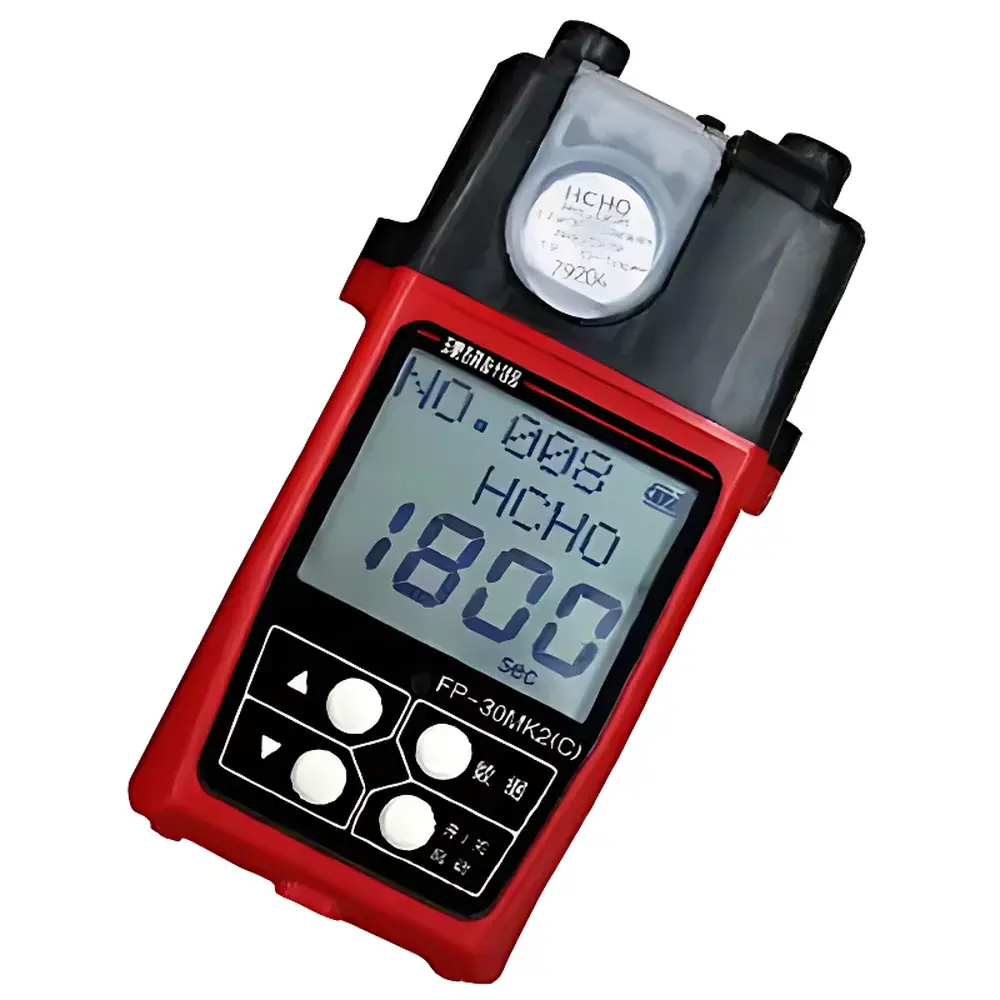
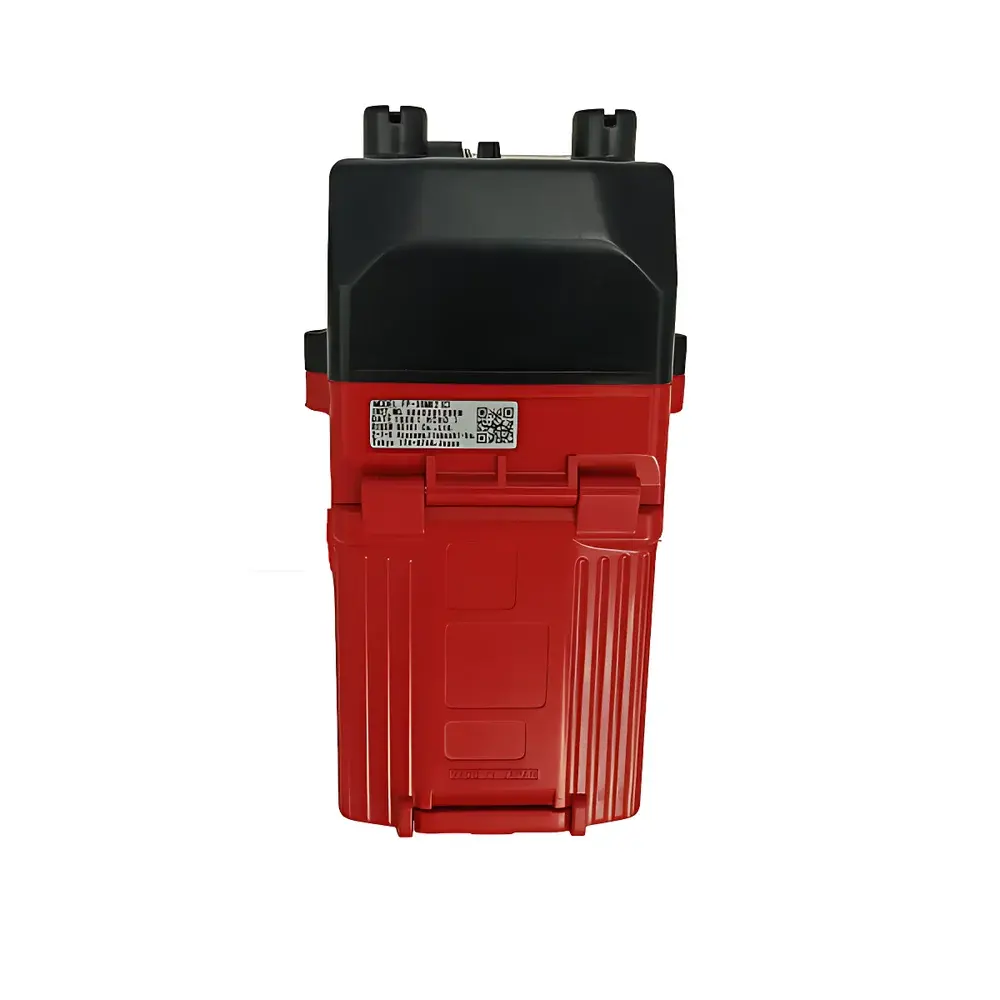
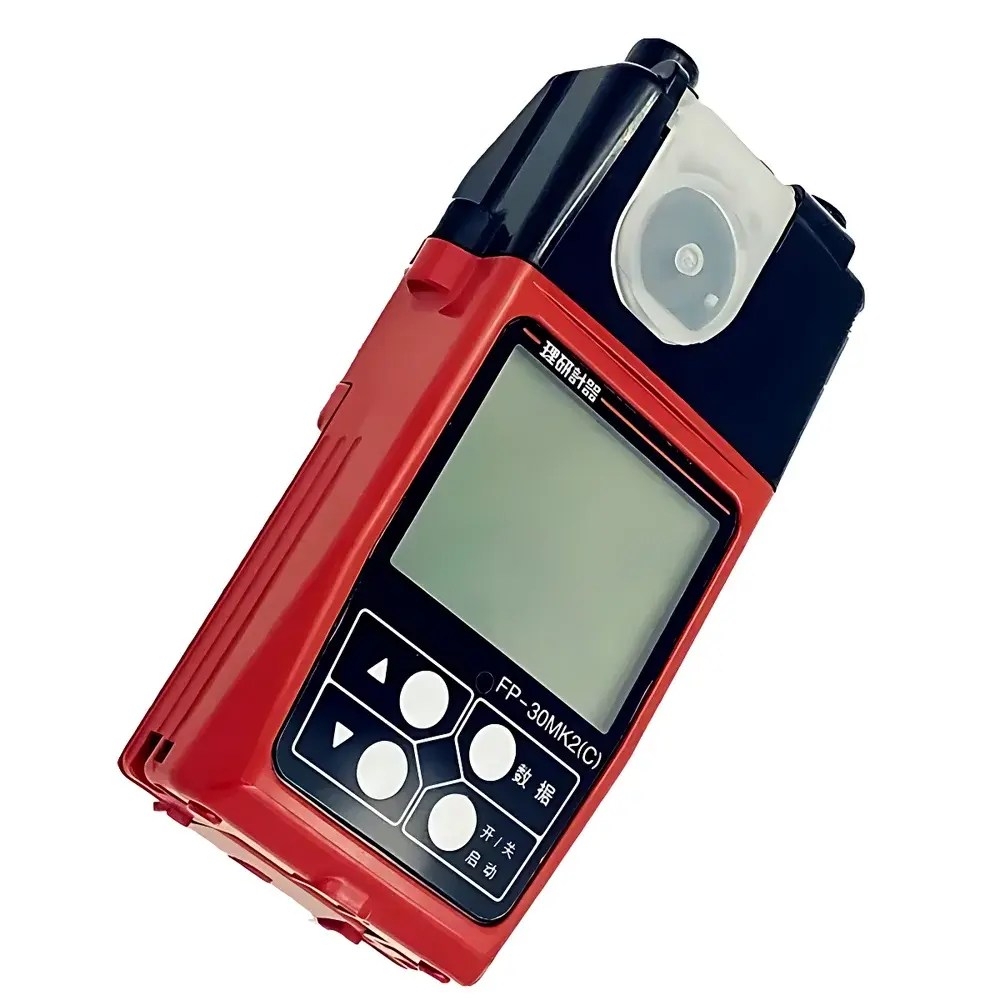
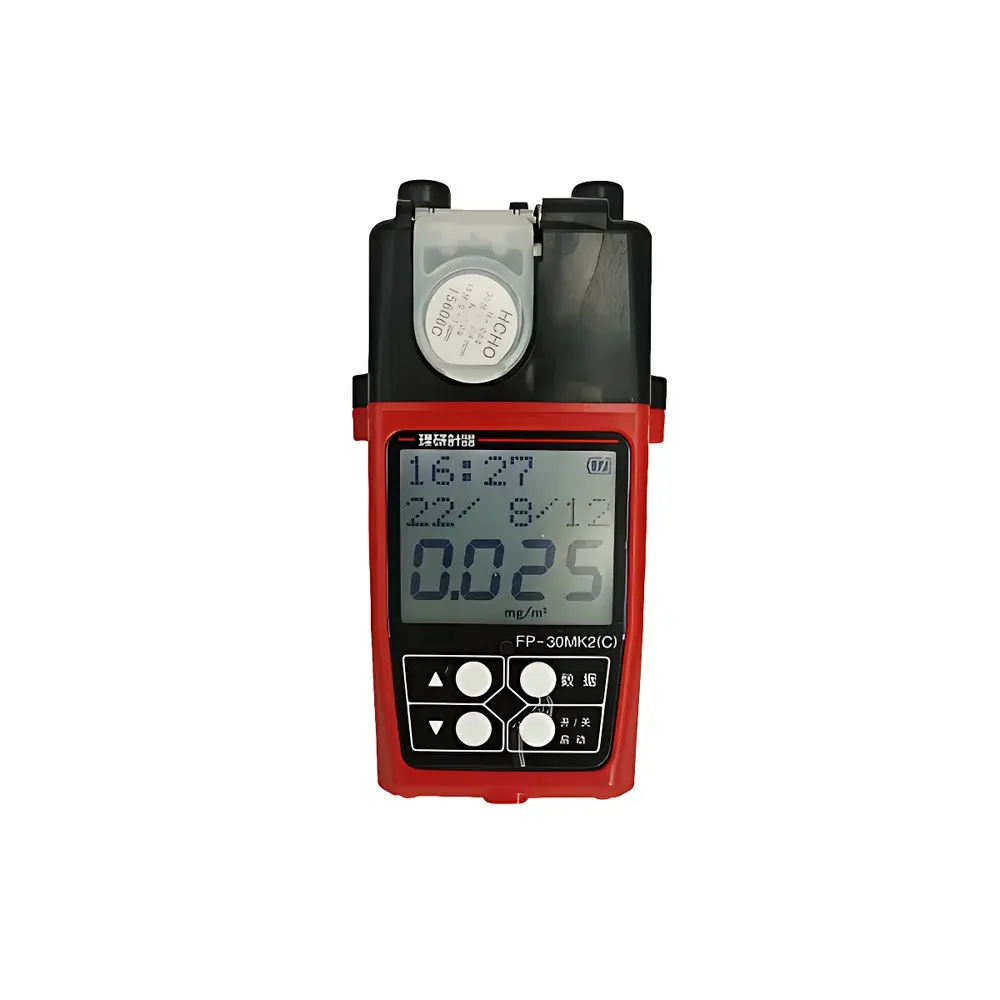
Riken FP-30MK2(C) Formaldehyde Analyzer
| Brand | Riken |
|---|---|
| Origin | Japan |
| Model | FP-30MK2(C) |
| Detection Principle | Photometric Colorimetry (based on acetylacetone reaction) |
| Measurement Range | 0.000–0.50 mg/m³ (TAB No.008) |
| Resolution | 0.01 mg/m³ (TAB No.008) |
| Repeatability | ≤ ±7% of reading |
| Sampling Method | Pump-aspirated |
| Response Time | 900 s (15 min) for TAB No.009 |
| Operating Temperature | −10 to +40 °C |
| Operating Humidity | ≤90% RH (non-condensing) |
| Flow Rate | 0.5 L/min |
| Data Storage | 99 measurement records with timestamp |
| Power Supply | 4 × AA alkaline batteries |
| Battery Life | Approx. 12 h (at 20 °C, no backlight, no alarm) |
| Dimensions | 80 × 150 × 40 mm (W×H×D, excluding protrusions) |
| Weight | ~250 g (excluding batteries) |
Overview
The Riken FP-30MK2(C) Formaldehyde Analyzer is a portable, field-deployable instrument engineered for reliable, on-site quantification of formaldehyde (HCHO) in ambient air and indoor environments. It operates on the internationally recognized photometric colorimetric principle—specifically, the acetylacetone (AA) derivatization method—where formaldehyde reacts with acetylacetone under acidic conditions and heat to form a stable yellow chromophore (3,5-diacetyl-1,4-dihydrolutidine), whose absorbance at 412 nm is directly proportional to formaldehyde concentration. This method is standardized in ISO 16000-3, ASTM D5197, and GB/T 18204.2–2014, ensuring regulatory alignment across global occupational health and indoor air quality (IAQ) assessment frameworks. Unlike electrochemical or semiconductor sensors, the FP-30MK2(C) eliminates cross-sensitivity to common interferents (e.g., VOCs, NOx, CO) by leveraging selective chemical derivatization and optical detection. Its dual-range capability—switchable between TAB No.008 (high-sensitivity mode) and TAB No.009 (extended-range mode)—enables precise monitoring across diverse scenarios: from low-level residential IAQ compliance (0.000–0.50 mg/m³) to industrial hygiene screening (up to 1.250 mg/m³).
Key Features
- Integrated pump-aspirated sampling system with constant flow control (0.5 L/min), ensuring consistent sample volume delivery and minimizing flow-induced measurement drift.
- Self-diagnostic firmware that continuously monitors battery voltage, sensor integrity, pump operation, thermal stability, and internal system errors—triggering clear LCD alerts for immediate troubleshooting.
- Embedded real-time clock and automatic data logger storing up to 99 measurement records with date/time stamps, eliminating manual transcription and supporting audit-ready documentation.
- Compact, ergonomic design (80 × 150 × 40 mm; ~250 g) optimized for handheld operation during extended walk-through surveys or fixed-point monitoring in offices, schools, hospitals, and construction sites.
- Low-power architecture enabling ~12 hours of continuous operation on four standard AA alkaline cells—ideal for unattended deployments in remote or infrastructure-limited locations.
- High-contrast LCD display with unit-specific resolution: 0.01 mg/m³ for TAB No.008 and 0.025 mg/m³ for TAB No.009—supporting both precision reporting and rapid trend interpretation.
Sample Compatibility & Compliance
The FP-30MK2(C) is validated for direct analysis of formaldehyde in undiluted ambient air matrices without pre-concentration or filtration—provided relative humidity remains below 90% RH and condensation is absent. It complies with Japanese Industrial Standards (JIS B 7970), meets the performance criteria outlined in ISO 16000-3:2019 Annex C for active sampling formaldehyde analyzers, and aligns with the analytical methodology referenced in US EPA Compendium Method TO-11A. While not inherently 21 CFR Part 11 compliant (as it lacks electronic signature functionality), its immutable timestamped data log supports GLP-compliant recordkeeping when exported via optional serial interface and archived with controlled access protocols. The instrument’s repeatability (≤ ±7% of reading) satisfies routine QA/QC requirements for environmental screening per ISO/IEC 17025:2017 Clause 7.7.
Software & Data Management
Data retrieval is performed via RS-232 serial interface using Riken-supplied PC software (compatible with Windows 7–11). The software enables batch export of stored records into CSV or Excel formats, time-series graphing, and calibration log review. All measurements include embedded metadata: sampling duration, selected TAB mode, ambient temperature/humidity (recorded at start), and instrument serial number—facilitating traceability in multi-instrument studies. Though the device itself does not support cloud synchronization or wireless transmission, its structured ASCII output format integrates seamlessly with LIMS platforms via custom API wrappers or middleware scripts, satisfying enterprise-level data governance policies.
Applications
- Indoor Air Quality (IAQ) assessments in residential buildings, kindergartens, elderly care facilities, and newly renovated offices per WHO guidelines (0.1 mg/m³ ceiling) and China’s GB 50325–2020 Class I limits.
- Occupational exposure monitoring in furniture manufacturing, plywood production, textile finishing, and resin synthesis plants—comparing results against OSHA PEL (0.75 ppm ≈ 0.91 mg/m³) or ACGIH TLV (0.3 ppm ≈ 0.36 mg/m³).
- Post-remediation verification following formaldehyde abatement treatments (e.g., catalytic oxidation, activated carbon filtration) in heritage conservation and museum storage environments.
- Academic research on emission kinetics from building materials (e.g., particleboard, MDF, adhesives) under controlled chamber conditions (ASTM D6007).
- Field validation of low-cost sensor networks—serving as a reference-grade transfer standard during co-location studies.
FAQ
What formaldehyde detection method does the FP-30MK2(C) use, and why is it preferred over electrochemical sensors?
It employs the acetylacetone-based photometric colorimetric method—a wet-chemistry technique with high selectivity for formaldehyde and minimal interference from aldehydes, ketones, or nitrogen oxides. Electrochemical sensors often suffer from drift and cross-reactivity; this method provides superior long-term stability and metrological traceability.
Can the instrument be calibrated in the field without specialized equipment?
Yes—zero calibration is performed using clean ambient air or nitrogen; span calibration requires only a certified formaldehyde permeation tube or gas standard cylinder (e.g., 0.25 mg/m³ in N₂), compatible with standard gas-handling accessories.
Is the FP-30MK2(C) suitable for outdoor ambient air monitoring?
It is designed primarily for indoor and semi-enclosed environments. For ambient air applications, particulate filtration (e.g., Teflon membrane) and temperature stabilization are recommended to maintain accuracy within its specified operating range (−10 to +40 °C, ≤90% RH).
How is data integrity ensured during extended logging sessions?
Each recorded entry includes an internal timestamp, measurement mode identifier (TAB No.008/009), and instrument status flags—preventing post-hoc alteration. The memory is non-volatile and retains data even after battery replacement.
Does the analyzer meet any international certification requirements for use in regulated laboratories?
While not CE-marked for EU medical devices or UKCA-certified, it is widely accepted in accredited environmental testing labs under ISO/IEC 17025 as a validated field instrument when operated per manufacturer instructions and supported by documented calibration history.
Related Products







