
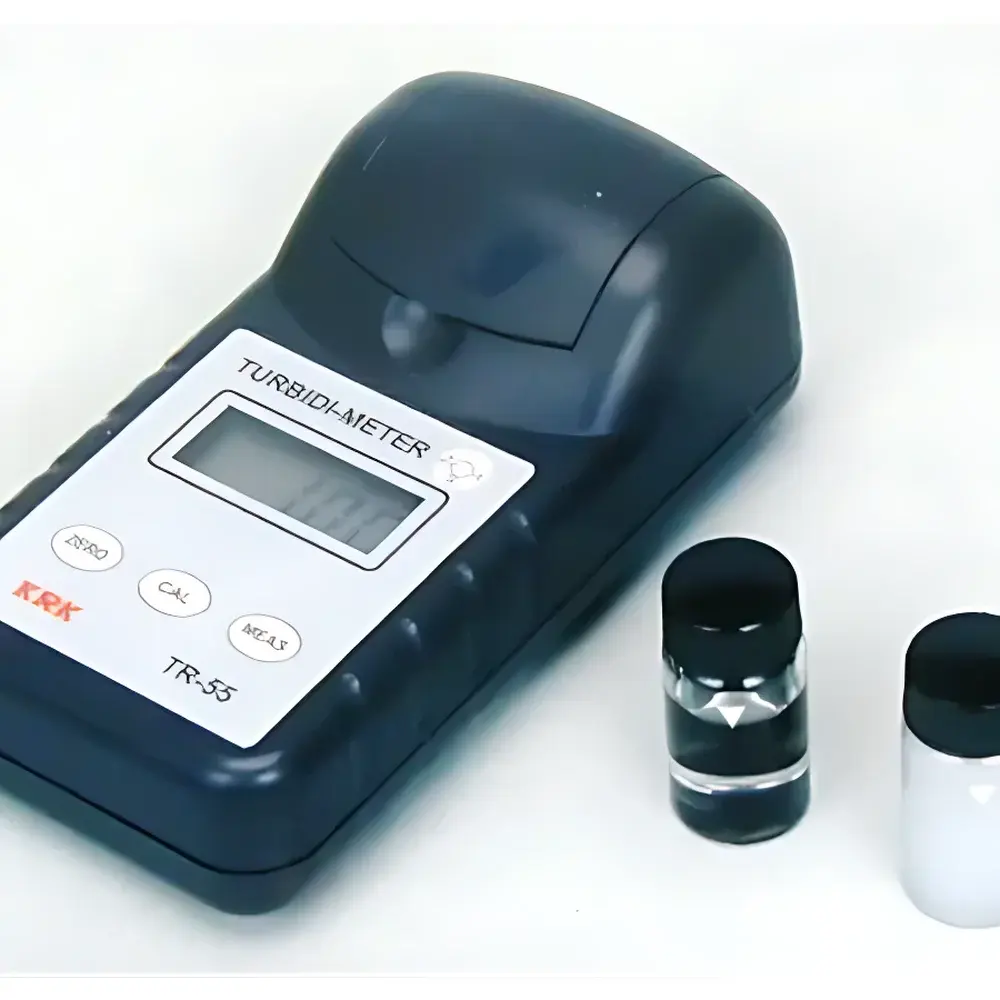
Rikorika TR-55 High-Sensitivity Turbidimeter
| Brand | Rikorika |
|---|---|
| Origin | Japan |
| Model | TR-55 |
| Measurement Principle | 90° Nephelometric Detection with Near-Infrared Light Source |
| Range | 0.1–1000 NTU (3-range auto-scaling) |
| Resolution | 0.01 NTU (0.1–11 NTU), 0.1 NTU (11–110 NTU), 1 NTU (110–1000 NTU) |
| Accuracy | ±2% of reading |
| Light Source | 850 nm Near-Infrared LED |
| Optical Geometry | ISO 7027-compliant 90° scattered-light detection |
| Compliance | Meets ISO 7027, ASTM D6508, and EPA Method 180.1 requirements |
Overview
The Rikorika TR-55 High-Sensitivity Turbidimeter is an optical analytical instrument engineered for precise, trace-level turbidity quantification in potable water, ultrapure process water, wastewater effluent, and environmental surface water samples. It operates on the nephelometric principle defined in ISO 7027, utilizing a collimated near-infrared (NIR) light source at 850 nm to illuminate the sample and detecting scattered light at a precise 90° angle relative to the incident beam. This geometry minimizes interference from sample coloration, absorbance, and fluorescence—common confounding factors in visible-light-based turbidimeters—thereby ensuring high fidelity across low- and high-turbidity regimes. Unlike traditional transmission-based or broad-spectrum white-light systems, the TR-55’s monochromatic NIR emission eliminates spectral overlap with natural chromophores (e.g., humic substances, iron complexes), significantly enhancing measurement robustness in colored or organically rich matrices.
Key Features
- Triple-range automatic scaling: 0.1–11 NTU (0.01 NTU resolution), 11–110 NTU (0.1 NTU resolution), and 110–1000 NTU (1 NTU resolution), enabling seamless transition across diverse sample classes without manual range selection.
- ISO 7027–compliant 90° scattered-light detection architecture with optimized photodiode positioning and optical shielding to suppress stray light and ambient interference.
- Stable 850 nm near-infrared LED light source with calibrated intensity output and thermal drift compensation, delivering long-term photometric stability and reduced lamp aging effects.
- Integrated temperature sensor for real-time compensation of refractive index variations, supporting accurate turbidity reporting per ISO 7027 Annex B guidelines.
- Sealed, IP65-rated housing with corrosion-resistant stainless-steel sample chamber and quartz cuvette interface, suitable for field deployment and laboratory benchtop use.
- Zero-point verification using certified formazin-free calibration standards (e.g., AMCO-AE or StablCal), eliminating reliance on unstable primary standards.
Sample Compatibility & Compliance
The TR-55 accepts standard 25 mm round glass or disposable plastic cuvettes (10 mm path length optional via adapter). It supports direct measurement of filtered and unfiltered aqueous samples—including drinking water, membrane filtrate, cooling tower water, and river/lake monitoring specimens—without dilution in most cases. All measurements adhere to internationally recognized protocols: ISO 7027 for instrument performance validation, ASTM D6508 for online and portable turbidimeters, and U.S. EPA Method 180.1 for regulatory compliance in public water systems. The device meets GLP documentation requirements when paired with optional audit-trail-enabled data logging software and supports traceability through user-defined calibration logs, timestamped measurements, and electronic signature-capable reporting.
Software & Data Management
The TR-55 interfaces via USB-C or RS-232 to Rikorika’s TURBO-Link™ PC application (Windows 10/11), which provides full instrument control, real-time graphing, statistical analysis (mean, SD, CV%), and customizable report generation. Raw data exports in CSV and PDF formats include metadata such as operator ID, calibration date, cuvette ID, temperature, and instrument serial number—enabling alignment with FDA 21 CFR Part 11 electronic record requirements when deployed with validated system configuration and access controls. Optional Bluetooth module enables wireless synchronization with mobile field tablets running Android-based Rikorika FieldSync™ app for remote logging during watershed surveys or distribution network audits.
Applications
- Verification of filtration efficiency in municipal and industrial water treatment plants, particularly for membrane integrity testing (e.g., ultrafiltration and nanofiltration validation).
- Monitoring low-turbidity boiler feedwater and semiconductor-grade ultrapure water (UPW), where sub-0.1 NTU detection sensitivity is critical for corrosion and particle-induced wafer defects.
- Regulatory compliance sampling under national drinking water standards (e.g., WHO Guidelines, EU Directive 98/83/EC, China GB 5749-2022) requiring repeatable, ISO-aligned turbidity reporting.
- Environmental field studies assessing sediment resuspension, stormwater runoff impact, and post-dredging plume dispersion in estuarine and lacustrine ecosystems.
- Pharmaceutical water system qualification (PW, WFI) per USP and ISO 14644-1, supporting routine monitoring and deviation investigation.
FAQ
Does the TR-55 require annual recalibration by the manufacturer?
No. The TR-55 is designed for user-performed calibration using NIST-traceable secondary standards; however, annual verification against primary formazin-equivalent reference materials is recommended per ISO/IEC 17025 laboratory accreditation requirements.
Can the instrument measure turbidity in colored samples such as peat-stained river water?
Yes. The 850 nm NIR source minimizes absorption by dissolved organic carbon (DOC), enabling reliable turbidity quantification in highly chromatic waters where visible-light turbidimeters exhibit significant negative bias.
Is the TR-55 compatible with automated sampling systems?
Yes. Analog 4–20 mA and digital Modbus RTU outputs are available via optional I/O module, allowing integration into SCADA platforms for continuous monitoring in water distribution networks or treatment basins.
What cuvette cleaning protocol is recommended to prevent carryover error?
Rinse with deionized water followed by isopropanol; air-dry vertically in dust-free environment. Avoid abrasive wipes or ultrasonic cleaning unless verified for quartz compatibility per ASTM D6508 Annex A4.
How does the TR-55 handle air bubbles or suspended gas in wastewater samples?
The instrument’s rapid 3-second measurement cycle and built-in bubble rejection algorithm automatically discard transient spikes caused by microbubbles, improving reproducibility in aerated or septic influent streams.







