
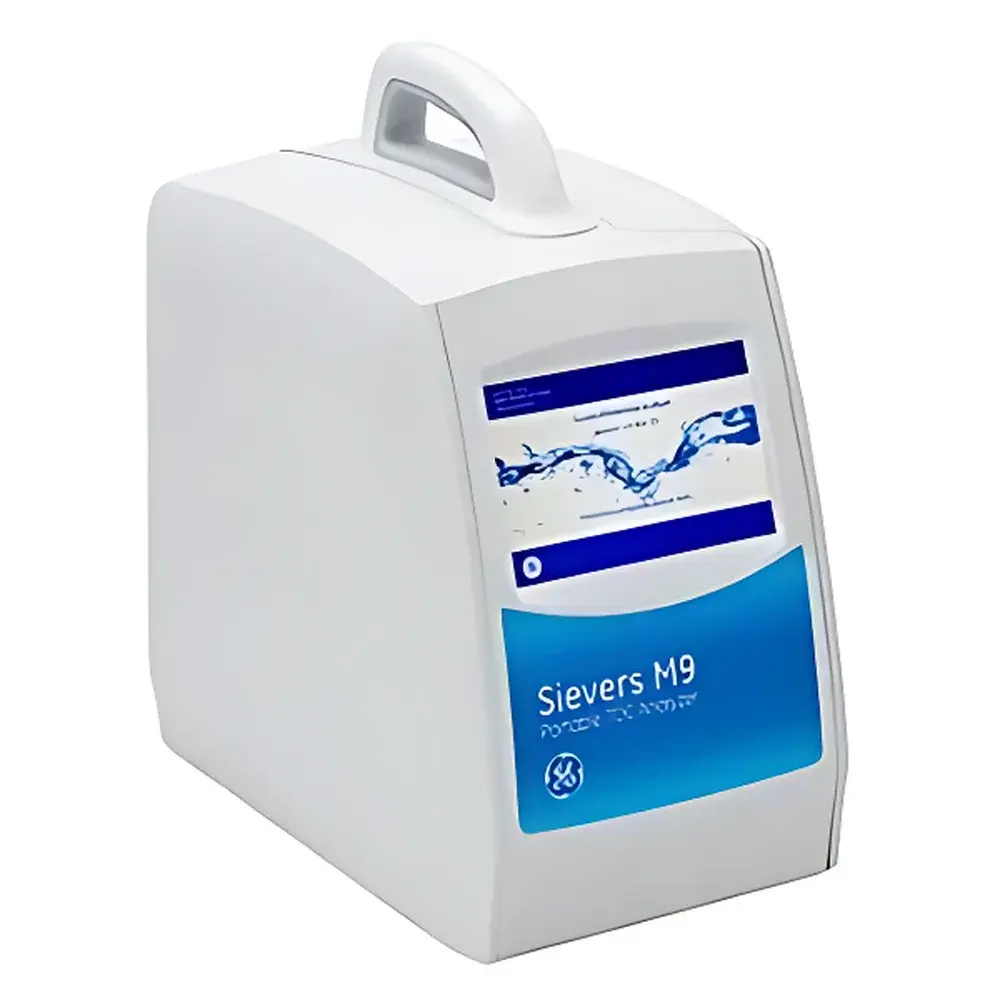
Sievers M9 Portable Total Organic Carbon Analyzer
| Brand | Sievers (Veolia) |
|---|---|
| Origin | USA |
| Model | Sievers M9 Portable Analyzer |
| Instrument Type | Portable TOC Analyzer |
| Detection Principle | Membrane Conductivity Detection |
| Oxidation Method | UV/Persulfate Oxidation |
| Measurement Range | 0.03 ppb – 50 ppm |
| Accuracy | ±2% or ±0.5 ppb (whichever is greater) |
| Resolution | 0.01 ppb |
| Detection Limit | 0.03 ppb |
| Repeatability | RSD < 1% |
| Analysis Time | 2 minutes |
| Calibration Interval | 12 months |
| Data Interfaces | USB, 4–20 mA, Modbus TCP/IP |
| Enclosure Rating | Dust- and splash-resistant |
| Regulatory Compliance | Designed for USP <643>, EP 2.2.44, ASTM D7573, ISO 8245, and FDA 21 CFR Part 11–ready data integrity workflows |
Overview
The Sievers M9 Portable Total Organic Carbon (TOC) Analyzer is an engineered solution for high-fidelity, field-deployable organic carbon quantification in ultrapure water (UPW), pharmaceutical process water, clean-in-place (CIP) rinse validation, and environmental monitoring applications. Based on membrane conductivity detection following UV/persulfate oxidation, the M9 converts non-purgeable organic carbon (NPOC) into CO₂, which is selectively permeated through a hydrophobic gas-permeable membrane into an electrolyte-filled conductivity cell. This principle eliminates interferences from inorganic ions, chloride, and conductivity background drift—ensuring robustness across diverse sample matrices without requiring acid sparging or carrier gas. As a successor to the Sievers 900 series, the M9 integrates hardware simplification with intelligent software logic to minimize operator intervention, reduce interpretation ambiguity, and support audit-ready data generation under GLP/GMP environments.
Key Features
- True portable architecture: Battery-operated operation with integrated rechargeable power system enables deployment in cleanrooms, manufacturing suites, and remote field sites without external utilities.
- UV/persulfate oxidation module: Delivers complete oxidation of recalcitrant organics—including humic acids, surfactants, and low-molecular-weight compounds—without reliance on high-temperature combustion or external oxidant cylinders.
- Membrane conductivity detector: Provides inherent selectivity for CO₂ over ionic interferents; no calibration drift due to electrolyte depletion or electrode fouling.
- Intuitive 7-inch capacitive touchscreen interface: Features context-aware dashboard navigation, real-time status indicators, and embedded diagnostic logging for rapid troubleshooting.
- Automated method execution: Preconfigured sequences for USP , EP 2.2.44, and ASTM D7573 include auto-selective reagent dosing, flow optimization, and blank subtraction—all validated per ICH Q2(R2) guidelines.
- Modular service design: Field-replaceable oxidation cell, membrane stack, and fluidic cartridge enable <15-minute maintenance without specialized tools or OEM dispatch.
- No external gases or hazardous chemicals required: Eliminates dependency on compressed air, nitrogen, or sodium persulfate solutions—reducing operational overhead and safety compliance burden.
Sample Compatibility & Compliance
The M9 accommodates liquid samples ranging from deionized water (resistivity >18.2 MΩ·cm) to moderately conductive wastewater (up to 500 µS/cm), with optional dilution protocols for high-TDS matrices. Its NPOC measurement mode ensures compatibility with pharmacopeial requirements for Water for Injection (WFI), Purified Water (PW), and Clean Steam condensate. The instrument meets electromagnetic compatibility (EMC) per IEC 61326-1 and carries CE marking for EU deployment. All data acquisition, storage, and reporting functions adhere to ALCOA+ principles (Attributable, Legible, Contemporaneous, Original, Accurate, Complete, Consistent, Enduring, Available) and support 21 CFR Part 11-compliant electronic signatures when paired with validated LIMS or ELN systems.
Software & Data Management
Embedded firmware v3.2+ includes configurable user roles (Operator, Supervisor, Administrator), full audit trail logging (with immutable timestamps and operator ID), and encrypted local database storage (SQLite-based, AES-256). Data export supports CSV, PDF, and XML formats with embedded metadata (method ID, calibration history, QC results). Remote connectivity via Modbus TCP/IP allows integration into SCADA or MES platforms for real-time TOC trending and SPC charting. USB host port enables direct transfer to secure corporate networks without cloud dependency—critical for regulated biopharma facilities with air-gapped infrastructure.
Applications
- Pharmaceutical water system validation: On-line and grab-sample verification of WFI loops, PW distribution networks, and point-of-use locations per Annex 1 and EU GMP Chapter 5.
- Cleanroom environmental monitoring: Rapid assessment of TOC in HVAC humidification water and equipment rinse waters to prevent microbial nutrient carryover.
- Biotechnology process support: Monitoring of buffer preparation tanks, chromatography eluates, and ultrafiltration permeates for organic leachables and cleaning residue.
- Environmental compliance: Field screening of surface water, groundwater, and effluent streams against EPA Method 415.3 and ISO 8245 thresholds.
- Microelectronics UPW qualification: Sub-ppb level detection for semiconductor fab feedwater and tool rinse validation where carbon-induced particle nucleation must be controlled.
FAQ
What is the minimum detectable TOC concentration?
The M9 achieves a method detection limit (MDL) of 0.03 ppb with a resolution of 0.01 ppb, verified using potassium hydrogen phthalate (KHP) standard solutions traceable to NIST SRM 1012.
How often does the instrument require calibration?
Calibration is validated annually (12-month interval) per manufacturer specifications; however, daily system suitability testing (SST) with certified reference materials is recommended for GxP environments.
Can the M9 operate without network connectivity?
Yes—the analyzer functions autonomously with full data capture, method execution, and report generation offline; network connection is only required for remote diagnostics or LIMS synchronization.
Is the M9 compliant with pharmacopeial monographs?
It fully supports USP , EP 2.2.44, and JP 2.59 methodologies, including automatic TC/NPOC mode selection, acidification control, and oxidation efficiency verification per regulatory acceptance criteria.
What maintenance is required between calibrations?
Routine tasks include weekly membrane stack inspection, quarterly oxidation cell cleaning with citric acid solution, and annual replacement of the UV lamp (rated life: 10,000 hours). No consumables beyond the proprietary fluidic cartridge are needed.
Related Products







