
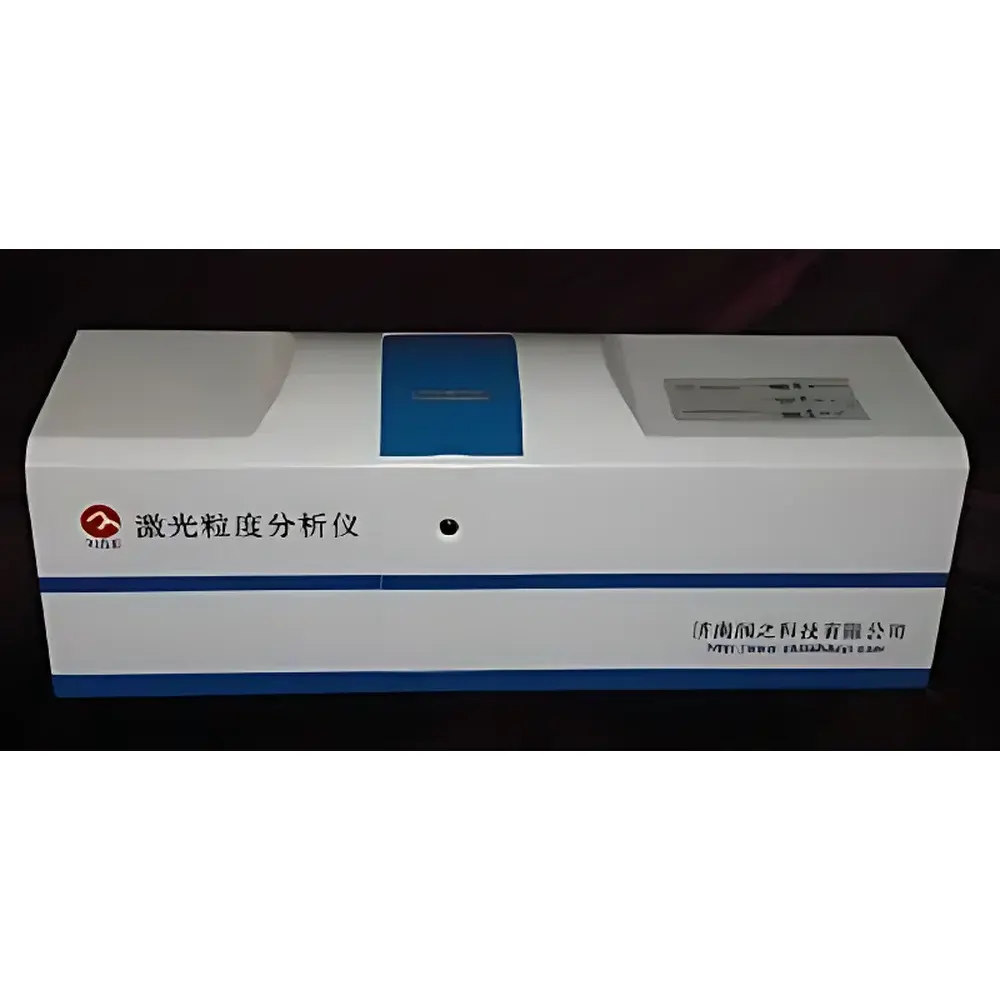
Rise-2002 Laser Particle Size Analyzer
| Origin | Beijing, China |
|---|---|
| Manufacturer Type | Authorized Distributor |
| Origin Category | Domestic (China) |
| Model | Rise-2002 |
| Pricing | Available Upon Request |
| Measurement Range | 0.1–600 µm |
| Accuracy Error | < ±1% (D50, Certified Reference Materials per GB/T 19077) |
| Repeatability | < ±1% (D50, Certified Reference Materials) |
| Electrical Supply | AC 220 ±10 V, 50 Hz, 200 W |
| Dimensions (L×W×H) | 1000 × 330 × 320 mm |
| Weight | 38 kg |
Overview
The Rise-2002 Laser Particle Size Analyzer is a high-performance, benchtop instrument engineered for precision particle size distribution (PSD) measurement in research laboratories and quality control environments. It operates on the fundamental principle of Mie scattering theory—fully accounting for the complex refractive index of both particles and dispersant—to quantitatively invert angular light-scattering intensity profiles into volumetric particle size distributions. Unlike simplified Fraunhofer approximations, the Rise-2002 implements full-range Mie-based inversion without prior assumptions about distribution shape, enabling true non-parametric analysis. This approach eliminates bias introduced by constrained fitting algorithms and ensures fidelity to the physical scattering behavior of heterogeneous particulate systems. The system features a stabilized He–Ne laser source (λ = 632.8 nm), offering exceptional coherence, narrow linewidth, and >25,000-hour operational lifetime—critical for long-term signal stability and inter-laboratory reproducibility.
Key Features
- Optimized Optical Architecture: Single-range convergent optical path design minimizes reliance on Fourier lens assemblies, broadening measurable angular range up to 90° while maintaining high resolution across the full 0.1–600 µm dynamic range.
- Advanced Detector Array: Non-uniform, cross-dimensional 3D扇-shaped (fan-shaped) photodiode matrix with primary and auxiliary detectors ensures comprehensive capture of forward-, side-, and back-scattered light—maximizing signal fidelity and minimizing truncation error.
- Integrated Wet Dispersion System: Fully embedded 400 mL stainless-steel sample cell with optimized geometry for residue-free drainage and rapid cleaning; compatible with water, deionized water, ethanol, and other common dispersants.
- Programmable Ultrasonication: 100 W ultrasonic transducer with digitally controlled duration (0–9 min 50 s, 1-s resolution); simultaneous ultrasonication and measurement enabled via electromagnetic shielding—essential for breaking hard agglomerates without interrupting data acquisition.
- Dynamic Fluid Management: Independent, touch-adjustable control of stirrer speed (0–3000 rpm) and recirculation pump rate (0–5000 rpm), both displayed numerically; real-time coordination with ultrasonication prevents bubble formation and re-agglomeration during measurement.
Sample Compatibility & Compliance
The Rise-2002 is validated for use with powders, suspensions, emulsions, and colloidal dispersions across pharmaceuticals, ceramics, catalysts, pigments, battery materials, and geological samples. Its wet dispersion methodology conforms to ISO 13320:2020 (Particle size analysis — Laser diffraction methods) and supports traceability to NIST-traceable reference materials (e.g., NIST SRM 1963, 2800 series). Instrument operation and data handling are structured to support GLP-compliant workflows, including user-accessible audit trails, electronic signature readiness, and export formats compatible with FDA 21 CFR Part 11–aligned LIMS integration (via CSV, Excel, PDF, and image outputs). All mechanical and optical components comply with Q/01RZ01–2004—Rise’s internal manufacturing standard for metrological reliability and long-term stability.
Software & Data Management
The PADMAS (Particle Diameter Measure & Analysis System) software provides a comprehensive, modular platform for raw data processing and reporting. It supports differential and cumulative volume-based distributions, Rosin–Rammler (R–R), custom binning (1–130 user-defined channels within 0.02–2000 µm), sieve-equivalent (mesh) grading, and number-weighted analysis. Standard output includes D10, D50, D90, span, specific surface area (volume- and mass-normalized), and statistical comparison across batches. Reports are exportable to Excel (.xlsx), vector graphics (.svg/.pdf), and bitmap formats (.png/.jpg); bilingual (English/Chinese) report templates include editable headers/footers and print preview. Raw scattering intensity arrays and intermediate inversion matrices are retained for reprocessing—ensuring full transparency and method validation capability.
Applications
The Rise-2002 delivers quantitative PSD data critical for process development and release testing in regulated industries. In pharmaceutical manufacturing, it verifies milling efficiency and excipient uniformity per USP and . In advanced materials R&D, it characterizes nanoparticle dispersion stability, cathode/anode slurry homogeneity, and sintering precursor consistency. For QC labs, its <±1% repeatability (D50) and accuracy against certified standards enable robust specification compliance monitoring. The system also supports method development for challenging samples—including high-density metals, hydrophobic organics, and shear-sensitive biopolymers—through customizable dispersion protocols documented in application notes supplied with each instrument.
FAQ
What dispersion media are compatible with the Rise-2002?
Deionized water, distilled water, ethanol, isopropanol, and other low-viscosity, optically transparent liquids with known refractive indices may be used—provided they do not chemically react with or dissolve the sample.
Is the instrument compliant with ISO 13320?
Yes—the optical design, calibration protocol, and Mie-based inversion algorithm fully satisfy the requirements of ISO 13320:2020 for laser diffraction particle sizing.
Can raw scattering data be exported for third-party analysis?
Yes—intensity vs. angle raw data files (.txt) and full inversion matrices are accessible via the software’s “Advanced Export” module.
Does the system support automated batch reporting?
Yes—PADMAS includes template-driven batch reporting with automatic statistical summarization (mean, SD, CV%), pass/fail flagging against user-defined limits, and timestamped PDF generation.
What maintenance is required for long-term performance stability?
Routine cleaning of the flow cell and optical windows; annual verification using NIST-traceable polystyrene latex standards; no optical alignment is needed due to the fixed, pre-calibrated convergent optical path.



