
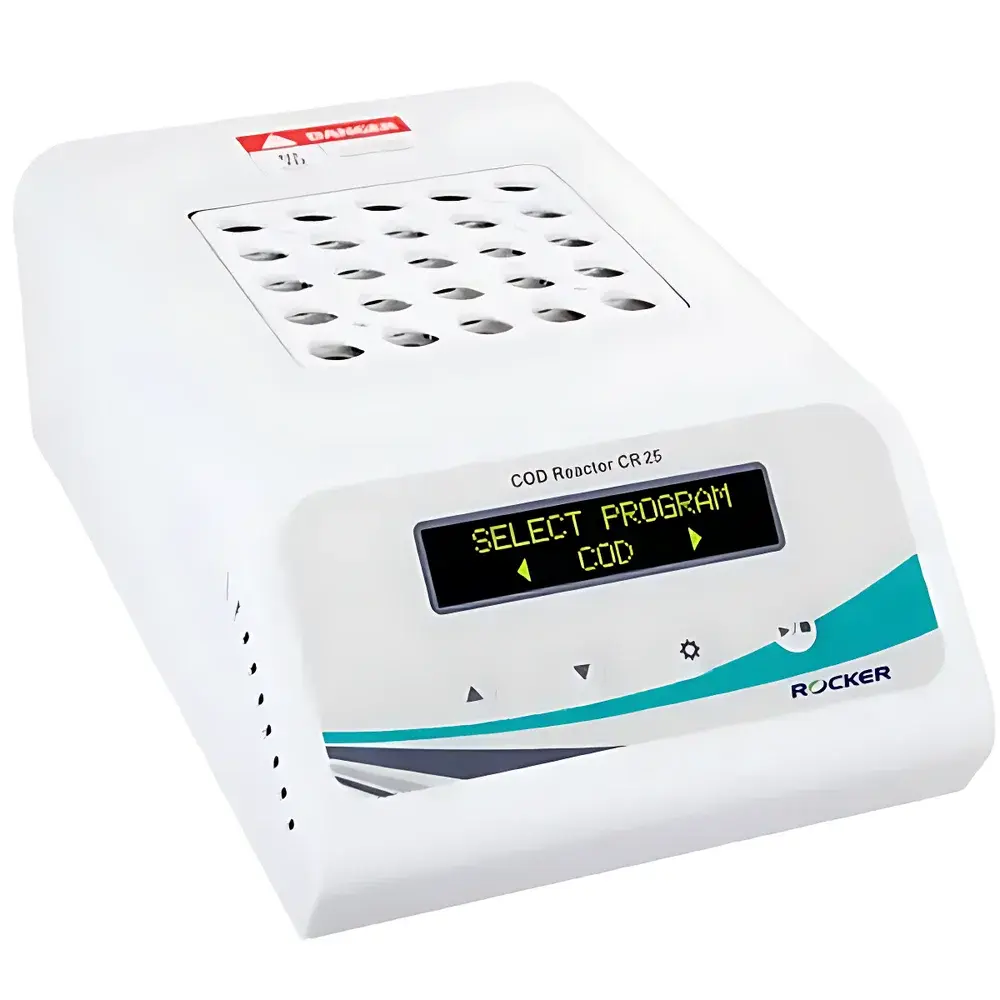
ROCKER CR25 COD Digestion Block
| Brand | ROCKER |
|---|---|
| Origin | Taiwan |
| Manufacturer Type | Authorized Distributor |
| Regional Classification | Domestic (Taiwan) |
| Model | CR25 |
| Price Range | USD 850–1,150 |
| Digestion Method | Rapid Closed-Reflex Digestion |
| Heating Module | Single Aluminum Block |
| Batch Capacity | 25 Samples |
| Temperature Range | Ambient +5°C to 200°C |
| Temperature Accuracy | ±2°C |
| Temperature Stability | ±1°C |
| Sample Vial Capacity | 15 mL |
| Vial Diameter Compatibility | Ø16 mm |
| Timer Range | 1–999 min (countdown) or continuous mode |
| Preset Programs | COD (150°C/120 min), COD2 (165°C/20 min), TP (150°C/30 min), TN (105°C/30 min), TPN (120°C/30 min), TOC (105°C/120 min) |
| Custom Program Storage | 2 user-defined protocols |
| Power Rating | 350 W |
| Display | OLED screen |
| Net Weight | 5.1 kg |
| Dimensions (L×W×H) | 31 × 19 × 12 cm |
| Input Voltage Options | 110 V / 60 Hz or 220–240 V / 50 Hz |
| Safety Certifications | CE compliant |
| Standard Compliance | NIEA W517.52B (Taiwan EPA), US EPA Method 410.4, ISO 15705:2002 (ST-COD) |
Overview
The ROCKER CR25 COD Digestion Block is a precision-engineered thermal digestion system designed for rapid, reproducible chemical oxygen demand (COD) analysis in accordance with internationally recognized closed-reflux methodologies. It operates on the principle of controlled thermal oxidation of organic matter in aqueous samples using acidic potassium dichromate under reflux conditions. Unlike open-boiling systems, the CR25 employs a sealed, high-stability aluminum heating block to maintain uniform temperature distribution across all 25 sample positions—minimizing inter-vial variance and ensuring compliance with regulatory digestion protocols. Its architecture integrates thermal inertia management and active temperature feedback control to sustain ±1°C stability during extended runs, critical for achieving high repeatability in COD determination per ISO 15705:2002 and US EPA Method 410.4.
Key Features
- 25-position single-block design optimized for Ø16 mm COD vials (15 mL capacity), with PTFE-insulated safety cover standard-equipped to prevent accidental contact with heated surfaces
- OLED display interface with intuitive navigation, real-time temperature readout, and dual-mode timer (countdown or continuous)
- Six factory-preset digestion programs aligned with common water quality parameters: COD (150°C/120 min), COD2 (165°C/20 min), TP, TN, TPN, and TOC
- Two programmable memory slots supporting custom temperature/time profiles (30–200°C; 1–999 min)
- Auto-shutdown and audible alert upon program completion—ensuring operator safety and energy efficiency
- CE-certified electrical architecture with over-temperature protection and thermal cut-off circuitry
- Compact footprint (31 × 19 × 12 cm) and lightweight construction (5.1 kg) suitable for benchtop deployment in QC labs, municipal testing facilities, and field-deployable mobile laboratories
Sample Compatibility & Compliance
The CR25 accommodates standard 15 mL borosilicate glass COD vials with Ø16 mm outer diameter, compatible with reagent kits from major suppliers including Hach, Merck, and Lovibond. Its thermal profile fidelity enables direct implementation of closed-reflux procedures specified in NIEA W517.52B (Taiwan Environmental Protection Administration), US EPA Method 410.4, and ISO 15705:2002 for ST-COD (Standardized Test–COD). The system supports GLP-aligned workflows through deterministic timing control and unambiguous thermal setpoint execution—facilitating audit-ready documentation when paired with external lab information management systems (LIMS). While not intrinsically 21 CFR Part 11 compliant, its operational consistency and traceable parameter logging support integration into validated GMP/QC environments where electronic records are maintained externally.
Software & Data Management
The CR25 operates as a standalone hardware platform without embedded data logging or network connectivity. All operational parameters—including active program ID, set temperature, elapsed time, and remaining countdown—are displayed in real time on the OLED interface. For laboratories requiring electronic record retention, the device is intended for use with complementary tools such as digital logbooks, LIMS-integrated barcode scanners, or time-stamped video documentation of start/stop events. Its deterministic behavior—zero drift in temperature ramping, repeatable dwell accuracy, and consistent cooldown kinetics—enables robust correlation between instrument operation and analytical results generated by downstream spectrophotometric or titrimetric quantification steps.
Applications
The CR25 serves as a core digestion module in environmental testing laboratories performing routine and regulatory COD analysis on diverse aqueous matrices, including municipal wastewater influent and effluent, industrial process streams, surface water (rivers, lakes), groundwater, and treated effluents subject to discharge permitting. Its rapid COD2 protocol (165°C/20 min) provides a validated alternative to conventional 2-hour reflux for screening applications, while the full 120-minute COD program ensures complete oxidation for complex, high-load samples. Additional preconfigured methods support parallel digestion for total phosphorus (TP), total nitrogen (TN), combined TPN, and total organic carbon (TOC) assays—enhancing laboratory throughput without cross-method reconfiguration delays.
FAQ
Does the CR25 include built-in data logging or USB export capability?
No—the CR25 is a dedicated thermal controller without internal memory storage or digital output interfaces. Data capture must be performed manually or via external systems.
Is the heating block interchangeable for different vial sizes?
No—the CR25 uses a fixed 25-hole aluminum block engineered exclusively for Ø16 mm vials. Alternate blocks are not available.
Can the CR25 be used for non-COD applications such as heavy metal digestion?
It is not validated for EPA Method 3010A, 3050B, or similar acid digestion protocols requiring pressurized vessels or higher temperatures (>200°C); use only within specified operating limits and method scope.
What voltage options are available for international deployment?
Units are supplied in two configurations: 110 V / 60 Hz (North America/Japan) or 220–240 V / 50 Hz (EU, ASEAN, Australia); verify model suffix before ordering.
Is the optional polycarbonate safety shield required for regulatory compliance?
While not mandated by ISO or EPA standards, the shield is strongly recommended—and often required by institutional EHS policies—to mitigate injury risk from potential vial rupture during high-temperature digestion.
Related Products







